
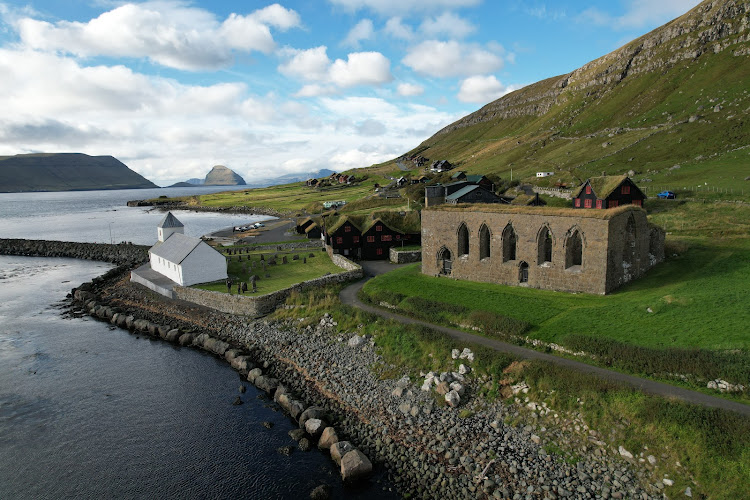
Kirkjubømúrurin is the roofless medieval Cathedral of St Magnus at X625+Q44, Kirkjubøur 175, in the historic coastal center of Kirkjubøur on southern Streymoy, Faroe Islands. Begun around 1300 during the episcopate of Bishop Erlendur, its substantial stone walls mark the archipelago’s former ecclesiastical capital. Travelers come for Gothic masonry, the scale of an ambitious medieval building, and a compact village where a working church and historic farmhouse stand within minutes of the ruin.
What to Expect at Kirkjubømúrurin
Known locally as Múrurin, the cathedral measures roughly 27 by 11 meters, with surviving walls rising about nine meters. Its dark local stone, pointed openings, and carefully dressed architectural details distinguish it from the timber-and-turf buildings associated with Faroese villages. Walk around the exterior first to understand the rectangular plan, then examine the accessible interior. Without a roof or furnished galleries, the architecture itself is the principal exhibit: window openings frame the landscape, while deep masonry reveals the practical challenge of building a monumental church on an exposed Atlantic coast.
The cathedral was dedicated to St Magnus, the martyred Earl of Orkney, reflecting the islands’ connections across the medieval North Atlantic. Whether the building was ever fully completed remains debated; avoid imagining a securely documented finished interior. Kirkjubøur’s importance also extended beyond this structure: it was the seat of the Faroese bishopric before the Reformation. The celebrated carved medieval choir stalls associated with the village are displayed at the National Museum in Hoyvík, not inside this ruin. That distinction makes a museum visit a useful companion to the surviving architecture.
- Gothic openings: Pointed arches express the cathedral’s connection with wider European church architecture rather than domestic Faroese building traditions.
- Massive stone walls: Follow the perimeter to appreciate the thickness, height, and ambitious proportions of the medieval project.
- Roofless interior: Open sky replaces a ceiling, making changing weather and light part of the experience.
- St Magnus dedication: The cathedral’s patron links Kirkjubøur with Orkney and the religious networks of the North Atlantic.
- Historic village setting: Nearby St Olav’s Church and the turf-roofed Kirkjubøargarður farmhouse complete the picture of the former episcopal settlement.
Kirkjubømúrurin at a Glance
| Detail | Information |
|---|---|
| Address | X625+Q44, Kirkjubøur 175, Faroe Islands |
| Neighborhood / Area | Historic village center, southern Streymoy |
| Operating Hours | Monday–Friday 09:00–20:00; Saturday–Sunday open 24 hours. Visit in daylight and respect conservation closures. |
| Admission / Price Range | Free access to the ruin; $ budget category |
| Recommended Visit Duration | 30–45 minutes; 60–90 minutes with nearby village landmarks |
| Nearest Transit / Parking | Tórshavn city bus route 5 to Kirkjubøur; village visitor parking, followed by a short walk |
| Official Website & Phone | Tjóðsavnið’s Kirkjubømúrurin page; National Museum enquiries: +298 318076 |
Visiting Tips, Getting There & Nearby Pairings
Choose a clear daylight interval rather than planning around a particular hour: rain and low cloud can change conditions quickly. Bring a waterproof outer layer and shoes with grip, since exposed stone and grass become slippery. From Tórshavn, take municipal bus route 5 to Kirkjubøur and check the return timetable through Tórshavn municipality before leaving; services are less frequent than urban routes. Drivers should use village visitor parking, avoid private farm access, and continue on foot.
Stone thresholds, uneven ground, and grass mean the ruin is not a reliably smooth, step-free circuit for wheelchairs or strollers; exterior viewing may be the more practical option. There is no tower climb or elevator. Within a five-minute walk, visit St Olav’s Church, a medieval church still used for worship, and Kirkjubøargarður, also known for its historic Roykstovan room. Respect services and the farmhouse’s residential character; interior access is separate from the cathedral. Allow another few minutes for the shoreline views toward Hestur, keeping away from exposed edges in strong winds.
Frequently Asked Questions
When is Kirkjubømúrurin open, and when should I visit?
Listed hours are 09:00–20:00 on weekdays and round-the-clock on weekends. Daylight offers safer footing and clearer views of the masonry; winter daylight is short.
Do I need tickets or a reservation?
The cathedral ruin is free to visit, and independent visits do not require a timed ticket. Separate arrangements may apply to farmhouse interiors or organized village tours.
How long should I spend here?
Budget 30–45 minutes for the ruin and photographs. Extend that to 60–90 minutes to include the church, farmhouse exterior, and shoreline without rushing.
Is it suitable for children and visitors with limited mobility?
Children can enjoy the open-air setting, but need supervision around rough masonry and the coast. Visitors with limited mobility should expect uneven surfaces and thresholds rather than continuous wheelchair-friendly access.
When planning your Faroe Islands travel guide or browsing verified attractions in Faroe Islands, pair this stop with standout local spots including Saga Museum, Trælanípa, THE TARV Grillhouse, and Roykstovan (nearby).


