
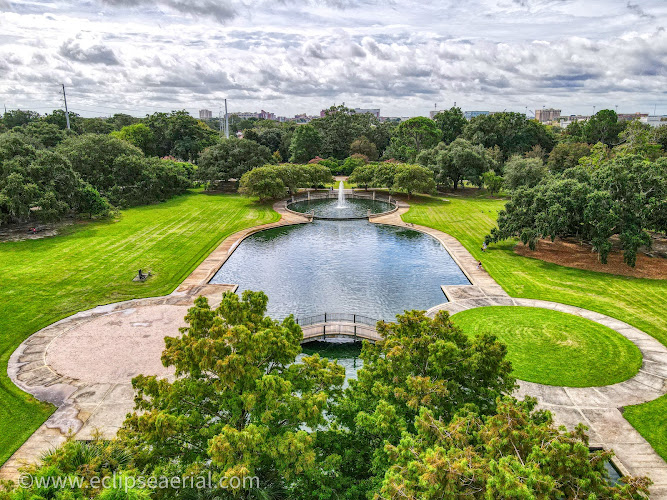
Hampton Park is a roughly 60-acre public park at 30 Mary Murray Drive in Charleston’s Hampton Park Terrace neighborhood, beside The Citadel. Developed following the 1901–1902 South Carolina Inter-State and West Indian Exposition, it combines extensive flower beds, an old rose collection, mature Lowcountry trees, and walking routes. Travelers come for an unhurried garden walk, family picnics, and a landscape whose history reaches from horse racing and the Civil War to Reconstruction and twentieth-century civic life.
What to Expect at Hampton Park
The park’s appeal is its combination of horticulture and everyday neighborhood recreation. Staff and volunteers maintain Charleston’s most extensive municipal park floral displays, including an old rose collection and changing seasonal plantings. Live oaks, palms, and other trees and shrubs create an informal arboretum, with open lawns between shaded sections. Follow the interior paths past the pond and planting beds, then join the fitness route beside Mary Murray Drive. Picnic tables, a playground, drinking fountains, and public restrooms make a longer stay practical.
This was formerly the Washington Race Course. In May 1865, newly emancipated Black Charlestonians helped organize a major commemoration of Union soldiers buried here, an event frequently discussed in the history of Memorial Day. The later exposition transformed the grounds with landscaped spaces and temporary exhibition buildings. The park’s namesake, Wade Hampton III, was a Confederate general, slaveholder, and South Carolina governor. For another perspective on Charleston’s history, seek out the Denmark Vesey monument, dedicated in 2014, and the Charleston Horticultural Society’s Layers of the Landscape audio walking tour.
- Old rose collection: Historic rose varieties complement seasonal beds maintained by city staff and volunteers.
- Denmark Vesey monument: A bronze figure commemorates the Black Charleston leader associated with the planned 1822 uprising against slavery.
- Fitness circuit: The roughly one-mile perimeter provides a straightforward route for walking, running, and rolling.
- Pond and shaded lawns: Water, spreading trees, and open grass offer quieter stops between garden sections.
- Family facilities: A playground, picnic tables, restrooms, and drinking fountains support an inexpensive outdoor outing.
Hampton Park at a Glance
| Detail | Information |
|---|---|
| Address | 30 Mary Murray Drive, Charleston, SC 29403 |
| Neighborhood / Area | Hampton Park Terrace; upper Charleston peninsula, adjoining The Citadel |
| Operating Hours | Listed as open 24 hours Monday–Sunday; daylight is best for gardens and navigation. |
| Admission / Price Range | Free general admission; $ budget tier |
| Recommended Visit Duration | 45 to 90 minutes |
| Nearest Transit / Parking | CARTA Route 102 serves nearby Rutledge Avenue; on-site parking is available around the park. |
| Official Website & Phone | City of Charleston Hampton Park information; +1 843-724-7324 |
Visiting Tips, Getting There & Nearby Pairings
Arrive early for cooler walking conditions, especially from late spring through September. Spring brings particularly rewarding flower displays; summer calls for water, insect repellent, and shaded breaks, while winter allows comfortable longer walks beneath evergreen foliage. Ordinary visits require no reservation. The city’s Walk, Run & Roll program restricts vehicles on the perimeter during designated exercise periods; check the official page before driving directly to a preferred parking area. Keep dogs leashed, collect waste, and leave planted beds undisturbed.
Drivers can use on-site parking rather than searching for a downtown garage. For buses, check CARTA’s current Route 102 timetable and Rutledge Avenue stops. The paved perimeter and relatively level terrain suit wheelchairs and strollers, but interior surfaces and tree-root irregularities require more attention; use designated crossings around moving traffic. Benches provide rest stops. Pair the park with The Citadel’s Summerall Chapel, roughly 5–15 minutes away depending on your exit and campus access, or Allan Park, about 10–15 minutes southeast. Huger Street’s dining addresses are another short walk from the southern side.
Frequently Asked Questions
What are Hampton Park’s hours, and when should I visit?
The park is listed as open 24 hours daily. Visit in daylight for the flowers and historical features, ideally early in the morning during Charleston’s hotter months.
Is Hampton Park free, and do I need reservations?
General admission is free, and casual walks and picnics need no ticket. Organized gatherings and weddings should be discussed with the city beforehand rather than treated as ordinary drop-in visits.
How long should I spend at Hampton Park?
Allow 45–90 minutes for the perimeter, flower beds, pond, and Vesey monument. Add time for the audio tour, a picnic, or playground stops.
Is Hampton Park suitable for families and wheelchair users?
The playground, restrooms, picnic tables, and broad lawns make it useful for families. Wheelchair users and stroller pushers will find the paved perimeter more predictable than uneven interior sections; road crossings still need care.
When planning your Charleston travel guide or comparing verified attractions and parks in Charleston, pair this stop with standout local spots including The Charleston Museum, Old Exchange and Provost Dungeon, Children's Museum of the Lowcountry, and Vern's (1.3 km away).


