
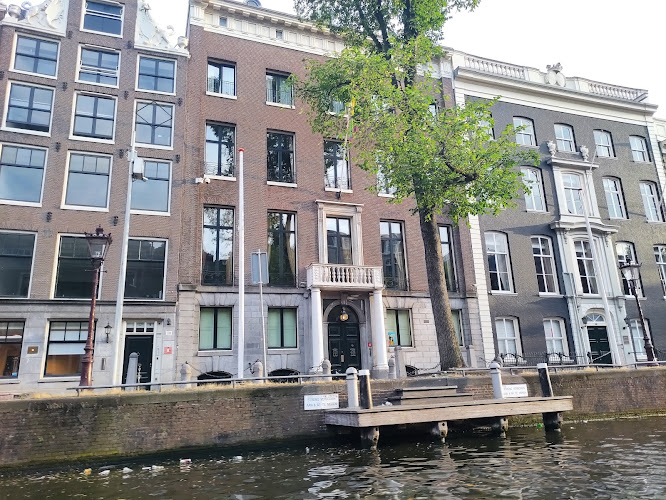
Huis met de Kolommen Ambtswoning Burgemeester van Amsterdam is Amsterdam’s official mayoral residence at Herengracht 502, 1017 CB Amsterdam, in the southern Canal Belt near Vijzelstraat. Built in 1672 for merchant Paulus Godin, this double-width canal mansion has housed the mayoral residence since 1927. Travelers come for its columned entrance, marble balcony, and connections to Amsterdam’s mercantile and civic history. It remains a working residence and reception venue, not a museum: plan an exterior stop rather than a walk through furnished rooms.
What to Expect at Huis met de Kolommen
Also called the Deutzhuis, the mansion rewards a slow look from the opposite bank of the Herengracht. Its broad frontage contrasts with Amsterdam’s narrower canal houses. Architect Abraham van der Hart remodeled the building in 1791; the entrance ensemble, marble balcony, corner pilasters, and straight cornice with triglyph detailing give the facade its formal, classical character. Look also for the Empire-style door and fanlight with a lantern, and the six stone posts marking the frontage. The building is protected as Rijksmonument 1871.
The address also exposes the uncomfortable foundations of some canal-house fortunes. Godin was involved in the slave trade, a history acknowledged by a plaque at the residence. Centuries later, banker Cornelis Johannes Karel van Aalst offered the house to the municipality in 1926; it became the official residence in 1927, during Willem de Vlugt’s mayoralty. Today, civic receptions and official business take priority over sightseeing. There are no regular public galleries, audio guides, museum shop, or visitor café; interior access depends on specifically announced heritage events.
- Columned entrance: The architectural feature behind the house’s Dutch name, meaning “House with the Columns.”
- Marble balcony: A prominent element of the entrance composition associated with the 1791 remodeling.
- Classical facade: Corner pilasters and a triglyph cornice distinguish this broad mansion from neighboring gabled houses.
- Slavery memorial plaque: A reminder to connect the building’s wealth with Paulus Godin’s involvement in human trafficking.
- Mayoral history: An official residence since 1927, spanning the Depression, German occupation, and postwar rebuilding.
Huis met de Kolommen at a Glance
| Detail | Information |
|---|---|
| Address | Herengracht 502, 1017 CB Amsterdam, Netherlands |
| Neighborhood / Area | Southern Canal Belt, near Vijzelstraat and the Golden Bend |
| Operating Hours | Exterior visible from the public street daily; no regular public interior opening hours. |
| Admission / Price Range | Free exterior viewing ($); no regular interior admission ticket. |
| Recommended Visit Duration | 15 to 25 minutes |
| Nearest Transit / Parking | Rembrandtplein: trams 4 and 14; Rokin: metro 52. Paid parking at The Bank, Amstelstraat. |
| Official Website & Phone | City of Amsterdam; municipal information: 14 020, or +31 20 624 1111 from abroad. |
Visiting Tips, Getting There & Nearby Pairings
Visit in daylight to examine the stonework and read the plaque; morning works well for an unhurried architectural walk. Rembrandtplein’s tram stops are about five minutes away, while Rokin metro station, on line 52, is roughly a ten-minute walk. Check routes with GVB before traveling. Driving adds little convenience: canal-side spaces are limited and paid, and The Bank garage is a nearby alternative. Wheelchair users and families with strollers can view the facade without entering the building, but narrow pavements, uneven paving, parked bicycles, and bridge gradients require care. Do not assume step-free interior access; discuss arrangements with organizers before any special opening.
Keep the entrance clear and photograph the architecture from public space without intruding on residents or official arrivals. Pair the stop with Museum Van Loon, about five minutes away on Keizersgracht, for a separately ticketed canal-house interior and garden. The FOAM photography museum is also around five minutes away, while Rembrandtplein offers cafés and terraces within a similar walk. For more architecture, continue west along Herengracht toward the Golden Bend, where unusually wide plots reveal the scale of seventeenth-century elite building. Neither seating nor visitor toilets should be expected at the residence itself.
Frequently Asked Questions
What are the opening hours and best time to visit?
The exterior can be viewed from the public street throughout the day, but the residence has no regular interior opening hours. Come during daylight for the facade and plaque rather than treating it as a late-night attraction.
Is admission free, and can you reserve a tour?
Viewing the building from outside is free and requires no reservation. There is no routine tourist tour to book; consult municipal announcements for occasional heritage openings and their registration requirements.
How much time should you allow?
Allow 15 to 25 minutes to study the entrance, read the plaque, and cross the canal for a wider view. Budget another hour or more if you add a nearby museum.
Is it suitable for families and wheelchair users?
This is a short outdoor architecture stop, without children’s activities or visitor facilities. Wheelchair users should account for constrained canal-side pavements; keep children close beside the water and when crossing cycle traffic.
When planning your Amsterdam travel guide or comparing verified attractions and monument in Amsterdam, pair this stop with standout local spots including Cool Electric, Leo, Steez Snowboard Experiences, and Banks Mansion (nearby).


