
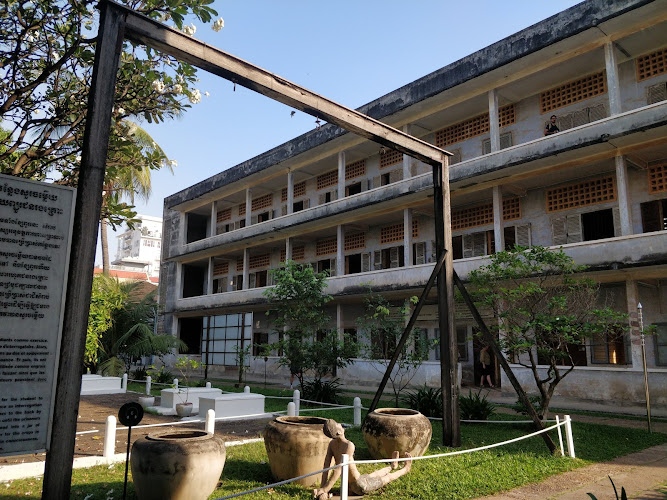
Tuol Sleng Genocide Museum preserves the former Security Prison 21, known as S-21, where the Khmer Rouge imprisoned, interrogated, and murdered thousands of people between 1975 and 1979. Set within a former secondary-school compound in Phnom Penh, it is a memorial site and historical museum rather than a conventional sightseeing stop. Its classrooms, corridors, cells, photographs, and records confront visitors with the machinery of persecution at an intensely human scale.
The museum sits on Street 113 in Boeung Keng Kang 3, a comparatively central Phnom Penh neighborhood of low-rise streets, local businesses, and cafés. Behind the compound walls, the atmosphere changes quickly: school buildings and open courtyards reveal how an ordinary civic setting was transformed into a prison. Plan to move slowly, keep conversations quiet, and give the material the attention it demands.
Standout Highlights & What Not to Miss
The strongest visit follows the museum’s sequence rather than rushing between buildings. A multilingual audio guide can help connect individual rooms and artifacts to the broader history, while the portrait galleries and survivor testimony prevent the story from becoming abstract. Content is distressing and includes evidence of torture, imprisonment, and mass violence; visitors should decide in advance whether they are ready for that material.
- Building A: Former classrooms contain iron bedframes and other evidence associated with interrogation. The building establishes the contrast between the site’s school origins and its later use as a prison.
- The memorial courtyard: Fourteen white graves commemorate people found at the prison when Phnom Penh was liberated in January 1979. Pause here before or after the interior galleries.
- Prisoner portraits: The photographic record gives faces to people processed through S-21. Look closely, but allow time to step back when the cumulative effect becomes overwhelming.
- Preserved cells in Building C: Brick and wooden cells, along with barred and screened galleries, show the physical confinement imposed on prisoners. Upper levels involve stairs.
- Vann Nath’s paintings and documentary archive: Survivor Vann Nath’s work depicts conditions inside the prison, while documents and photographs explain how bureaucracy enabled the atrocities. The archive is included in UNESCO’s Memory of the World Register.
Visitor Strategy & Planning Snapshot
| Planning Factor | What to Expect | Practical Strategy |
|---|---|---|
| Ideal Arrival Window | Quieter conditions are generally easier to find earlier in the day, before the site feels emotionally and physically crowded. | Arrive near opening where possible, allowing a calm start and time to pause between buildings. |
| Typical Time Needed | Most visitors need two to three hours for the main buildings, portraits, cells, paintings, and courtyard. | Reserve the full block rather than squeezing it between tours or a departure. |
| Booking / Queue Reality | Entry procedures, guide availability, and visitor volume can vary by day and season. | Confirm current admission arrangements before going; choose an audio guide or guide if available and useful to you. |
| Terrain & Accessibility | Courtyards and some ground-floor displays enable a partial visit, but uneven thresholds and stairs restrict access to upper galleries. | Visitors with limited mobility should focus on accessible areas and ask staff about the most manageable route. |
| Weather / Seasonal Fit | Phnom Penh’s heat and rain can make outdoor transfers and the open courtyard tiring. | Carry water, dress for heat, and allow flexibility during wet weather; the visit is largely indoors but not climate-controlled throughout. |
Honest Trade-Offs: Best For vs. Who Might Skip
Tuol Sleng is essential for history-minded visitors, educators, adult learners, and reflective travelers seeking to understand Cambodia beyond its monuments and markets. It is especially valuable when paired with careful reading or an audio guide, because the evidence gains meaning through context. It may not be appropriate for young children, visitors looking for a light cultural stop, or anyone who feels unprepared for explicit accounts and images of atrocity. The emotional weight is not a drawback to be overcome; it is central to the museum’s purpose. A shorter, partial visit is preferable to hurrying through difficult galleries without space to process them.
Neighborhood Context & How to Pair Your Visit
Because the museum is in Boeung Keng Kang 3, it fits naturally into a central Phnom Penh day on foot or by short ride. Keep the immediate schedule uncluttered: begin here, then take time for a quiet meal or coffee in the surrounding streets rather than moving directly to another emotionally demanding site. For a broader historical itinerary, pair it with the city’s riverside, civic landmarks, or a later visit to another Khmer Rouge-era memorial, but avoid treating either as a checklist. The most respectful route leaves room for reflection, shade, water, and an unhurried transition back into the city.
When planning your Angkor Wat travel guide or comparing verified attractions and museums in Angkor Wat, pair this stop with standout local spots including Prasat Preah Khan, Prasat Ta Keo, Sokha Siem Reap Resort & Convention Center, and National Museum of Cambodia (2.3 km away).


