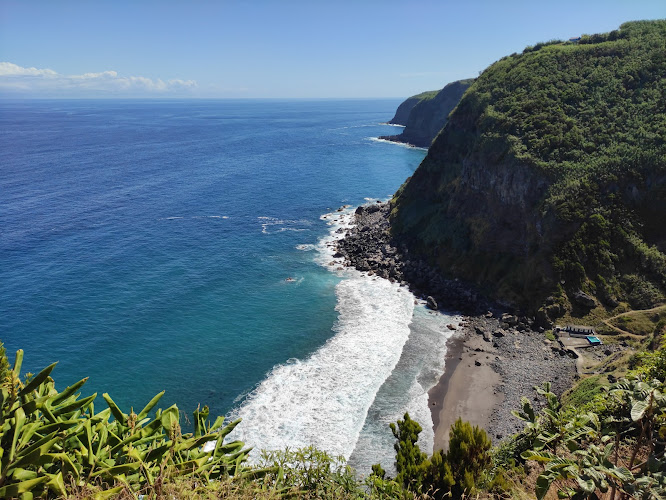
Miradouro da Boca do Inferno is one of São Miguel’s defining volcanic lookouts: a ridge-top viewpoint above the Sete Cidades caldera, where a sequence of green crater walls and lakes unfolds beneath the visitor. The experience is as much about the approach as the panorama. A woodland path from the Lagoa do Canário area rises to an exposed earthen ridge, placing walkers unusually close to the dramatic geography they have come to see.
Set in the highlands of western São Miguel, within Ponta Delgada municipality in the Azores, this is a natural stop rather than a town-based attraction. The practical arrival point is the Lagoa do Canário woodland entrance off the EN9-1A road. From there, the setting quickly changes from sheltered forest to open, wind-prone slopes, with Lagoa de Santiago, Lagoa Rasa and the wider Sete Cidades basin appearing in layers when cloud permits.
Standout Highlights & What Not to Miss
This viewpoint earns its reputation through depth and composition rather than a single framed lake. Give yourself time to look in more than one direction, wait for breaks in moving cloud, and appreciate how the ridge, woodland, lakes and caldera walls fit together. Conditions can transform the scene in minutes, so a partial view should not necessarily be the final word.
- The ridge approach: The narrow, photogenic route is an essential part of the visit, creating a striking foreground before the broader panorama opens up. Keep to the established path and avoid the steep vegetated edges.
- Lagoa de Santiago below: This deep green lake occupies a steep-sided inner crater and provides one of the most immediate, dramatic elements of the view.
- Layered Sete Cidades scenery: Look beyond the nearer slopes for Lagoa Rasa and the larger caldera basin, including the broad water of Lagoa Azul when visibility is clear.
- Lagoa do Canário woodland: The forested approach offers a quieter counterpoint to the exposed viewpoint and makes the walk feel like a small outing rather than a roadside photo stop.
- Changeable light: Mist, cloud shadows and sudden clearings are central to the atmosphere. Photographers should plan for patience rather than assume a guaranteed wide-open vista.
Visitor Strategy & Planning Snapshot
| Planning Factor | What to Expect | Practical Strategy |
|---|---|---|
| Ideal Arrival Window | Light and visibility vary rapidly; the ridge is most atmospheric when clouds are moving through the caldera. | Arrive early for a calmer feel, or retain flexibility to revisit if low cloud hides the lakes. |
| Typical Time Needed | The stop commonly takes 60 to 90 minutes, including the walk from the woodland entrance, viewpoints and photo pauses. | Allow extra time if weather is unsettled or if pairing it with nearby lakes and overlooks. |
| Booking / Queue Reality | This is an open landscape viewpoint, not a timed museum-style attraction, but popular conditions can make paths and photo positions feel busy. | Do not build the day around a single quick photograph; walk carefully and wait for space at the narrowest sections. |
| Terrain & Accessibility | The final approach includes steps, uneven ground and a narrow exposed ridge. There is no step-free wheelchair access to the viewpoint. | Wear secure footwear, keep children close, and choose another Sete Cidades stop if balance, mobility or exposure is a concern. |
| Weather / Seasonal Fit | Wind, rain and fog are possible at any time in the uplands, and cloud can erase the panorama without warning. | Bring a waterproof outer layer and protect cameras; check conditions locally, but be prepared for fast change. |
Honest Trade-Offs: Best For vs. Who Might Skip
Boca do Inferno is especially rewarding for landscape photographers, volcano enthusiasts, active families and independent road-trippers who value a short walk with a major visual payoff. It is also a strong choice for travelers who want to understand the scale of Sete Cidades beyond a conventional roadside overlook. The trade-off is real: this is not a polished, universally accessible viewing platform. Uneven surfaces, steps, wind exposure and the ridge’s narrow feel can be uncomfortable for visitors with limited mobility, a strong fear of heights, or anyone seeking a quick, sheltered stop. On a foggy day, the destination may offer mood and forest but little of the celebrated panorama. If conditions are poor and time is limited, it can be wiser to continue exploring and return later than to force the visit.
Neighborhood Context & How to Pair Your Visit
Think of Boca do Inferno as part of a self-driven Sete Cidades upland circuit rather than an isolated destination. Pair the walk with time around Lagoa do Canário, then continue to other caldera viewpoints and down toward the village of Sete Cidades for a change from high, exposed terrain to lakeside scenery. The route is not a walkable urban itinerary: distances between major sights are best handled by car, while the viewpoint itself is explored on foot. Keep the order flexible. If mist is sitting over the ridge, visit another nearby stop first and return when the cloud begins to lift. That adaptability is often the difference between merely reaching Boca do Inferno and seeing why it is one of São Miguel’s most memorable volcanic landscapes.
When planning your Azores travel guide or comparing verified attractions and scenic spot in Azores, pair this stop with standout local spots including Parque Natural da Ribeira dos Caldeirões, Terra Nostra Garden Hotel, Õtaka, and Miradouro das Cumeeiras (4.3 km away).