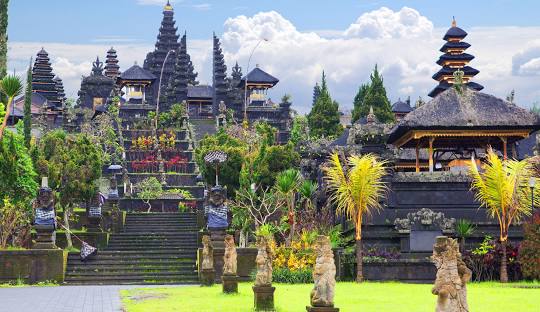
Besakih Great Temple is Bali’s principal Hindu sanctuary, at Besakih, Rendang, Karangasem Regency, Bali 80863, Indonesia, in Besakih village on Mount Agung’s southwestern slopes. Known as Bali’s Mother Temple, it is a living pilgrimage complex rather than a single monument. Its earliest recorded mention dates to an inscription from 1007, and it had become Bali’s central Hindu temple by the fifteenth century. Travelers come for monumental stairways, tiered shrines, mountain views, and the opportunity to understand Balinese worship. The Indonesian tourism authority outlines its history and religious importance.
What to Expect at Besakih Great Temple
Pura Penataran Agung anchors the visit. Its ascending terraces, stone staircases, split gateways, and black-thatched meru towers create the complex’s distinctive profile. Look uphill to understand the arrangement: successive sacred spaces rise toward Mount Agung, rather than unfolding along a flat sightseeing circuit. The mountain stands behind the roofs when clouds permit. This is an active place of worship, so the visitor route follows permitted paths around religious spaces; a ticket does not grant unrestricted access to prayer courtyards.
Besakih’s surrounding sanctuaries have distinct religious identities. Pura Kiduling Kreteg is associated with Brahma, while Pura Batu Madeg is dedicated to Vishnu, as described by the Bali provincial tourism office. Ask your guide to explain these relationships rather than treating every shrine as interchangeable. Offerings, incense, ceremonial clothing, and processions give the architecture its context. During ceremonies, leave passageways clear and watch from the areas your guide identifies; worship takes precedence over photography.
- Pura Penataran Agung: The principal sanctuary and architectural focus of the complex.
- Meru towers: Layered, dark-thatched shrine roofs rising above the surrounding courtyards.
- Split gateways: Monumental stone entrances framing the uphill approach.
- Pura Batu Madeg: A subsidiary temple associated with Vishnu.
- Living ceremonies: Pilgrims bring offerings and gather for worship throughout the religious calendar.
Besakih Great Temple at a Glance
| Detail | Information |
|---|---|
| Address | Besakih, Rendang, Karangasem Regency, Bali 80863, Indonesia. |
| Neighborhood / Area | Besakih village, Mount Agung’s southwestern slopes. |
| Operating Hours | Daily, 7 a.m.–6 p.m. WITA for sightseeing. |
| Admission & Ticket Prices | Paid admission, with different domestic and international tariffs. See the official visitor information for current prices and inclusions. |
| Recommended Visit Duration | Allow 1.5–2.5 hours for the guided route, stairs, and photographs. |
| Nearest Transit / Parking | Use the designated Besakih visitor parking complex; electric vehicles connect the arrival area with the lower temple approach. |
| Official Website / Phone | Indonesia Travel: official Besakih visitor guide. |
Visiting Tips, Getting There & Nearby Pairings
Aim for an early arrival, ideally around 8 a.m., and bring a light rain layer for the mountain setting. Arrange a car and driver for the return journey rather than relying on an onward street pickup. Head to the official visitor arrival facilities for tickets and your assigned guide. Admission includes a local guide, sarong rental, and one outward electric-vehicle transfer. Confirm the return walking arrangement before setting off. Cover your shoulders, follow local dress requirements, and ask before photographing worshippers.
The electric transfer reduces the approach walk but does not eliminate the temple’s stairways. Steep steps and terraced routes make a complete circuit unsuitable for most wheelchair users and cumbersome with a stroller; discuss a shorter lower-level visit before buying tickets. For nearby pairings, stay within the sacred precinct: ask your guide about Pura Basukihan and Pura Manik Mas, both listed in the official complex inventory. These are better candidates for short walking extensions than distant East Bali attractions; agree on a 5–15-minute extension according to your starting point, mobility, and permitted access.
Frequently Asked Questions
What are the opening hours, and when should I arrive?
Sightseeing hours are 7 a.m.–6 p.m. daily, Bali time. Arriving early leaves more time for the uphill route and photographs. Ceremonies can affect which paths visitors may use.
Is admission free, and should I reserve?
Admission is paid. Check the linked official visitor guide for current tariffs. Organize your visit through the official arrival facilities; separate cultural activities, including the documentary screening, have their own booking requirements.
How much time should I budget?
Set aside 1.5–2.5 hours on site, excluding the drive. Choose the longer allowance for a slower stair climb, architectural explanations, and additional permitted shrines.
Is Besakih suitable for children and wheelchair users?
Children can visit with supervision on the steps. A carrier is more practical than a stroller for the terraces. Wheelchair users should arrange a limited lower-area itinerary: the electric transfer is not a step-free route through the sanctuary.
When planning your Bali travel guide or comparing verified attractions and hindu temple in Bali, pair this stop with standout local spots including Bali Bird Park, GWK Cultural Park, Bali Museum, and Samsara Living Museum Bali (10.9 km away).