
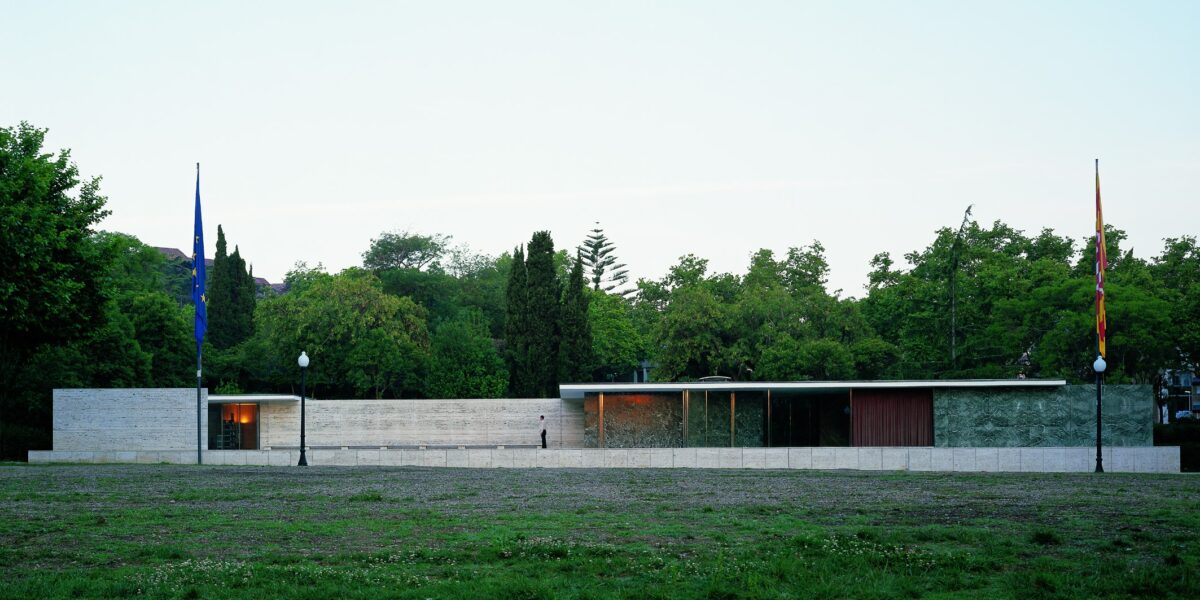
Mies van der Rohe Pavilion is a reconstructed landmark of modern architecture at Av. de Francesc Ferrer i Guàrdia, 7, Sants-Montjuïc, Barcelona, Spain. Originally designed by Ludwig Mies van der Rohe and Lilly Reich as the German Pavilion for Barcelona’s 1929 International Exposition, it reopened in 1986 after decades of absence. Travelers visit to experience its radical open plan, richly patterned stone, reflecting pools, and Barcelona chairs in their intended architectural setting.
What to Expect at Mies van der Rohe Pavilion
This is architecture to walk through slowly, not a museum of densely packed galleries. A broad travertine platform carries a flat roof supported by eight slender, chrome-clad cruciform columns. Glass partitions and freestanding stone walls guide movement without dividing the interior into conventional rooms. Watch how the golden onyx wall changes against the pale floor, then follow the sightlines between indoor space and the large outdoor pool. The building’s apparent simplicity depends on precise proportions, reflections, and exceptionally expressive materials.
The original pavilion was dismantled in 1930. Barcelona established the Fundació Mies van der Rohe in 1983 to pursue its reconstruction, undertaken by architects Ignasi de Solà-Morales, Cristian Cirici, and Fernando Ramos on the original site. Today, the building itself is the principal exhibit. The foundation also organizes architectural debate, exhibitions, and temporary art interventions that can alter familiar views of the space; consult its exhibitions programme before choosing a date.
- Golden onyx wall: The richly veined interior partition is the pavilion’s strongest visual anchor.
- Barcelona chairs: The iconic leather-and-metal furniture belongs to the design conceived for the 1929 pavilion.
- Georg Kolbe’s Dawn: A bronze female figure occupies the smaller pool, reflected in water, stone, and glass.
- Contrasting stone surfaces: Roman travertine, green marbles, and golden onyx give the restrained structure its color and texture.
- Two pools and changing viewpoints: Circling the pavilion reveals deliberately framed compositions rather than one definitive façade.
Mies van der Rohe Pavilion at a Glance
| Detail | Information |
|---|---|
| Address | Av. de Francesc Ferrer i Guàrdia, 7, 08038 Barcelona, Spain |
| Neighborhood / Area | Sants-Montjuïc; lower Montjuïc, beside the former exposition grounds |
| Operating Hours | Daily, generally 10am–8pm March–October and 10am–6pm November–February; check the official calendar for exceptions. |
| Admission & Ticket Prices | Paid admission; current rates, concessions, and tickets through the official website. |
| Recommended Visit Duration | 45–60 minutes; up to 90 minutes for architectural study or an exhibition. |
| Nearest Transit / Parking | Espanya: Metro L1 and L3, plus FGC trains; approximately 10–15 minutes on foot. Paid parking is available around Plaça d’Espanya. |
| Official Website / Phone | miesbcn.com / +34 932 15 10 11 |
Visiting Tips, Getting There & Nearby Pairings
Arrive around the 10am opening for an unhurried first circuit, especially if photography is your priority. Walk around twice: first to understand the layout, then to study reflections and joints between materials. Buy through the official ticket link and check the agenda for installations or events affecting the normal experience. From Espanya station, walk between the Venetian Towers along Avinguda de la Reina Maria Cristina, then turn toward CaixaForum and the pavilion. There is no need to climb to the upper terraces of Montjuïc.
The pavilion stands on a raised stone plinth, with steps on the obvious visitor approach; wheelchair and stroller users should contact staff beforehand to arrange the appropriate step-free entry. The principal spaces occupy one level, but exterior stone can become slippery when wet, and the pools require care with children. Pair your visit with CaixaForum Barcelona, roughly five minutes away in Josep Puig i Cadafalch’s former Casaramona factory, or the Museu Nacional d’Art de Catalunya, about 10–15 minutes uphill. Plaça d’Espanya and the Arenas shopping center offer dining options around 15 minutes away.
Frequently Asked Questions
When does the pavilion open, and when should I visit?
Opening is normally at 10am daily, with seasonal closing times of 6pm or 8pm. Morning is a useful choice for careful viewing; check the official calendar for special closures.
Is admission free, and should I reserve?
Standard admission is paid. Check current prices and concession conditions through the official website. Advance purchase is convenient; workshops, talks, and special activities may have separate booking requirements.
How long does a visit take?
Allow 45–60 minutes for the interior, pools, sculpture, and exterior viewpoints. Architecture enthusiasts can comfortably spend 90 minutes examining materials, photographing details, or exploring a temporary intervention.
Is it suitable for children and wheelchair users?
The compact layout suits a short family visit, and the foundation offers scheduled family workshops. Supervise children beside the pools. Wheelchair users should arrange step-free entry with staff because the main approach has steps.
When planning your Barcelona travel guide or comparing verified attractions and museums in Barcelona, pair this stop with standout local spots including Barceloneta Park, Museu de la Xocolata, ME Barcelona, and CaixaForum Barcelona (nearby).


