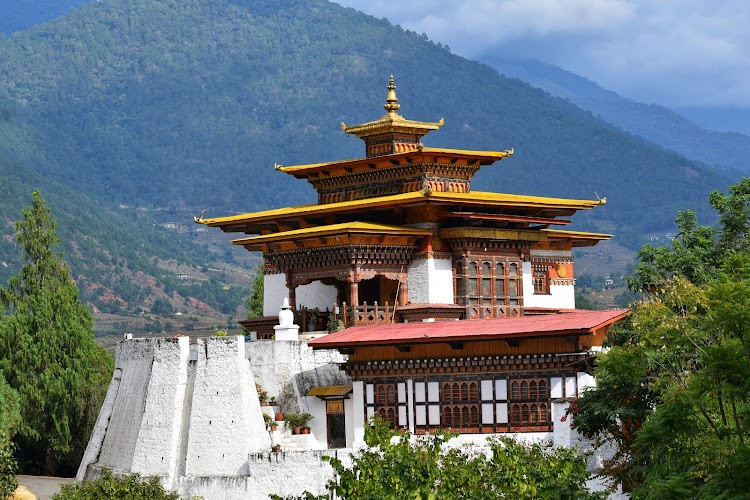
Punakha Dzong སྤུ་ན་ཁ་རྫོང་། is a working Buddhist monastery and administrative fortress at HVJ7+V6Q, beside the Pho Chhu–Mo Chhu confluence in Punakha, Bhutan; the riverside site has no numbered street address. Founded in 1637 by Zhabdrung Ngawang Namgyal, Bhutan’s unifying religious and political leader, it is formally called Pungthang Dewa Chhenbi Phodrang, the Palace of Great Happiness. Travelers come for its monumental Bhutanese architecture, richly decorated assembly hall, and extraordinary position between two rivers. It remains the winter residence of Bhutan’s central monastic body.
What to Expect at Punakha Dzong
The approach crosses the Mo Chhu on the roofed wooden Bazam bridge, reconstructed in traditional cantilever form in 2008. Beyond it, steep entrance stairs lead through massive gateways into a complex of whitewashed walls, red timber bands, projecting windows, and tiered golden roofs. Unlike many Bhutanese dzongs, Punakha has three principal courtyards. A six-story central tower, or utse, anchors the composition; administrative offices and monastic quarters occupy different parts of the fortress.
Follow your guide through the public courtyards toward the southern assembly hall, or kunrey, where monumental images of the Buddha, Guru Rinpoche, and Zhabdrung stand amid painted columns and Buddhist murals. Access changes with ceremonies and monastic business: the sacred Machey Lhakhang, associated with Zhabdrung’s preserved remains, is not a normal visitor stop. The dzong also hosted Ugyen Wangchuck’s coronation as Bhutan’s first king in 1907 and the royal wedding in 2011.
- Bazam bridge: A covered timber crossing frames the first close views of the fortress.
- Three courtyards: Distinct spaces reveal the dzong’s intertwined religious and administrative functions.
- Kunrey assembly hall: Large sacred figures, painted woodwork, and murals reward slow looking.
- Central utse: The six-story tower dominates the enclosure and surrounding river landscape.
- Spring jacarandas: Purple flowers, usually around April and May, contrast with the white walls.
Punakha Dzong at a Glance
| Detail | Information |
|---|---|
| Address | HVJ7+V6Q, Punakha, Bhutan; river confluence site without a numbered street address |
| Neighborhood / Area | Punakha Valley, Pho Chhu–Mo Chhu confluence |
| Operating Hours | Monday–Saturday, 9am–5pm; Sunday closed. Religious functions can affect access. |
| Admission / Price Range | Paid admission; $$ sightseeing budget. Check current entrance charges before visiting. |
| Recommended Visit Duration | 1.5 to 2 hours |
| Nearest Transit / Parking | Taxi or arranged vehicle from Khuruthang; roadside visitor parking near the bridge approach. No metro or railway. |
| Official Website & Phone | Punakha district administration; +975 17 92 05 45 |
Visiting Tips, Getting There & Nearby Pairings
Aim for the 9am opening, when the valley is generally cooler and there is time to explore before tour groups accumulate. Arrange your visit with your guide, especially around Punakha Drubchen and Tshechu, when ceremonies transform access and crowd levels. Khuruthang, the valley’s main service town, is a short drive away; taxis and arranged cars are more practical than relying on buses to the gate. Leave vehicles near the bridge approach and continue on foot.
The entrance’s steep stairs, raised thresholds, and uneven paving make this a difficult wheelchair visit; there is no continuous step-free visitor route through the historic interiors. Strollers are awkward, and young children need close supervision near stairs. Pair the dzong with the Mo Chhu riverbank immediately outside and, roughly 15 minutes’ walk toward the Pho Chhu upstream side, Punakha Suspension Bridge. Wear covered shoulders and long trousers or a long skirt; remove hats and shoes where required, and ask before photographing interiors.
Frequently Asked Questions
What are the opening hours and best visiting time?
Plan around Monday–Saturday, 9am–5pm; Sunday is listed as closed. Arrive near opening and have your guide check for religious closures before departure.
Is admission free, and should I book ahead?
Visitor admission is paid, separate from Bhutan’s national tourism charges. Ask your guide to confirm the current fee and entry arrangements; festival visits require more advance coordination than ordinary sightseeing.
How long should I allow?
Allow 1.5 to 2 hours for the bridge, courtyards, accessible religious spaces, and exterior photographs. Add another 45–60 minutes for the walk to the suspension bridge and back.
Is Punakha Dzong suitable for families and visitors with limited mobility?
Families can enjoy the bridge and courtyards, provided children can manage stairs and remain quiet in worship spaces. Visitors with limited mobility should discuss the entrance staircase with their guide; the riverbank offers exterior views without tackling the interior route.
When planning your Bhutan travel guide or comparing verified attractions and buddhist temple in Bhutan, pair this stop with standout local spots including Punakha Bridge view restaurant, Le Méridien Thimphu, Zombala 2 Restaurant, and MERENGMA' Bistro (2.1 km away).