
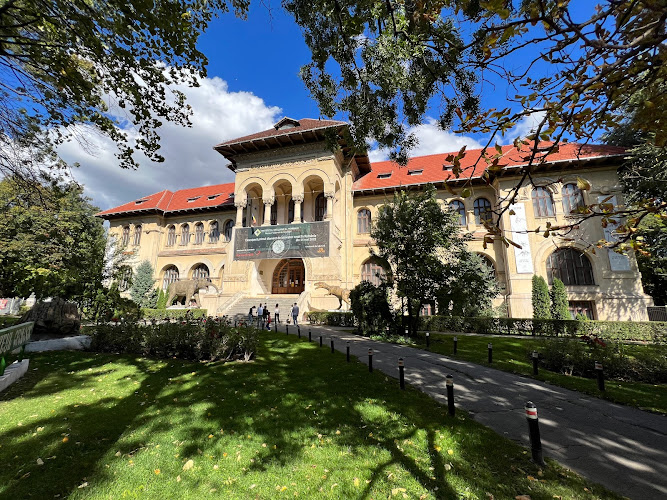
The National Museum of Geology is Romania’s principal earth-science museum: a compact, richly old-fashioned collection of minerals, rocks, gemstones and fossils arranged inside a grand Neo-Romanian landmark. It rewards close looking rather than hurried box-ticking, with glass cases full of crystalline color, textures and specimens that trace the deep history beneath Romania’s landscapes.
It stands at the southern end of leafy Kiseleff Boulevard, just north of Piața Victoriei in Bucharest’s elegant Sector 1. The setting is part of the draw. Before entering, take in the early-20th-century former Geological Institute headquarters, designed by Victor Ștefănescu; inside, high-ceilinged rooms, carved woodwork and the monumental stair give scientific displays a suitably dramatic frame.
Standout Highlights & What Not to Miss
This is not a hands-on science centre or a giant natural-history institution; its strength is the range and character of its collections, especially in a building that feels inseparable from them. Allow time to read labels selectively, compare forms and colors, and look beyond the headline dinosaur material. Families can keep the visit lively by alternating a focused gallery stop with time to notice a favorite crystal, fossil or architectural detail.
- The Neo-Romanian building: The façade and interior halls make an immediate impression. Look up at the detailing and pause on the central stair; architecture fans should treat the setting as an exhibit in its own right.
- Romanian mineral collections: Crystals, ores and mineral specimens connect the museum to the country’s historic mining regions, including the Apuseni Mountains. Compare luster, crystal shapes and the surprising variety of colors.
- Gemstone displays: Cut and rough stones provide an approachable entry point for visitors who do not arrive with a geology background. They are particularly useful for children learning to distinguish a mineral’s natural form from its finished use.
- Fossils and dinosaur material: Paleontology galleries span ancient marine life, invertebrate fossils and vertebrate finds, including Late Cretaceous material associated with the Hațeg region’s dwarf dinosaurs.
- Rocks that explain the country: Sedimentary formations, salt, crystalline material and other rock exhibits put Romania’s Carpathian geology into context. They are most rewarding when viewed as a story of landscapes, resources and deep time rather than as isolated samples.
Visitor Strategy & Planning Snapshot
| Planning Factor | What to Expect | Practical Strategy |
|---|---|---|
| Ideal Arrival Window | Displays are best enjoyed when galleries feel unhurried and labels are easy to approach. | Choose an earlier visit or a quieter weekday if flexibility allows, and leave room afterward for the boulevard or nearby museums. |
| Typical Time Needed | Most visitors need one to two hours; enthusiasts can linger longer over mineralogy and paleontology. | Allow about 75 minutes for highlights, or the full two hours if you enjoy reading scientific context and photographing details. |
| Booking / Queue Reality | It is a focused museum rather than a large, high-throughput attraction, but special activities can change demand. | Check current admission arrangements and any workshop or event schedule before setting out, especially on weekends or school breaks. |
| Terrain & Accessibility | The historic building has entrance steps and multiple levels. | Visitors with limited mobility should consult the museum’s accessibility information in advance and plan for the building’s heritage layout. |
| Weather / Seasonal Fit | Indoor galleries make this a useful all-weather stop in a city of broad boulevards and park walks. | Pair it with Kiseleff Boulevard in mild weather; use it as a cultured, weatherproof anchor on rainy, hot or cold days. |
Honest Trade-Offs: Best For vs. Who Might Skip
This museum is especially good for families with curious older children, geology buffs, history lovers and travelers who value period architecture as much as interactive spectacle. The collections offer substance, and the Romanian focus gives them a clear local identity. On the other hand, visitors expecting immersive digital installations, extensive English-language interpretation throughout, or a vast dinosaur hall may find the experience more traditional and concentrated than anticipated. Very young children may respond best to a short, treasure-hunt-style visit centered on sparkling minerals and fossils. The stairs and multiple levels also deserve attention from anyone for whom step-free movement is essential.
Neighborhood Context & How to Pair Your Visit
Build the museum into a relaxed Sector 1 itinerary rather than treating it as an isolated stop. Start around Piața Victoriei, walk north along Kiseleff Boulevard, and use the museum as an indoor counterpoint to the district’s broad, leafy streets and handsome institutional architecture. Its location also pairs naturally with other nearby cultural stops and a café break around the square. If you are heading toward Herăstrău Park, the museum makes a thoughtful first chapter: go from Romania’s geological foundations to one of Bucharest’s most appealing green spaces without crossing the city repeatedly.
When planning your Bucharest travel guide or comparing verified attractions and museums in Bucharest, pair this stop with standout local spots including Mercure Bucharest City Center, Macca – Vilacrosse Passage, Lupa Capitolina, and The National Museum of the Romanian Peasant (0.1 km away).


