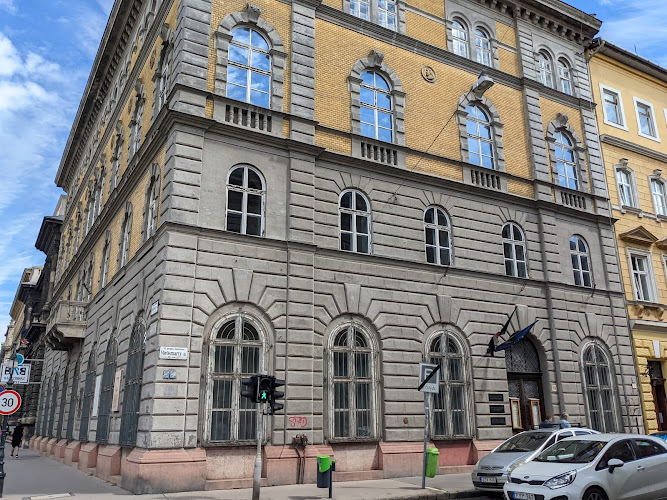
House of Terror is a history museum and memorial at Andrássy út 60, 1062 Budapest, Hungary, in Terézváros, District VI. Opened in 2002, it occupies the former headquarters of Hungary’s fascist Arrow Cross movement and, subsequently, the communist political police. Travelers visit to understand persecution, imprisonment and state violence through documents, testimony, reconstructed detention spaces and deliberately unsettling exhibition design. This is an emotionally demanding encounter with twentieth-century Hungary, not a conventional collection of objects behind glass. Start with the museum’s official website.
What to Expect at House of Terror
The dark roof canopy, cut with the word TERROR and ideological symbols, distinguishes the building from its elegant avenue neighbors. Inside, a Soviet tank stands beneath walls covered with victims’ portraits. The exhibition begins upstairs: the second-floor galleries introduce Nazi and Soviet occupation before examining the Arrow Cross regime. Films, photographs and strongly theatrical interiors establish a chronological route rather than an open-plan museum to explore randomly.
The first-floor exhibition addresses deportation, forced agricultural deliveries, political policing, show trials, propaganda and religious persecution. Look for Gábor Péter’s office setting and the Justice room’s material on Imre Nagy’s trial. A slow lift then descends toward the basement while an execution account plays. Crucially, the museum identifies half of this basement as reconstructed: these spaces communicate conditions of confinement, rather than presenting every cell as an untouched historical interior.
- Tank courtyard: A Soviet armored vehicle contrasts with the surrounding portrait memorial.
- Compulsory Deliveries room: A labyrinth decorated with lard blocks addresses coercion against farming communities.
- Churches room: A recessed cross and Cardinal Mindszenty’s cape convey religious repression.
- Basement cells: The wet cell, low-ceilinged “fox-hole” and tiny detention cell show different forms of confinement.
- Closing memorials: The Hall of Tears and Perpetrators’ Wall distinguish victims from those implicated in repression.
House of Terror at a Glance
| Detail | Information |
|---|---|
| Address | Andrássy út 60, 1062 Budapest, Hungary |
| Neighborhood / Area | Terézváros, District VI; Andrássy Avenue near Oktogon |
| Operating Hours | Tuesday–Sunday, 10am–6pm; Monday closed; ticket desk closes 5:30pm |
| Admission & Ticket Prices | Full price: HUF 4,000; eligible reduced admission: HUF 2,000; tickets sold onsite only |
| Recommended Visit Duration | Allow 2–3 hours, plus entrance queues |
| Nearest Transit / Parking | M1: Vörösmarty utca; trams 4 and 6: Oktogon; public transport is the simplest approach |
| Official Website / Phone | Official visitor information; +36 1 374 2600 |
Visiting Tips, Getting There & Nearby Pairings
Aim for the 10am opening on a weekday, and leave flexibility afterward: the museum warns of entrance queues during busy periods. Individual tickets cannot be bought online; arrange organized group visits directly with the museum. Bring identification if claiming a concession. All backpacks must go into the free cloakroom, regardless of size. Photography and video are prohibited except at the tank, under the museum’s visitor rules. Avoid arriving near the 5:30pm ticket cutoff if you want a substantial visit.
Vörösmarty utca on M1 is close by; Oktogon’s tram platforms are roughly five minutes away. The museum route spans several floors and includes a slow basement lift, dark spaces and confined reconstructed cells. Wheelchair and stroller users should telephone ahead to arrange a suitable entrance and circulation route rather than assuming the exhibition lift resolves every access need. Afterward, walk about five minutes to Liszt Ferenc tér’s cafés, around ten minutes to the Hungarian State Opera, or roughly fifteen minutes to Hunyadi tér’s market square for a less intense change of scene.
Frequently Asked Questions
When is House of Terror open, and when should I arrive?
Regular hours are Tuesday through Sunday, 10am–6pm, with Monday closure. The cash desk closes at 5:30pm. Arrive at opening for the most useful sightseeing window, and check official notices for holiday changes.
How much are tickets, and can I reserve online?
Full-price admission is HUF 4,000; the reduced ticket is HUF 2,000 for eligible visitors. Tickets are sold only at the museum, with no online purchase option. Group visits require separate advance arrangements.
How much time should I budget?
Set aside two to three hours to follow the chronological galleries, read contextual material and experience the basement without rushing. Add waiting time before admission, and leave room afterward to decompress.
Is it suitable for children and wheelchair users?
Children under 14 must have adult supervision. Torture, execution testimony and the reconstructed basement cells make this better suited to mature teenagers than young children. Wheelchair users should contact the museum about their specific route and basement access before visiting.
When planning your Budapest travel guide or comparing verified attractions and museums in Budapest, pair this stop with standout local spots including Corinthia Budapest, Kempinski Hotel Corvinus Budapest, Kiscelli Museum, and Franz Liszt Memorial Museum (0.1 km away).