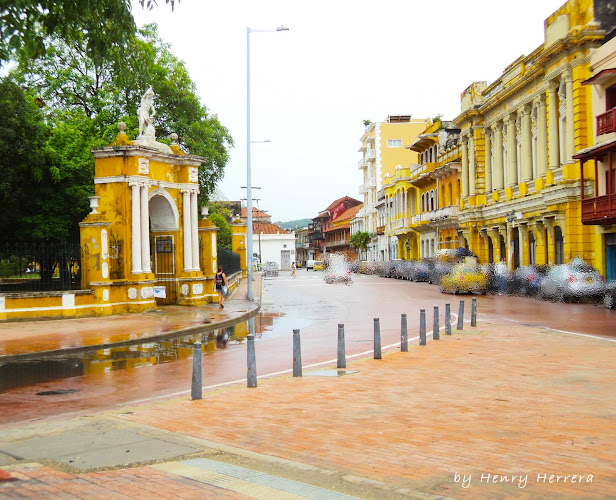
Plaza de la Aduana is Cartagena’s largest and most historically administrative square, at Cl. 32 #130 in El Centro, Cartagena de Indias, Cartagena Province, Bolívar 130001, Colombia. Just inside the walled city near the Torre del Reloj, this broad paved plaza developed from the early colonial Plaza del Mar into the seat of accounting and customs activity for a port city founded by Pedro de Heredia in 1533. Travelers come for the Christopher Columbus monument, the arcaded former Customs House, and a direct view of the civic architecture behind Cartagena’s maritime empire.
What to Expect at Plaza de la Aduana
This is an open public square rather than a museum, so there are no galleries, timed exhibits, or ticketed collections. Its experience is architectural and historical: stand in the center to take in the long, low façades, wooden balconies, shuttered windows, and shaded ground-floor arcades typical of the colonial core. The square’s main monument is a marble statue of Christopher Columbus, installed after the plaza had already cycled through the names Plaza del Mar, Plaza de la Contaduría, and Plaza de la Aduana; it was also known as Plaza Colón.
The dominant building is the former Casa de la Aduana, where customs administration once controlled goods arriving through Cartagena’s Caribbean port. It now houses the Alcaldía Mayor de Cartagena, or City Hall. Look along the plaza’s edges for the house associated with Pedro de Heredia and for the visual transition from civic buildings toward nearby religious and cultural landmarks. The plaza is especially useful as a short orientation stop after entering through the Clock Tower gate: the waterfront, San Pedro Claver quarter, and commercial streets of Centro all radiate from this area.
- Christopher Columbus statue: The central marble monument provides the square’s clearest landmark and a useful meeting point.
- Former Customs House: View the arcaded colonial building now occupied by Cartagena’s municipal government.
- Colonial civic setting: Read the plaza as the former administrative heart of the Spanish port, not as a self-contained museum.
- Clock Tower approach: Reach the square within a few minutes of Torre del Reloj, Cartagena’s principal pedestrian entrance.
- Architectural photography: Early and late light brings out balconies, pale façades, stone paving, and deep arcade shadows.
Plaza de la Aduana at a Glance
| Detail | Information |
|---|---|
| Address | Cl. 32 #130, El Centro, Cartagena de Indias, Bolívar 130001, Colombia |
| Neighborhood / Area | El Centro, inside Cartagena’s UNESCO-listed walled city |
| Operating Hours | Open public square, accessible 24 hours daily; City Hall offices keep separate business hours |
| Admission & Ticket Prices | Free public admission; no tickets or reservations required |
| Recommended Visit Duration | 20 to 40 minutes; allow longer when pairing it with nearby sights |
| Nearest Transit / Parking | La Bodeguita Transcaribe stop and cruise-terminal area are about a 5–10 minute walk; use paid private garages in Centro, as the plaza has no dedicated visitor parking |
| Official Website / Phone | Cartagena Mayor’s Office; no dedicated plaza visitor phone is published |
Visiting Tips, Getting There & Nearby Pairings
Arrive before 9 a.m. for cooler temperatures and clearer photographs, or after 4 p.m. when the façades receive softer light. The square can be busy when cruise passengers enter through the nearby port-side gate and during the drier December–April travel period. There is nothing to book for the plaza itself; reserve tickets only if continuing to a ticketed museum or guided walking tour. From La Bodeguita, walk inland toward Torre del Reloj and continue along Calle 32. Taxis can drop passengers near the pedestrianized historic-center streets, but traffic restrictions and narrow lanes make walking the final stretch the practical choice.
The plaza is largely level and open, making it manageable for wheelchairs and strollers, but its stone paving can be uneven and there are no plaza-specific elevators or visitor facilities. Use curb cuts and move slowly at the edges where surfaces change. Within a 5–15 minute walk, pair it with the Torre del Reloj and Portal de los Dulces, the Church and museum complex of San Pedro Claver, and the Museo de Arte Moderno de Cartagena in the former Royal Customs House area. For a meal or drink afterward, the arcaded streets around Plaza de los Coches and Calle de los Estribos offer many restaurant and café options.
Frequently Asked Questions
What are Plaza de la Aduana’s hours, and when is the best time to visit?
The square is open 24 hours a day because it is public space. Visit before 9 a.m. or after 4 p.m. for less intense heat and better light; use normal city-center awareness after dark.
Does Plaza de la Aduana charge admission or require reservations?
No. Entry to the square is free, and no reservation is required. The Alcaldía building is a working municipal office, not a regular ticketed visitor attraction.
How much time should I budget for Plaza de la Aduana?
Budget 20 to 40 minutes to see the Columbus monument, examine the former Customs House, and photograph the façades. Plan 1.5 to 2 hours if walking on to San Pedro Claver and the Museo de Arte Moderno.
Is Plaza de la Aduana suitable for families and wheelchair users?
Yes, as a brief outdoor stop: children have room to pause and the central space is mostly flat. Wheelchair users and stroller pushers should allow extra time for uneven stone paving, curbs, heat, and limited shade.
When planning your Cartagena travel guide or browsing verified attractions in Cartagena, pair this stop with standout local spots including Molinete Roman Forum Museum, El Burlador Gastrobar, Baluarte de Santo Domingo, and Sophia Hotel (nearby).