Xunantunich Mayan Ruins is an ancient Maya ceremonial center on Xunantunich Access Road, across the Mopan River from San Jose Succotz in Belize’s Cayo District. The site has no numbered street address. Its greatest expansion came during the Late Classic period, roughly AD 600–900, when monumental plazas, palaces, and temples developed on this limestone ridge. Travelers come for El Castillo’s sculpted friezes, views toward Guatemala, and the distinctive approach aboard a hand-cranked river ferry.
What to Expect at Xunantunich Mayan Ruins
The main ceremonial precinct gathers limestone buildings around broad, grassy plazas. Start with the visitor center’s archaeological interpretation, then walk through the northern palace area toward the principal plaza and El Castillo, also designated Structure A6. Approximately 40 meters tall, this temple-palace dominates the southern skyline. Its monumental proportions become clearer from the plaza: successive terraces rise above the lawn, while smaller buildings reveal how rulers organized ceremonial and residential space. Xunantunich’s modern name is commonly translated as “Stone Woman,” recalling a local apparition story rather than the city’s ancient name.
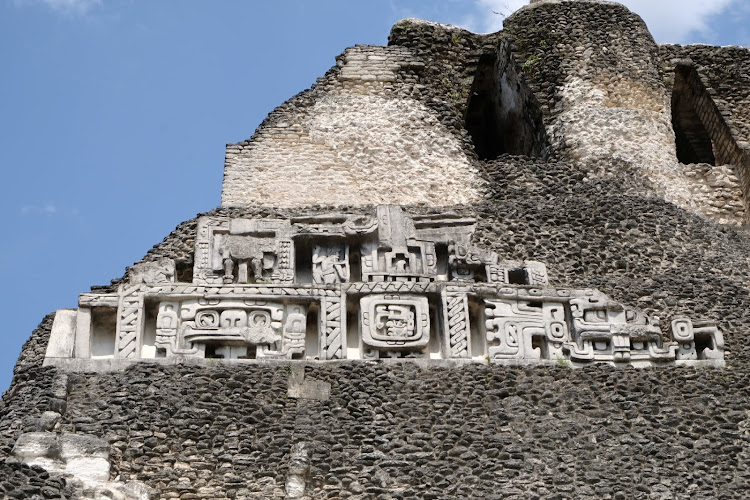
El Castillo’s eastern and western stucco friezes are the artistic centerpiece. Their masks and supernatural imagery express Maya ideas about rulership and the cosmos; protective reproductions allow visitors to appreciate the designs while conserving surviving originals beneath. Follow the designated climbing route only where access is open. The upper terraces overlook forest, farmland, and the Guatemala borderlands, but steep stairs and exposed edges demand attention. Back at ground level, the ball court and palace buildings reward slower exploration. Local guides can explain construction phases and political connections that are easy to miss when concentrating on the summit.
- El Castillo: The approximately 40-meter temple-palace provides the site’s most expansive elevated views.
- Stucco friezes: Monumental sculptural bands preserve the visual language of Maya sacred authority through protective replicas.
- Northern palace complex: Raised platforms and room remains illuminate elite life beyond the principal temple.
- Ball court: A compact ceremonial playing space adds context to the plazas and royal architecture.
- Mopan River ferry: The hand-cranked crossing connects Succotz with the uphill access road and makes arrival memorable.
Xunantunich Mayan Ruins at a Glance
| Detail | Information |
|---|---|
| Address | Xunantunich Access Road, San Jose Succotz, Cayo District, Belize; no numbered street address |
| Neighborhood / Area | Mopan River valley, west of San Ignacio and near Benque Viejo del Carmen |
| Operating Hours | Monday–Sunday, 8am–4pm; coordinate your return with ferry operations |
| Admission / Price Range | Paid admission; $ budget tier. Guide services cost extra; consult the official operator for current ticket categories |
| Recommended Visit Duration | 2–3 hours, including the river crossing and approach |
| Nearest Transit / Parking | San Ignacio–Benque Viejo buses along the George Price Highway; alight at the Succotz ferry. Parking near the site entrance after crossing |
| Official Website & Phone | National Institute of Culture and History; use its contact directory for Institute of Archaeology telephone enquiries |
Visiting Tips, Getting There & Nearby Pairings
Arrive near 8am for cooler climbing conditions and softer light on the limestone. From San Ignacio, take a Benque-bound bus or taxi to the Succotz ferry beside the George Price Highway. After crossing, the road climbs roughly 1.5 kilometers to the ruins: allow 25–35 minutes on foot, or arrange vehicle transport. Small vehicles can cross on the ferry, subject to operating conditions. Heavy rain and high river levels can interrupt access, so check before setting out. Carry Belize-dollar cash for admission and guide arrangements, drinking water, insect repellent, and shoes with dependable grip.
Grass, uneven stone, and changes in level make wheelchair and stroller travel challenging; vehicle access to the entrance avoids the long uphill walk. El Castillo requires stairs and has no elevator or step-free summit route. Use visitor facilities before exploring and take breaks outside the exposed plazas. Nearby pairings belong at the ferry end, not beside the hilltop ruins: the Mopan riverbank and San Jose Succotz village center are short walks of about 5–15 minutes from the landing, offering riverside views and local lunch stops after your descent.
Frequently Asked Questions
What are the opening hours and best arrival time?
The archaeological site opens daily from 8am to 4pm. Aim for opening time, and leave enough margin for the return ferry rather than starting your climb near closing.
Is admission free, and do I need a reservation?
Admission is paid, with separate charges for optional guides. Independent visitors generally buy tickets on arrival; check the official NICH website for current rates and arrange a specialist guide ahead if desired.
How much time should I allow?
Budget 2–3 hours for the crossing, principal buildings, and an unhurried climb. Add time if walking both directions between the ferry and entrance or taking an extended guided tour.
Is Xunantunich suitable for children and visitors with limited mobility?
Families can explore the plazas without climbing El Castillo, but children need close supervision around stairs and exposed drops. Visitors with limited mobility should arrange entrance transport and discuss ground conditions with staff before attempting the uneven archaeological precinct.
When planning your Caye Caulker travel guide or browsing verified attractions in Caye Caulker, pair this stop with standout local spots including The Lazy Lizard, The Pelican Sunset Bar, Tarpon feeding dock, and St. Herman's Blue Hole National Park (48.2 km away).