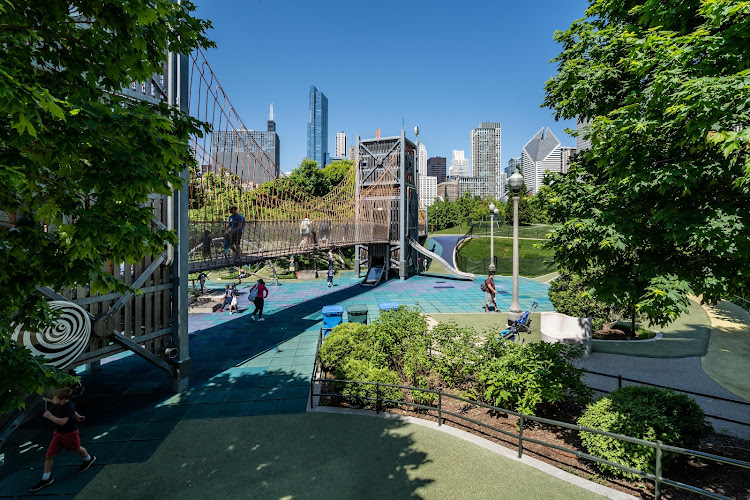
Chicago Loop is Chicago’s central business district and historic downtown, centered on the State Street and Madison Street intersection in Chicago, IL 60601–60605. Named for the elevated rail circuit completed in 1897, this dense street grid combines landmark skyscrapers, major museums, theater marquees, public art and lakefront parkland; travelers come to walk between Millennium Park, the Art Institute of Chicago, the Chicago River and Willis Tower without leaving the city’s urban core.
What to Expect at Chicago Loop
The Loop rewards an on-foot itinerary. Begin at Millennium Park’s Frank Gehry-designed Jay Pritzker Pavilion and Anish Kapoor’s mirror-polished Cloud Gate, then cross Michigan Avenue to the Art Institute of Chicago’s Beaux-Arts building, opened in 1893 for the World’s Columbian Exposition. Its collection includes Georges Seurat’s A Sunday on La Grande Jatte, Grant Wood’s American Gothic and the Thorne Miniature Rooms. The adjacent Chicago Cultural Center, completed in 1897 as the city’s first central library, has a Tiffany glass dome and rotating free exhibitions.
West of State Street, look up: Daniel Burnham and John Root’s 1885 Rookery Building has a glass-roofed light court remodeled by Frank Lloyd Wright, while the Monadnock Building’s load-bearing brick south half contrasts with its steel-framed northern half. The Chicago Theatre’s 1921 French Baroque-style auditorium and six-story vertical sign remain a State Street landmark. For broad city-and-lake views, Willis Tower’s Skydeck occupies the 103rd floor of the 1973 tower, while the Chicago Riverwalk brings seating, public art and river-level paths to the district’s northern edge.
- Millennium Park: See Cloud Gate, Crown Fountain and the curving stainless-steel bands of Jay Pritzker Pavilion.
- Art Institute of Chicago: Spend time with American icons, Impressionist paintings, the Modern Wing and the miniature Thorne Rooms.
- Chicago Cultural Center: Enter for free to view its Tiffany dome, Preston Bradley Hall and changing arts programming.
- Historic architecture: Tour or admire the Rookery, Monadnock, Marquette and Chicago Board of Trade buildings from the street.
- Theater and skyline: Catch a show at the Chicago Theatre or Broadway in Chicago venues, then head to Skydeck Chicago for long-distance views.
Chicago Loop at a Glance
| Detail | Information |
|---|---|
| Address | Downtown Chicago, centered at State Street and Madison Street, Chicago, IL 60601–60605 |
| Neighborhood / Area | The Loop; bounded broadly by the Chicago River, Lake Michigan, Ida B. Wells Drive and Roosevelt Road |
| Operating Hours | Public streets and parks are accessible daily; individual museums, theaters, shops and observatories keep separate hours |
| Admission / Price Range | Free to explore; attractions, performances, tours and dining are paid, with options from $ to $$$ |
| Recommended Visit Duration | 4 to 6 hours for highlights; a full day for a museum, architecture and a performance |
| Nearest Transit / Parking | CTA Red/Blue Line Jackson; Brown, Green, Orange, Pink and Purple Line stops at the Loop; paid garages at Millennium Park and Grant Park |
| Official Website & Phone | Chicago Loop Alliance; 312-782-9160 |
Visiting Tips, Getting There & Nearby Pairings
Arrive around 9 a.m. for the clearest views and easier photographs in Millennium Park before office commuters and tour groups fill the sidewalks. Reserve timed entry for the Art Institute and Skydeck, and buy theater tickets ahead for Friday and Saturday evenings. The Loop is easy to reach on CTA: Jackson connects to both the Red and Blue Lines, while Washington/Wabash and Adams/Wabash serve elevated trains. Use the CTA trip planner for elevator status and service changes. Drivers should reserve a paid garage rather than expect curbside parking; Millennium Park Garage is convenient for the park and Michigan Avenue.
Sidewalks along State, Michigan and Wacker are generally wide and curb-ramped, and Millennium Park’s principal paths are step-free. Washington/Wabash and Clark/Lake are accessible CTA stations, but not every historic station or older building has level access; check an attraction directly before arrival. Pair the Loop with the Chicago Riverwalk, a 10-minute walk north from Millennium Park; Grant Park and Buckingham Fountain, about 10 minutes south; or the Chicago Cultural Center, opposite the park. Revival Food Hall on South Clark Street and the restaurants along Randolph Street offer practical meal stops between galleries and evening performances.
Frequently Asked Questions
What are the best hours to visit the Chicago Loop?
The district itself is open at all hours, though parks, attractions and businesses operate on their own schedules. Weekday mornings are best for architecture walks and Millennium Park; theater activity and dining build from late afternoon through the evening.
Does it cost anything to explore the Loop?
Walking the streets, viewing exterior architecture, visiting Millennium Park and entering the Chicago Cultural Center are free. Budget separately for museum admission, Skydeck tickets, guided architecture tours, theater seats, meals and parking; reserve major paid attractions online.
How much time should I allow for the Chicago Loop?
Allow four to six hours to combine Millennium Park, the Cultural Center, an architecture walk and the Riverwalk. Add two to three hours for the Art Institute or Skydeck, and plan a full day if attending an evening show.
Is the Chicago Loop suitable for families and wheelchair users?
Yes: Millennium Park’s fountains, public art and open routes work well for families, while museums provide indoor options in cold or rainy weather. Step-free routes are available through much of the public realm, but elevator access varies at older elevated stations and landmark buildings.
When planning your Chicago travel guide or browsing verified attractions in Chicago, pair this stop with standout local spots including Downtown Chicago, Lincoln (Abraham) Park, The Gage, and Exchequer Restaurant & Pub (0.1 km away).