
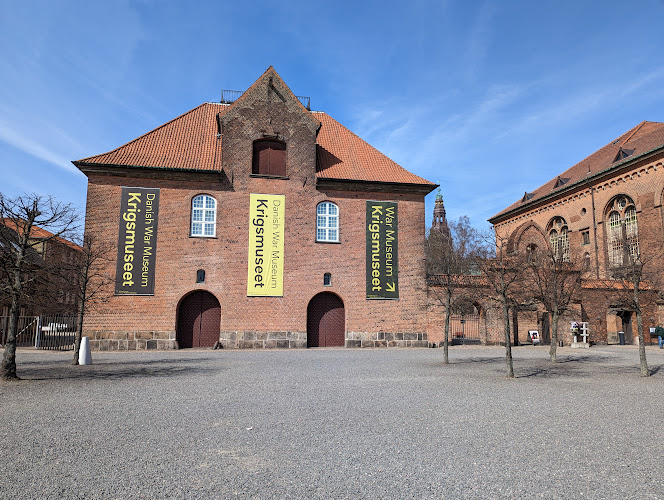
The War Museum is Denmark’s national museum of military history at Tøjhusgade 3, 1220 København, in Copenhagen’s Slotsholmen government and waterfront quarter, Denmark. Housed in Christian IV’s early-17th-century Arsenal (Tøjhuset), it explores how warfare has shaped Denmark and the lives of soldiers and civilians, from early modern campaigns to the present day. Travelers come for the monumental Renaissance building, historic arms and artillery, and a focused account of Danish conflicts that adds context to nearby Christiansborg Palace.
What to Expect at The War Museum
The setting is integral to the visit. Christian IV commissioned the Arsenal in the early 1600s to store weapons and military equipment for the Danish crown; its exceptionally long brick form, steep roof and repeated gables remain among Copenhagen’s most striking surviving utilitarian Renaissance structures. Inside, the scale of the former weapons storehouse gives large objects room to register: cannon, field guns and other artillery sit beneath the high timber roofline rather than being reduced to labels in compact display cases.
The galleries follow Danish military history across several centuries, using weapons, uniforms, medals, equipment and personal stories to consider both technology and consequences. Look for material connected with the wars of the 19th century, including 1864, as well as the German occupation during the Second World War and Denmark’s more recent international deployments. The museum does not treat conflict as a parade of hardware alone: accounts of individual soldiers, conscription and civilian experience give the collections a human frame. Allow time to compare the changing forms of swords, muskets, rifles and artillery, and to study the Arsenal itself between the exhibition sections.
- Christian IV’s Arsenal: Explore a rare early-1600s weapons storehouse with a vast, elongated Renaissance interior.
- Historic arms: Trace the development from edged weapons and firearms to modern military equipment.
- Artillery displays: See cannon and large-scale military objects in spaces designed for arsenal storage.
- Denmark at war: Place conflicts such as 1864, the Second World War and later overseas missions in Danish context.
- Soldiers’ stories: Use uniforms, medals and personal objects to understand service beyond battlefield strategy.
The War Museum at a Glance
| Detail | Information |
|---|---|
| Address | Tøjhusgade 3, 1220 København, Denmark |
| Neighborhood / Area | Slotsholmen, beside Christiansborg and Frederiksholms Kanal |
| Operating Hours | Daily, 10am–5pm; confirm holiday hours before travel |
| Admission & Ticket Prices | Paid admission; children under 18 are admitted free. Check the official ticket page for current adult and concession prices. |
| Recommended Visit Duration | 1.5 to 2 hours |
| Nearest Transit / Parking | Gammel Strand Metro is about a 10-minute walk; Christiansborg bus stops are nearby. Use paid city parking around Slotsholmen or BLOX. |
| Official Website / Phone | natmus.dk/museer-og-slotte/krigsmuseet/ · +45 41 20 60 80 |
Visiting Tips, Getting There & Nearby Pairings
Arrive close to the 10am opening or later in the afternoon for the calmest galleries, particularly on weekends and during Copenhagen’s summer visitor season. Buy tickets online through the museum’s official website when you want to avoid ticket-desk delays or need to confirm special opening arrangements. From Gammel Strand on the M3/M4 Metro, walk south-west through central Copenhagen and across Slotsholmen; the entrance is a short walk from Christiansborg. Drivers should not expect dedicated museum parking in this historic district: use a paid garage or marked public spaces, then finish on foot.
The Arsenal is a historic building, so outdoor approaches and surrounding streets can include cobbles or uneven paving. The museum provides step-free access and lifts for wheelchair users, with an accessible toilet; contact staff ahead if you need assistance or are visiting with a large stroller, since the older building’s circulation can be more constrained than a purpose-built museum. Pair a visit with Christiansborg Palace and its tower, about five minutes away, or walk roughly 10 minutes to The Black Diamond, the Royal Danish Library’s waterfront extension. For lunch, the cafés and restaurants around Gammel Strand, Frederiksholms Kanal and BLOX are all within an easy 5–15 minute walk.
Frequently Asked Questions
What are The War Museum’s hours, and when is the best time to visit?
The museum is generally open daily from 10am to 5pm. Go at opening or in the final two hours for a quieter experience, and verify holiday schedules on the official website before setting out.
How much do tickets cost, and should I reserve in advance?
The War Museum charges admission, while children and teenagers under 18 enter free. Adult and concession prices can change, so check the official online ticket page for the current rate; advance purchase is useful on busy dates but is not usually necessary for a standard individual visit.
How long should I budget for The War Museum?
Plan 1.5 to 2 hours for the permanent displays, the artillery and a close look at the Arsenal architecture. Allow longer if you read the contextual material on Denmark’s modern conflicts or combine it with Christiansborg nearby.
Is The War Museum suitable for families and wheelchair users?
Yes. Older children and teenagers interested in uniforms, weapons and Danish history will find plenty to engage with, though some war-related material may prompt discussion. Step-free access, lifts and an accessible toilet support wheelchair visits; contact the museum in advance for the smoothest arrival in the historic Arsenal.
When planning your Copenhagen travel guide or comparing verified attractions and museums in Copenhagen, pair this stop with standout local spots including The David Collection, citizenM Copenhagen Rådhuspladsen hotel, Alchemist, and Danish Architecture Centre (0.2 km away).


