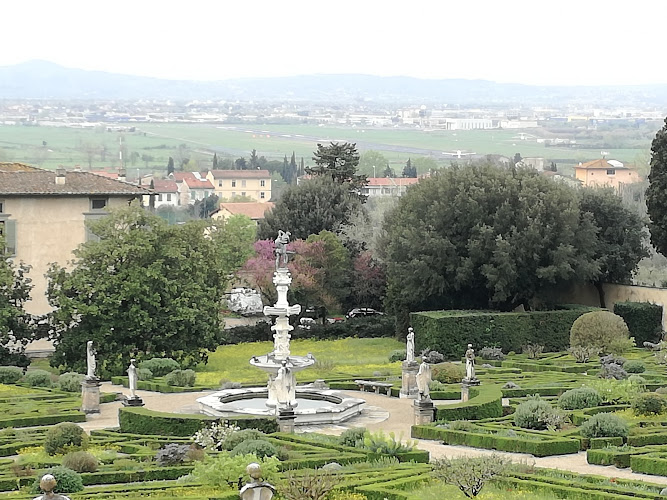
Villa di Castello is a Medici country estate at Via di Castello 44/46, 50141 Florence, in the Castello neighborhood northwest of the historic center. Purchased by the Medici in 1477, it acquired its influential Renaissance garden under Cosimo I, who commissioned Niccolò Tribolo from 1538. Travelers come for geometrical planting, citrus collections, sculptural fountains, and the remarkable Grotto of the Animals—not a conventional tour of furnished palace rooms.
What to Expect at Villa di Castello
The garden belongs to the UNESCO-listed Medici Villas and Gardens in Tuscany. Its axial layout links clipped evergreen compartments, fountains, terraces, and an upper wooded area, making water and topography part of a carefully ordered political landscape. Tribolo’s scheme helped establish the model of the Italian Renaissance garden subsequently developed at Boboli. The villa itself houses the Accademia della Crusca, the institution devoted to Italian language scholarship; ordinary garden admission does not include an unrestricted visit inside.
The most distinctive feature is the Grotta degli Animali, where carved animals gather above elaborate stone basins within a deliberately rocky architectural setting. Its sixteenth-century development involved Giorgio Vasari and Bartolomeo Ammannati following Tribolo’s initial garden project. Elsewhere, the Hercules and Antaeus fountain introduces the Medici taste for mythological imagery, while citrus trees in terracotta pots connect the ornamental garden with centuries of horticultural collecting. Citrus displays change when plants move into winter protection, and grotto access depends on conservation arrangements.
- Grotto of the Animals: Sculpted creatures, textured rockwork, and richly worked basins create the garden’s most unusual ensemble.
- Hercules and Antaeus fountain: A mythological centerpiece associated with Tribolo and Ammannati anchors the formal garden.
- Historic citrus collection: Potted citrus illustrates the Medici fascination with unusual varieties and specialist cultivation.
- Terraced Renaissance layout: Central axes and enclosed planting compartments reveal the garden’s sixteenth-century design principles.
- Upper woodland and January fountain: Ammannati’s figure of January, also associated with the Apennines, provides a contrasting woodland destination.
Villa di Castello at a Glance
| Detail | Information |
|---|---|
| Address | Via di Castello 44/46, 50141 Firenze FI, Italy |
| Neighborhood / Area | Castello, northwestern Florence |
| Operating Hours | Monday, 8:30am–6pm; Tuesday–Sunday closed. Check the official calendar before traveling for seasonal changes and exceptional openings. |
| Admission / Price Range | Free ordinary garden admission; $ budget outing. Check arrangements for special guided access. |
| Recommended Visit Duration | 60 to 90 minutes |
| Nearest Transit / Parking | Firenze Castello regional railway station, approximately 20–25 minutes on foot; limited street parking around Via di Castello. |
| Official Website & Phone | Regional Museums of Tuscany; +39 055 452691 |
Visiting Tips, Getting There & Nearby Pairings
Choose an opening-time arrival for softer light across the formal compartments, particularly in warm weather. Spring and early autumn suit a longer walk; winter changes the citrus display and can make shaded paths damp. Check the official museum calendar before making this suburban journey, especially if the grotto is your priority. Start with the lower formal garden, continue toward the grotto, then tackle the upper woodland if conditions and mobility allow. Do not plan around an on-site café or a guaranteed guided tour.
Regional trains on the Florence–Prato corridor stop at Firenze Castello; check individual services through Trenitalia. The final walk uses neighborhood streets rather than a continuous garden path. Drivers should allow time to find a legal street space and avoid obstructing residential entrances. Gravel, gradients, and steps between garden levels make this a partially accessible landscape rather than a uniformly step-free circuit; discuss the entrance and practicable route by telephone before bringing a wheelchair. Pair the garden with Villa Corsini a Castello, roughly five minutes away, or Villa La Petraia, around 10–15 minutes uphill; both have separate opening arrangements.
Frequently Asked Questions
What are the opening hours and best arrival time?
The published schedule lists Monday, 8:30am–6pm, with closure Tuesday–Sunday. Verify your date on the official calendar and aim for opening, particularly during summer heat.
Is admission free, and should I reserve?
Ordinary garden admission is free. Special visits and access to sensitive areas can follow separate arrangements, so ask specifically about the grotto rather than assuming every feature is accessible.
How much time should I allow?
Allow 60–90 minutes for the formal garden, fountains, and upper woodland. Add walking time from the station and a separate visit allowance for La Petraia or Villa Corsini.
Is the garden suitable for wheelchairs and families?
Families can enjoy the animal sculptures and open-air setting, but children need supervision near basins and terrace edges. Wheelchairs and strollers encounter gravel, slopes, and stepped connections; confirm a suitable route before arrival.
When planning your Florence travel guide or comparing verified attractions and parks in Florence, pair this stop with standout local spots including Tivoli Palazzo Gaddi Firenze Hotel, La Divina Pizza, Terzo Giardino, and University of Florence – Museum of Pathological Anatomy (1.9 km away).