
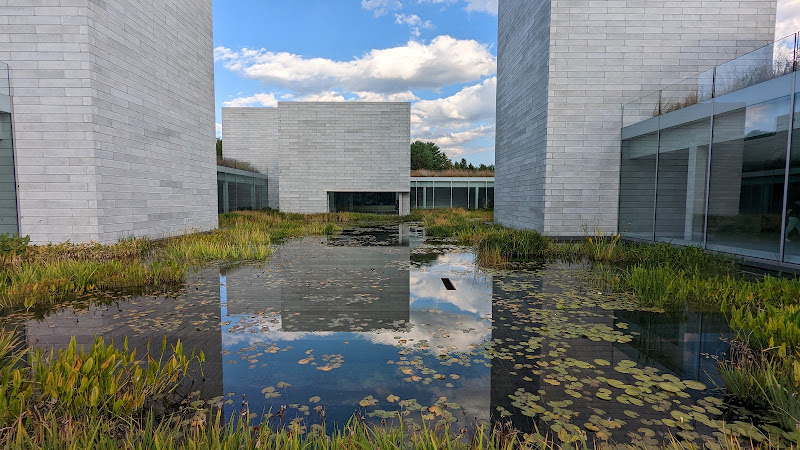
Glenstone is a nearly 300-acre museum of modern and contemporary art at 12100 Glen Road in Potomac, Maryland, founded by Mitchell and Emily Wei Rales in 2006 to unite post-World War II art, museum architecture, and restored rolling landscape into a single contemplative experience. Holding an average visitor rating of 4.8 out of 5 stars across more than 1,890 verified reviews, it ranks among the top-rated points of interest in Potomac, Maryland. Current hours, seasonal schedules, and visitor guidelines are maintained on the official Glenstone website.
Unlike crowded urban museums where visitors rush past ratusan canvases in an hour, Glenstone intentionally caps hourly admission so guests encounter monumental sculptures, single-artist architectural rooms, and organic meadows in near-silence. Following a major 2018 expansion designed by Thomas Phifer and Partners, the campus now encompasses two primary museum buildings—The Gallery and The Pavilions—connected by miles of gravel and boardwalk trails winding past outdoor masterworks by Jeff Koons, Richard Serra, Michael Heizer, Andy Goldsworthy, and Ellsworth Kelly.
Key Takeaways & Quick Visitor Highlights
- The Pavilions (2018): A 204,000-square-foot complex of cast-concrete cubes designed by Thomas Phifer and Partners, arranged around an 18,000-square-foot central Water Court filled with aquatic iris and water lilies.
- Single-Artist Permanent Rooms: Dedicated architectural installations created for Robert Gober, Charles Ray, Cy Twombly, On Kawara, Brice Marden, Michael Heizer, and Pipilotti Rist.
- Jeff Koons’ Split-Rocker: A towering 37-foot outdoor topiary sculpture planted with more than 50,000 live flowering plants that bloom from May through October.
- Richard Serra’s Four Rounds: Equal Weight, Unequal Measure (2017) housed in its own custom-built octagonal concrete pavilion along the woodland trail.
- The Gallery (2006): The original 30,000-square-foot stone, zinc, and teak museum building designed by Charles Gwathmey of Gwathmey Siegel & Associates.
- Always-Free Admission & Sustainable Dining: Free timed entry for all visitors age 12 and older, plus seasonal locally sourced fare at The Cafe and The Patio.
Inside The Pavilions, The Gallery & Single-Artist Installations
Your visit begins at the cedar-clad Arrival Hall, where a tree-lined meadow path leads 10 minutes uphill to The Pavilions. Designed by architect Thomas Phifer and constructed from stacked six-foot-long blocks of poured-in-place gray concrete, The Pavilions encloses a lush, open-air Water Court whose surface shifts with the sky and seasons. Glass-walled corridors surround the pool, offering quiet transitions between 11 distinct exhibition rooms lit almost entirely by calibrated natural skylights.
Whereas most museums group works by movement or decade, several rooms in The Pavilions are permanently dedicated to a single artist’s vision. You will step into Cy Twombly’s monumental acrylic suites, Brice Marden’s Moss Sutra with the Seasons, On Kawara’s Today Series date paintings, and Michael Heizer’s sunken outdoor earthwork Collapse, while the largest changing gallery hosts rotating thematic surveys pulled from Glenstone’s 1,300-work post-World War II collection.
Across the stream valley stands The Gallery, the original 2006 museum building designed by Charles Gwathmey, which presents focused thematic exhibitions and overlooks an outdoor reflection pond anchored by Auguste Rodin and Ellsworth Kelly sculptures.
Walking the Outdoor Sculpture Trail & Landscape
Landscape architect Adam Greenspan of PWP Landscape Architecture transformed nearly 300 acres of former fox-hunting pasture into an organic sanctuary planted with over 8,000 native oaks, maples, redbuds, and sycamores. Along the gravel paths and timber boardwalks, outdoor sculptures emerge from the hills rather than sitting on formal pedestals.
Highlights along the loop include Jeff Koons’ 37-foot Split-Rocker (half pony, half dinosaur rockers fused together and covered in 50,000 live petunias, begonias, and geraniums during warm months), Michael Heizer’s 248-foot earth-carved Compression Line, Tony Smith’s geometric black steel Smog, Félix González-Torres’ twin circular pools Untitled (Toronto), and Andy Goldsworthy’s three fieldstone Clay Houses. Do not miss Janet Cardiff and George Bures Miller’s Forest (for a thousand years…), a 28-minute spatial sound installation hidden in a woodland clearing where dozens of concealed speakers create an uncanny acoustic narrative among the trees.
How to Book Free Glenstone Tickets & Walk-In Entry Rules
Admission to Glenstone and on-site parking are always free, but advance timed-entry reservations are required for most drivers and fill rapidly. New blocks of tickets are released on the 1st of every month at 10:00 AM Eastern Time on glenstone.org for visits two months out (for example, on November 1 at 10:00 AM, tickets open for January). Note that due to the fragility of unguarded open-floor artworks, all visitors must be at least 12 years of age, and children ages 12 to 17 must be accompanied by an adult.
If your desired date is sold out online, you can still enter Glenstone guaranteed without a reservation in four ways: 1) Ride the Montgomery County Ride On Bus Route 301 from Rockville Metro Station (Red Line), which stops directly inside the Glenstone campus every 30–40 minutes; 2) Show a valid student ID (age 12+); 3) Show a valid school educator or museum professional ID; or 4) Show an active-duty military ID (plus up to 5 family members age 12+).
Glenstone: Visitor Information, Hours & Planning Summary
| Visitor Detail | Verified Information (Glenstone) |
|---|---|
| Official Address | 12100 Glen Rd, Potomac, MD 20854 |
| City & Neighborhood | Potomac, Maryland — Potomac, Maryland (15 miles northwest of Washington, D.C.) |
| Operating Hours | Thursday–Sunday 10:00 AM–5:00 PM; Closed Monday–Wednesday |
| Recommended Duration | 3 to 4.5 hours |
| Admission / Pricing | Always Free (timed-entry reservations released on the 1st of each month at 10:00 AM ET; guaranteed entry for Ride On Bus 301 passengers, students, educators & active military) |
| Visitor Rating | 4.8 / 5.0 (1,890 reviews) |
| Phone Contact | +1 301-983-5001 |
| Official Website | https://www.glenstone.org/ |
Glenstone Highlights & Experience Comparison
| Campus Space | Architect / Designer | Must-See Artworks & Features | Photography Policy |
|---|---|---|---|
| The Pavilions | Thomas Phifer and Partners (2018) | 18,000-sq-ft Water Court, single-artist rooms (Twombly, Gober, Ray, Heizer) | No indoor photography permitted (phones silenced) |
| The Gallery | Gwathmey Siegel & Associates (2006) | Rotating thematic exhibitions from the post-WWII collection | No indoor photography permitted |
| Outdoor Sculpture Trail | PWP Landscape Architecture | Jeff Koons Split-Rocker, Andy Goldsworthy Clay Houses, Janet Cardiff sound forest | Personal handheld phone/camera photos allowed outdoors |
| Four Rounds Pavilion | Thomas Phifer / Richard Serra | Richard Serra’s Four Rounds: Equal Weight, Unequal Measure (four forged steel cylinders) | No indoor photography permitted |
| The Cafe & The Patio | Thomas Phifer and Partners | Woodland-facing glass dining room and seasonal soup/salad/sandwich patio | Open Thu–Sun during museum hours |
Frequently Asked Questions About Glenstone
How much do tickets to Glenstone Museum cost and when are they released?
Admission and parking at Glenstone are completely free. Timed-entry tickets are released on the 1st of each month at 10:00 AM ET on glenstone.org. Walk-in entry without a reservation is guaranteed for students (12+), educators, active-duty military, and passengers arriving via Ride On Bus 301.
Why does Glenstone have a minimum age requirement of 12?
Because most sculptures and paintings at Glenstone are displayed in open architectural spaces without glass barriers, ropes, or stanchions, the museum enforces a strict minimum visitor age of 12 years old (including infants in carriers) to protect the art and preserve a quiet environment.
Can you take photos inside Glenstone Museum?
Personal handheld photography is permitted outdoors across the 300-acre landscape and sculpture trails (including at Jeff Koons’ Split-Rocker), but photography and video recording are strictly prohibited inside all indoor exhibition buildings, including The Pavilions and The Gallery.
How much walking is required during a visit to Glenstone?
Expect to walk between 2 and 3.5 miles across gently rolling hills, gravel paths, and stone floors during a typical 3- to 4-hour visit. Wear comfortable closed-toe walking shoes; accessible shuttles and wheelchairs are available free of charge upon request from any gray-uniformed guide.
When is Jeff Koons’ Split-Rocker in bloom at Glenstone?
The 50,000 live flowering plants on Jeff Koons’ 37-foot Split-Rocker sculpture are planted each spring and remain in full bloom from May through October before being removed for winter dormancy from November through April.
What are the dining options at Glenstone?
Glenstone operates two on-site dining venues—The Cafe (located along the woodland path near The Gallery) and The Patio (adjacent to the Arrival Hall)—serving seasonal soups, salads, sandwiches, pastries, coffee, beer, and wine made with organic local ingredients. Outside food and picnics are not permitted.
Editorial & Visitor Information Last Verified: . Always confirm seasonal holiday hours, special event closures, and current ticket pricing directly via the official Glenstone website before travelling to 12100 Glen Rd, Potomac, MD 20854.
When planning your Germantown travel guide or comparing verified attractions and museums in Germantown, pair this stop with standout local spots including Stoney River Steakhouse and Grill, MISSION BBQ, Ridge Road Recreational Park, and Seneca Creek State Park (8.8 km away).


