
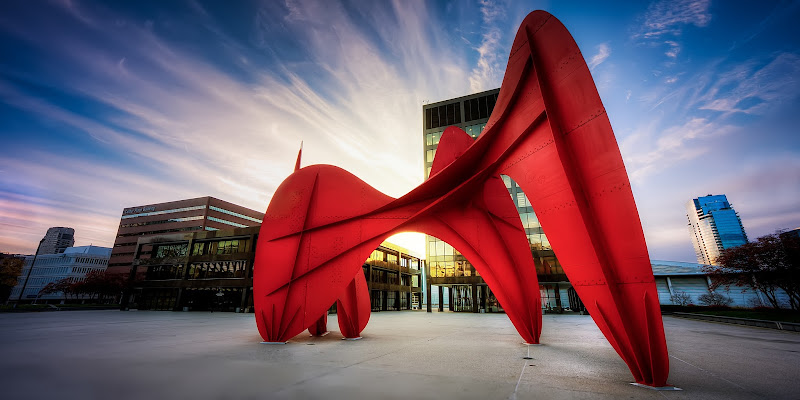
La Grande Vitesse is Alexander Calder’s monumental, vermilion-red abstract steel sculpture in Calder Plaza at 300 Ottawa Avenue NW, downtown Grand Rapids, Michigan 49503, beside City Hall and the Kent County complex. Installed in 1969 after a City of Grand Rapids commission, this 43-ton work is a defining piece of American public art and an essential stop for architecture, photography, and Calder fans.
What to Expect at La Grande Vitesse
Meaning “The Great Swiftness,” La Grande Vitesse is an open, walk-around sculpture rather than a museum with enclosed galleries. Calder composed its sweeping plates, cutouts, and arching legs to change shape as viewers move through the plaza. Its intense red painted-steel surface contrasts sharply with the pale stone, glass, and concrete of the surrounding civic buildings; from some angles, the negative spaces frame City Hall, sky, and passing downtown traffic.
The sculpture was the first major public artwork commissioned for Grand Rapids’ civic center and helped establish the city’s long-running commitment to public art. It was dedicated in 1969 and is widely associated with the civic identity of Grand Rapids. Plan to circle it slowly, looking through the oval and triangular openings and stepping back to take in its 54-foot height and roughly 43-foot span. Calder Plaza is also a working event space, hosting festivals, demonstrations, and seasonal programming, so the setting can feel either calm or distinctly urban.
- Alexander Calder sculpture: The landmark 1969 stabile is formed from bolted and welded steel plates painted Calder’s signature red.
- Changing sightlines: Walk all the way around the work to see its fins, arches, and cutout voids align differently against downtown buildings.
- Calder Plaza setting: The broad civic plaza places the sculpture between Grand Rapids City Hall and county-government architecture.
- Public-art history: The commission marked a pivotal early investment in monumental public art by the City of Grand Rapids.
- Photography stop: Wide angles from the plaza edges capture the sculpture’s full scale; closer views emphasize its industrial joints and painted planes.
La Grande Vitesse at a Glance
| Detail | Information |
|---|---|
| Address | Calder Plaza, 300 Ottawa Avenue NW, Grand Rapids, MI 49503 |
| Neighborhood / Area | Downtown Grand Rapids civic center, near Monroe Center |
| Operating Hours | Outdoor plaza generally accessible 24 hours daily; event setups or security operations can limit access. |
| Admission / Price Range | Free public artwork; no ticket required. |
| Recommended Visit Duration | 20 to 40 minutes; allow longer when pairing it with nearby downtown sights. |
| Nearest Transit / Parking | The Rapid downtown service and stops around Ottawa and Monroe are nearby; Government Center Ramp is adjacent to the plaza. |
| Official Website & Phone | City of Grand Rapids; 616-456-3000 |
Visiting Tips, Getting There & Nearby Pairings
Visit in early morning for cleaner photographs and fewer pedestrians, or near dusk when the red steel stands out against a changing sky. There are no timed tickets, guided tours, bag checks, indoor galleries, café, or museum shop: this is public art experienced independently and at your own pace. Photography is a natural part of a plaza visit, but keep clear of barricades and production areas during civic events. The work is outdoors, so dress for West Michigan weather and take extra care on wet or icy pavement.
Calder Plaza is reached easily on foot from central downtown and by The Rapid’s downtown transit connections; check current stop locations and detours through the Rapid before traveling. The adjacent Government Center Ramp is the most convenient paid parking option. The main plaza routes are broad, paved, and generally step-free, making the sculpture viewable from wheelchair and stroller height, though crowding and temporary event fencing can alter circulation. Pair the stop with Rosa Parks Circle, about five minutes south; the restaurants and bars around Monroe Center and Ionia Avenue, roughly five to ten minutes away; or the Grand Rapids Public Museum across the Grand River, around a 12-minute walk.
Frequently Asked Questions
When is La Grande Vitesse open, and what is the best time to visit?
Because it stands in a public outdoor plaza, La Grande Vitesse can generally be viewed at any hour. Early morning is best for unobstructed photos, while daylight provides the clearest view of Calder’s plate construction; confirm access if a festival or civic event is scheduled in Calder Plaza.
Does La Grande Vitesse charge admission or require reservations?
No. Viewing the sculpture is free, and there are no reservations, timed entries, or standard guided-tour tickets. Parking in the nearby Government Center Ramp is paid, and event-day parking availability may vary.
How much time should I budget for the sculpture?
Budget 20 to 40 minutes to walk the plaza, study the work from several angles, and photograph it. Give yourself 90 minutes or more if combining it with Rosa Parks Circle, Monroe Center, or a walk toward the Grand River.
Is La Grande Vitesse accessible and suitable for families?
Yes. The open paved plaza offers generally step-free viewing and enough space for wheelchairs, strollers, and children to appreciate the sculpture’s scale. It is not a climbing structure, and caregivers should keep children close around streets, event equipment, and any temporary barriers.
When planning your Grand Rapids travel guide or browsing verified attractions in Grand Rapids, pair this stop with standout local spots including The Finnley Hotel, Engine House, San Chez A Tapas Bistro, and Homewood Suites by Hilton Grand Rapids Downtown (0.3 km away).


