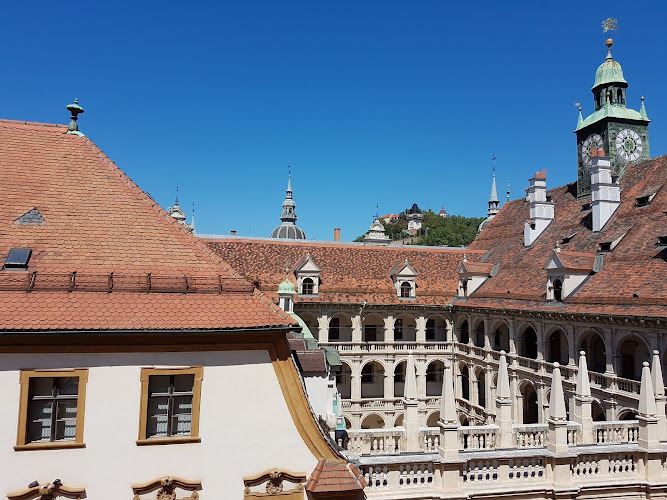
Old Town Of Graz is the UNESCO-listed historic centre of Graz, mapped at Badgasse 3, 8010 Graz, in the Innere Stadt district of Graz, Austria. Developed beneath the fortified Schlossberg from the Middle Ages onward, this compact quarter preserves Gothic, Renaissance, Baroque and 19th-century streetscapes rather than a single enclosed attraction. Travelers come to walk its cobbled lanes, stand in the ceremonial Hauptplatz, see arcaded courtyards and climb or look up toward the city’s landmark hill.
What to Expect at Old Town Of Graz
Begin at Hauptplatz, the broad central square framed by the 19th-century Rathaus and a fountain of Archduke Johann. From here, Herrengasse runs south through the commercial spine of the old town, where façades reveal medieval plots behind later Baroque and Historicist fronts. Turn into Landhausgasse for the Landhaus, a 16th-century Renaissance complex with a three-storey arcaded courtyard, then continue to Glockenspielplatz for the mechanical carillon figures that appear at its scheduled daily performances.
The most rewarding route links Hauptplatz with Franziskanerplatz, Mehlplatz, Färberplatz, Sporgasse and the cathedral quarter. Graz Cathedral retains its late-Gothic exterior, while the nearby Mausoleum of Emperor Ferdinand II is one of the city’s major early-Baroque monuments. In Graz Castle, look for the celebrated double spiral staircase: two stone flights rise separately, meet, and separate again. The old town also contains the Styrian Armoury, whose four floors hold about 32,000 historic weapons and suits of armour; it is a separate museum with its own opening times and admission.
- Hauptplatz: Graz’s civic square, with the Rathaus, Archduke Johann Fountain and direct access to Herrengasse.
- Landhaus courtyard: A refined Italian Renaissance arcaded court designed in the 16th century.
- Sporgasse and Glockenspielplatz: Narrow historic lanes, merchant-house façades and the animated Glockenspiel.
- Cathedral quarter: Graz Cathedral, the Mausoleum and the unusual double spiral staircase in Graz Castle.
- Schlossberg outlooks: The Clock Tower and hilltop paths rise immediately above the old-town roofs.
Old Town Of Graz at a Glance
| Detail | Information |
|---|---|
| Address | Badgasse 3, 8010 Graz, Austria |
| Neighborhood / Area | Innere Stadt, the historic centre below Schlossberg |
| Operating Hours | Public streets and squares are accessible 24 hours daily; churches, museums and courtyards keep separate hours. |
| Admission & Ticket Prices | Free public admission to the old town. Museums, the Schlossberg funicular and individual interiors charge separately; check the official city website before visiting. |
| Recommended Visit Duration | 2 to 3 hours for the core walk; allow half a day with the Armoury, cathedral quarter or Schlossberg. |
| Nearest Transit / Parking | Hauptplatz/Congress tram stop; Parkgarage Pfauengarten is a short walk away. |
| Official Website / Phone | graz.at / +43 316 80750 |
Visiting Tips, Getting There & Nearby Pairings
Arrive early, ideally before 9am, for quieter photographs around Hauptplatz, Landhausgasse and Sporgasse; the lanes become livelier from late morning through the afternoon. The centre itself needs no ticket or reservation, so save advance planning for timed museums and the Schlossberg funicular. Hauptplatz/Congress is the most convenient tram stop, served by several central Graz routes; from there, Hauptplatz and Herrengasse are immediately at hand. Drivers should use a central garage rather than expect street parking in the pedestrian-focused core.
Old Town Of Graz is workable with a wheelchair or stroller, but it is not uniformly smooth: cobbles, narrow passages, kerbs and the steep Schlossberg create uneven conditions. Stay on principal streets such as Herrengasse and use the city’s barrier-free map to locate step-free routes and accessible public toilets. Pair the walk with Schlossberg’s Clock Tower, around 10 to 15 minutes uphill or via funicular, or cross the Mur to the Kunsthaus Graz and Murinsel in about 10 minutes. For a meal or coffee, the terraces around Mehlplatz, Färberplatz and Franziskanerplatz are all within a five-minute walk.
Frequently Asked Questions
What are the hours and best time to visit Old Town Of Graz?
The streets and public squares are open around the clock. Go early in the morning for calmer lanes and clearer views of the façades, or in the evening for dining and an illuminated Hauptplatz. Museum, church and courtyard access follows each site’s own timetable.
Does Old Town Of Graz require tickets or reservations?
No ticket or reservation is needed to walk the historic centre. The Styrian Armoury, Schlossberg funicular and some interiors are separately managed paid experiences, so reserve or verify opening arrangements directly with the relevant attraction during busy periods.
How much time should I budget for the old town?
Allow two to three hours for Hauptplatz, Herrengasse, Landhaus, Glockenspielplatz, Sporgasse and the cathedral quarter. Plan four to five hours if you add the Styrian Armoury, lunch in the old town and a Schlossberg ascent.
Is Old Town Of Graz suitable for families and wheelchair users?
Families can comfortably explore the traffic-restricted central streets, with the Glockenspiel and Schlossberg particularly appealing for children. Wheelchair users should plan a route on smoother main streets and consult Graz’s barrier-free city map, as many side lanes are cobbled and Schlossberg is steep.
When planning your Graz travel guide or browsing verified attractions in Graz, pair this stop with standout local spots including Styrian Armory, Herzl Weinstube, Hotel Mercure Graz City, and Main Square Of Graz (nearby).