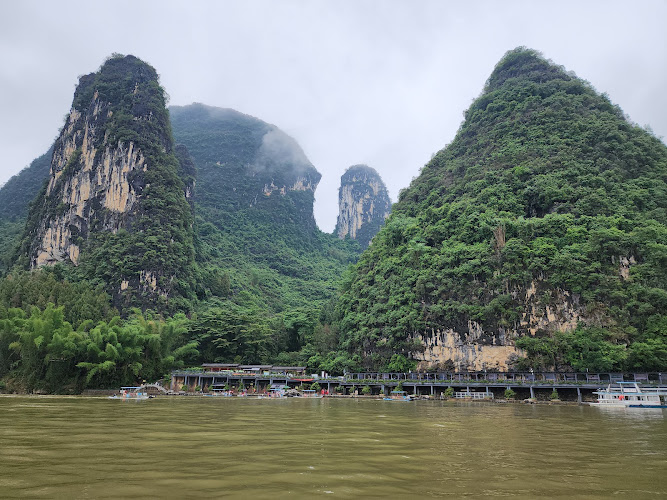
Lijiang, or the Li River, is the limestone-framed river running through Guilin in Guangxi, China—not Lijiang city in Yunnan. Its lower-river locality is Pingle County, Guilin, Guangxi 542400; this natural waterway has no single street address or neighborhood entrance. Travelers primarily visit the celebrated Guilin–Yangshuo stretch upstream for boat journeys past tower karst, bamboo-lined banks, and farming villages. These landscapes have shaped Chinese painting and poetry for centuries, and the river near Xingping appears on the reverse of China’s 20-yuan banknote.
What to Expect at Lijiang
The classic sightseeing corridor extends roughly 83 kilometers between Guilin and Yangshuo. Full-length cruises depart from Mopanshan or Zhujiang wharves, outside central Guilin, and travel downstream between steep limestone towers formed through long-term dissolution and erosion. Boats offer seated viewing and outdoor decks, with facilities varying by vessel class. This is a moving landscape rather than a park with one gate: river bends repeatedly reveal new arrangements of cliffs, sandbars, orchards, and waterfront settlements.
The most recognizable scenery lies around Yangdi and Xingping. Nine Horse Fresco Hill presents a sheer, patterned rock face where visitors look for horse-like shapes; Yellow Cloth Shoal is associated with reflections in calmer water. Motorized sightseeing rafts operate on designated shorter sections and are distinct from the quieter bamboo-raft experiences on Yangshuo’s Yulong River. Farther downstream, Pingle marks the meeting of the Li, Gongcheng, and Lipu rivers, beyond the main postcard cruise corridor. Do not travel to Pingle expecting the standard Guilin departure piers.
- Nine Horse Fresco Hill: A limestone cliff whose contrasting rock markings inspire the traditional horse-counting game.
- Yellow Cloth Shoal: A celebrated reach for mountain reflections when river conditions are calm.
- Xingping’s banknote landscape: The clustered peaks associated with the 20-yuan note, seen around the town’s riverfront.
- Full-length river cruise: The Mopanshan or Zhujiang–Yangshuo route links successive karst formations without changing boats.
- Seasonal river scenery: Spring mist softens the peaks; autumn often offers clearer outlines and more comfortable outdoor viewing.
Lijiang at a Glance
| Detail | Information |
|---|---|
| Address | Li River, Pingle County, Guilin, Guangxi 542400, China; cruise boarding is at separately designated wharves. |
| Neighborhood / Area | Guilin–Yangshuo–Pingle river corridor; principal sightseeing reaches around Yangdi and Xingping. |
| Operating Hours | River viewpoints: daylight visits recommended daily. Full-length cruises generally depart in the morning; departures follow the booked sailing schedule. |
| Admission / Price Range | Public riverbank viewing is generally free; cruises and rafts require paid tickets. Typical cruise tier: $$; fares vary by vessel and route. |
| Recommended Visit Duration | 4 to 5 hours aboard a full cruise; allow a full day with transfers. |
| Nearest Transit / Parking | Road transfers to Mopanshan or Zhujiang; Yangshuo railway station is near Xingping. Wharf vehicle areas accommodate drop-offs and managed parking. |
| Official Website & Phone | Li River Scenic Area official website; use the contact number attached to your booked sailing. |
Visiting Tips, Getting There & Nearby Pairings
Reserve the official river route ahead for weekends and Chinese public holidays, checking the departure wharf, vessel class, meal inclusions, and return transport. Arrive at the booked check-in time with your passport. Mopanshan and Zhujiang are reached by road, typically around 45–60 minutes from central Guilin depending on traffic; no metro serves them. A hotel-arranged transfer or taxi is simpler than piecing together local buses. Self-driving requires planning because the cruise ends downstream, not beside your parked car. Heavy rain, high water, or low water can alter operations.
For a shorter outing, base yourself in Xingping: its old street, waterfront, and riverbank banknote-viewing area can be linked on foot, with individual legs of roughly 5–15 minutes depending on your landing point. These are upstream pairings, not walks from Pingle. Waterfront paving gives way to steps, uneven edges, and sloping landing ramps; changing water levels affect boarding gradients. Confirm wheelchair boarding and accessible toilets before paying, since upper decks commonly require stairs. Carry sun protection and water, use toilets at larger terminals or aboard equipped cruise boats, and avoid swimming in the navigation channel.
Frequently Asked Questions
When is Lijiang open, and when should I visit?
The river has no universal opening hours, but cruises run to scheduled departures, usually in the morning. Spring brings mist and rain; autumn is often comfortable for deck viewing and riverside walks.
Is admission free, and do cruises need reservations?
Many public riverbank viewpoints are free, while boat excursions are paid. Reserve cruises ahead and compare route, vessel class, transfers, and meal inclusions through the official booking service.
How much time should I budget?
Allow a full day for a Guilin–Yangshuo cruise, including terminal transfers and onward travel. A Xingping waterfront visit with a shorter boat excursion can fit into half a day.
Is the river suitable for families and wheelchair users?
Larger cruise boats generally offer a more practical family outing than small rafts, which have operator-specific passenger restrictions. Wheelchair users should arrange boarding assistance in advance and confirm step-free access to seating and toilets on the particular vessel.
When planning your Guilin travel guide or browsing verified attractions in Guilin, pair this stop with standout local spots including Yangshuo Mountain Nest Boutique Hotel, Sugarhouse, Cobani Gyro & Kebab, and Yangshuo Resort (16.2 km away).