
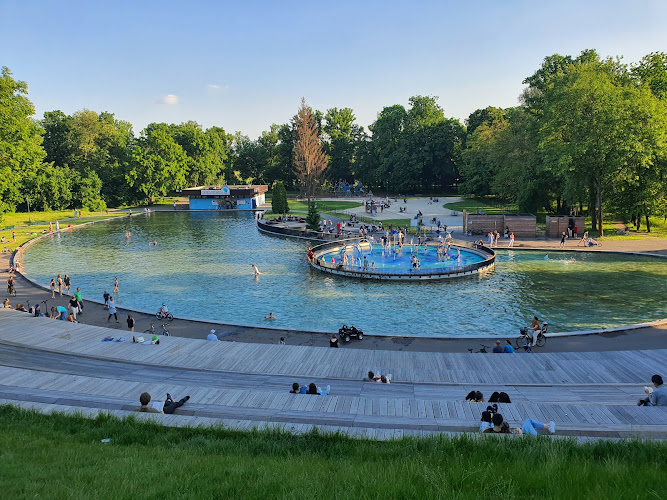
Henryk Jordan Park is Kraków’s historic public recreation park: a generous sweep of English-style greenery where shaded paths, children’s play spaces, sports courts and avenues of Polish commemorative busts share the same grounds. Founded in 1889 through the initiative of physician Henryk Jordan, it was conceived not simply as a decorative garden but as a place for outdoor exercise, learning and healthy play.
The park sits in Krowodrza’s university-facing quarter, immediately north of the wide Błonia meadow and west of the Old Town’s denser streets. Mature deciduous trees and lawns make it feel calmer than the surrounding city arteries, yet it remains an active neighborhood park rather than a museum piece. Families, walkers, runners and court users give it an easygoing local rhythm throughout the day.
Standout Highlights & What Not to Miss
Give yourself permission to wander rather than treating the park as a direct route between sights. Its appeal lies in the combination of historical markers and everyday recreation: one path may lead from a patriotic bust to a playground, a pond or a lively game on the courts. The following are the details most worth seeking out.
- The commemorative bust avenues: Follow the sculptures for a compact introduction to figures celebrated in Polish culture and science, including Nicolaus Copernicus, Adam Mickiewicz and Frédéric Chopin. They give the landscape an unusually strong historical thread.
- The Henryk Jordan memorial: Look for the tribute to the physician whose ideas about supervised outdoor activity for children shaped the original purpose of the grounds.
- Children’s recreation areas: The park’s founding mission is still visible in its play-focused character. This is a particularly useful break for families after more formal sightseeing in central Kraków.
- Courts and active spaces: Basketball and volleyball facilities lend the park an energetic, lived-in feel. Even visitors not playing can enjoy the contrast with Kraków’s historic-core promenades.
- The pond and tree shade: Pause beside the small pond or take a slower loop beneath the mature canopy. These quieter corners are best appreciated away from the busiest play areas.
Visitor Strategy & Planning Snapshot
| Planning Factor | What to Expect | Practical Strategy |
|---|---|---|
| Ideal Arrival Window | Mornings tend to suit a quieter historical walk; later in the day the recreational areas can feel more animated. | Arrive early for photographs of the busts and leafy paths, or come later if you want to see the park at its most local and active. |
| Typical Time Needed | A relaxed circuit, the busts and a pause by the pond usually fit comfortably into a short visit. | Allow 1 to 2 hours; add time if children will use the playgrounds or if you are pairing the park with Błonia. |
| Booking / Queue Reality | The grounds work primarily as an open public park, not a timed-ticket attraction. Recreation facilities may have their own patterns of use. | There is no need to build your day around a formal entry slot; simply keep expectations flexible around popular play and court areas. |
| Terrain & Accessibility | Broad main paths and generally level ground are welcoming for wheelchairs and strollers, while smaller routes can have gravel or uneven edges. | Stay on the wider paths for the smoothest circuit, particularly after wet weather, and treat side trails as optional rather than essential. |
| Weather / Seasonal Fit | Leafy months emphasize shade and outdoor play; cooler months reveal more of the park’s layout and sculpture lines. | Use it as a green-weather break from the center, but bring layers and rain protection when conditions are unsettled. |
Honest Trade-Offs: Best For vs. Who Might Skip
Henryk Jordan Park is best for families with young children, recreational walkers, outdoor sports enthusiasts and visitors interested in the civic history behind Polish memorial culture. It offers a welcome change of pace from Kraków’s churches, galleries and packed medieval streets, with enough historical detail to reward an attentive stroll. It is also a practical choice when different members of a group want different things: a child can play while another visitor looks for the busts or rests under the trees. The trade-off is that this is a functioning urban park, not a manicured show garden or a major monument with a single dramatic centerpiece. Those seeking dense architectural sightseeing, highly curated interpretation, guaranteed quiet, or a destination devoted to formal gardens may prefer to keep this as a secondary stop. The experience is strongest when approached as an atmospheric, locally used landscape with history embedded in it.
Neighborhood Context & How to Pair Your Visit
Build a walk around the park and Błonia, the vast open meadow directly to its south, for one of Kraków’s most spacious urban outings. Start with the park’s memorial avenues, continue through its shady interior and then step out to the broad views and open sky of Błonia; together they balance sculpture, recreation and landscape. From there, the university-side streets make a natural transition toward the city center, while the nearby National Museum area can suit travelers who want to add art or Polish cultural history to the day. Keep the route unhurried: this is an excellent place for a picnic-style pause or a reset between indoor attractions, rather than a stop to rush through. Its walkable setting also makes it easy to tailor the outing to energy levels, whether that means a brief pond-and-bust loop or a longer promenade continuing along Błonia.
When planning your Krakow travel guide or comparing verified attractions and parks in Krakow, pair this stop with standout local spots including Father Bernatek’s Bridge, Bielańsko-Tyniecki Landscape Park, Adam Mickiewicz Monument, Kraków, and National Museum in Kraków (0.6 km away).


