
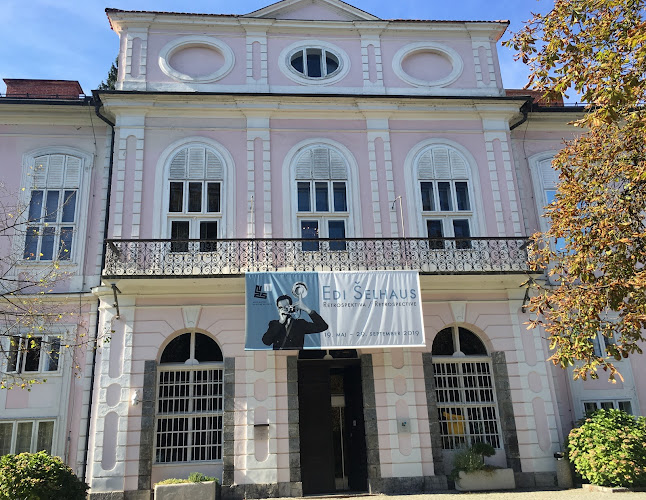
The National Museum of Contemporary History (Muzej novejše zgodovine Slovenije) is a history museum at Celovška cesta 23, 1000 Ljubljana, set inside Cekin Castle (Cekinov grad) on the edge of Tivoli Park. The mansion dates to the 18th century and has housed the museum’s collections since 1952, when the institution was founded as a museum of the national liberation struggle. Today it tells the story of Slovenia in the 20th and 21st centuries through original objects, personal testimony and large-scale installations, and travelers come to understand how a small Alpine nation passed through two world wars, Yugoslavia and independence in 1991.
What to Expect at National Museum of Contemporary History
The museum’s guiding line is “we tell stories about Slovenian history of the 20th and 21st centuries,” and the approach is human-scale rather than purely chronological. Exhibitions combine documents, uniforms, posters, photographs, film and recorded voices, with oral history playing a central role: visitors hear from people who lived through occupation, partisan resistance, postwar upheaval, socialist everyday life and the Ten-Day War of 1991. Galleries are arranged across the upper floors of the castle, and the building’s floor plan is published on the museum website, which helps in planning a route.
The collection is also known for individual objects that carry unusual stories. The museum’s “famous objects” section features a wartime Enigma cipher machine, a hand-painted tarok card deck made by the artist Boris Kobe during his imprisonment in a concentration camp, and the dagger associated with General Leon Rupnik, the wartime collaborationist. Art forms a thread through the displays too, from propaganda posters and political graphics to works created in captivity. A museum shop sells books, catalogues and Slovenian souvenirs, and the in-house library supports researchers.
- Oral history installations: Recorded testimonies let visitors hear firsthand accounts of war, occupation and the road to independence.
- Enigma cipher machine: One of the featured “famous objects,” it illustrates the role of wartime communications and codebreaking.
- Boris Kobe’s camp tarok deck: A set of playing cards made by an artist-prisoner, a small and affecting piece of resistance art.
- Rupnik’s dagger: A weapon tied to one of the most controversial figures of Slovenian wartime history.
- Cekin Castle itself: The historic mansion, with its Knights’ Hall (Viteška dvorana), is part of the experience and is used for events and rentals.
National Museum of Contemporary History at a Glance
| Detail | Information |
|---|---|
| Address | Celovška cesta 23, 1000 Ljubljana, Slovenia |
| Neighborhood / Area | Edge of Tivoli Park, near the city center |
| Operating Hours | Tuesday to Sunday 10:00 to 18:00; closed Monday |
| Admission / Price Range | Paid admission, $ to $$ tier; current ticket tiers are listed on the museum’s Vstopnice page |
| Recommended Visit Duration | 1.5 to 2.5 hours |
| Nearest Transit / Parking | City bus stops along Celovška cesta; paid street and garage parking in central Ljubljana |
| Official Website & Phone | muzej-nz.si, +386 1 300 96 10 |
Visiting Tips, Getting There & Nearby Pairings
The museum is a short walk or a brief bus ride from central Ljubljana, and Celovška cesta is served by several city bus lines. Arriving at opening on a weekday morning gives the quietest galleries, since school groups tend to book mid-morning slots. Guided tours (Vodstva) can be arranged through the museum, and the website offers an English version, interactive content and a dedicated accessible-museum (Dostopni muzej) section, so check it before you go if you need adapted formats. Because the building is a historic mansion, confirm step-free routes and lift access with the staff on +386 1 300 96 10 when traveling with a wheelchair or stroller. The museum also offers programs for children and families, which makes it workable for older kids with an interest in history.
Pair the visit with Tivoli Park, which begins next to the museum and offers shaded avenues, gardens and open lawns for a post-museum walk. Within roughly 10 to 15 minutes on foot or by bike you can reach the National Museum of Slovenia and the Museum of Modern Art, so a full day of Ljubljana culture is easy to build around this stop.
Frequently Asked Questions
What are the opening hours and best time to visit?
The museum is open Tuesday to Sunday from 10:00 to 18:00 and closed on Mondays. Weekday mornings shortly after opening are generally calmest, while weekends and school-trip hours are busier.
How much do tickets cost and do I need to book?
Admission is paid, in the budget-friendly $ to $$ range, with current adult, concessional and family prices published on the museum’s Vstopnice page at muzej-nz.si. Individual visitors can usually buy at the door; groups and guided tours should be arranged in advance.
How long should I plan for a visit?
Allow 1.5 to 2.5 hours to take in the main exhibitions, the famous objects and the oral history stations. History enthusiasts who listen to the full testimonies may want closer to three hours.
Is the museum accessible and suitable for families?
The museum runs an accessible-museum program and dedicated offerings for children and families, along with a text-size and contrast tool on its website. Because the venue is a historic castle, call ahead to confirm lift access and step-free routes for your needs.
When planning your Ljubljana travel guide or comparing verified attractions and museums in Ljubljana, pair this stop with standout local spots including Računalniški muzej / Slovenian Computer History Museum, AS BOUTIQUE HOTEL, Ljubljana, Central Market, and Tivoli Boutique Inn (0.4 km away).


