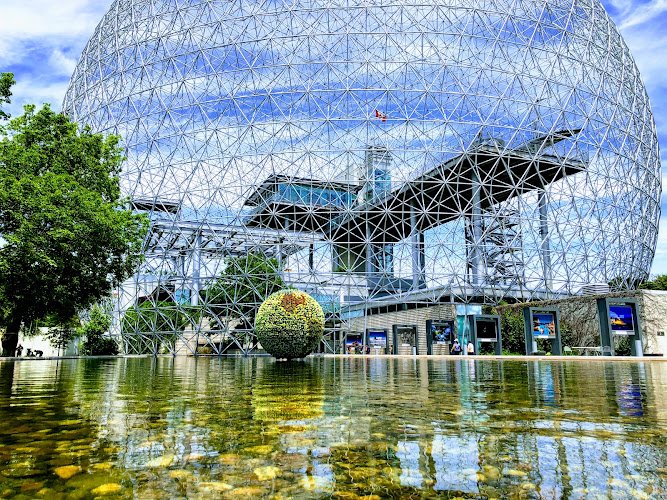
The Biosphere is Montreal’s environment museum, housed inside the most recognizable relic of Expo 67. Buckminster Fuller designed the huge sphere as the United States pavilion, and it now sits on Île Sainte-Hélène in Parc Jean-Drapeau, a short distance across the river from downtown and Old Montreal. Seen from the bridges or the waterfront, it reads as a pale, see-through globe floating above the trees.
What sets it apart is the pairing of landmark architecture with a focused mission: water, climate, biodiversity and sustainable living. With a 4.3 rating from more than 7,500 reviews, it draws design fans, school groups and families. Reviewers like the exhibit presentation and the skyline views, while a few note that the collection is compact rather than encyclopedic.
Standout Highlights & What Not to Miss
Start outside, then work upward. These are the pieces visitors most often single out:
- The geodesic dome itself. Buckminster Fuller’s lattice of steel tubing was built as the American Pavilion for Expo 67. The acrylic skin burned away in a 1976 fire, so today you see the bare skeleton against the sky, and the scale is best appreciated from the lawn outside before you enter.
- The upper observation level. Climb or ride up inside the lattice for views toward the downtown skyline, the St. Lawrence and the Expo-era islands. Walking close to the structure’s ribs gives a feel for Fuller’s engineering that photographs flatten.
- Free lobby displays. The entrance area includes material on the dome’s history and Fuller’s work, so even travelers who skip the paid exhibits get useful context.
- Climate and water exhibits. Interactive models, animations and illustrated panels cover ecology, biodiversity, climate change and the St. Lawrence. Content is bilingual and pitched at general audiences rather than specialists.
- Rotating exhibitions. The museum, part of the Espace pour la vie network, has recently shown group exhibitions on sharing the planet with other species and an Emolab show on climate emotions aimed at families. Check what is on before you go.
- Outdoor photo displays. Large-format exhibitions are sometimes set up on the grounds in front of the dome, free to wander past in good weather.
Visitor Strategy & Planning Snapshot
The museum is small enough to fit into half a day, but timing and tickets make a real difference.
| Planning Factor | What to Expect | Practical Strategy |
|---|---|---|
| Ideal Arrival Window | Weekday mornings are calmer; reviewers report the exhibits feel uncrowded on weekdays, with weekends and school-group days busier. | Arrive near opening, do the exhibits first, then spend the afternoon in the park. |
| Typical Time Needed | About 1.5 to 2 hours inside; add an hour or more for the surrounding grounds. | Families with kids should plan closer to 2-3 hours. Architecture-only visitors can do a 20-minute exterior loop. |
| Booking / Queue Reality | Paid admission with adult, senior, student and child rates on the official ticketing page. Exhibits can reach capacity at certain times. | Buy tickets online ahead, especially in summer and on holidays. A combined Espace pour la vie pass exists if you plan several sites. |
| Terrain & Accessibility | Flat paved paths on the island; the entrance, parking, restrooms and seating are wheelchair accessible, and wheelchair rental is offered. | Expect a 10-minute walk from the metro. Ask staff at the desk about the best route to upper levels if mobility is limited. |
| Weather / Seasonal Fit | The interior is climate-controlled, but the park setting is best in late spring through early fall. | In summer, bring sun protection for the walk. In winter the museum is a warm stop, though the island is windy and quiet. |
Getting there is part of the plan. The Yellow Line metro stops at Jean-Drapeau, followed by a walk of roughly ten minutes through the park, and a seasonal bus and paid parking are also options. Sturdy walking shoes beat sandals, since the island invites wandering.
Honest Trade-Offs: Best For vs. Who Might Skip
The Biosphere suits architecture and engineering enthusiasts, families with school-age children, and travelers who want a skyline view without a tower queue. It also works well for anyone interested in how a city talks about climate and water in an accessible, bilingual format. If you only want the photograph, the exterior and free lobby give you most of that without paying admission.
You might skip the paid exhibits if you expect a large, deep science museum, since the displays are modest in volume and designed for broad audiences. Travelers with only a day in Montreal and no interest in the islands may prefer to spend the time in the Old Port or on the Plateau. Bad weather also reduces the appeal of the grounds, which are a big part of the experience.
Neighborhood Context & How to Pair Your Visit
Although it carries a Ville-Marie address, the Biosphere feels removed from downtown, which is its charm. Pair it with a stroll around Île Sainte-Hélène: the shaded paths, river and skyline overlooks, and remnants of Expo 67 make a natural loop. Within the same park, the Montreal Casino and the Circuit Gilles-Villeneuve sit on neighboring Île Notre-Dame, and the Espace pour la vie sites near the Olympic Stadium can be added on another day using the combined pass.
A sensible half-day runs like this: morning exhibits and the observation level, a picnic or snack-kiosk lunch on the grounds in season, then an easy walk back to the metro. Finish in Old Montreal for dinner, using the skyline you just saw from above as your orientation.
When planning your Montreal travel guide or comparing verified attractions and museums in Montreal, pair this stop with standout local spots including BOUILLON BILK, Hotel Bonaventure Montréal, Sofitel Montreal Golden Mile, and Parc Jean-Drapeau (0.2 km away).