
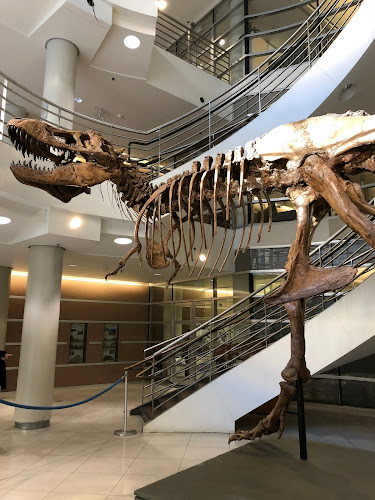
Berkeley Natural History Museums is UC Berkeley’s network of natural-history collections and public fossil displays, centered in the Valley Life Sciences Building at 3101 Valley Life Sciences Bldg, Berkeley, CA 94720, on the west side of the university campus near Downtown Berkeley. Its roots run through landmark campus collections including the University of California Museum of Paleontology, founded in 1874, and Joseph Grinnell’s Museum of Vertebrate Zoology, founded in 1908; travelers come for an accessible introduction to California geology, evolution, plants, insects, and wildlife.
What to Expect at Berkeley Natural History Museums
This is not a single ticketed museum with a prescribed gallery route. Berkeley Natural History Museums connects research institutions including the UC Museum of Paleontology, Museum of Vertebrate Zoology, Essig Museum of Entomology, Jepson Herbarium, and UC Botanical Garden. The public-facing experience is strongest in the Valley Life Sciences Building, where fossil displays turn a working university science building into a rewarding short stop between campus landmarks. Start with the paleontology cases, then follow the displays chronologically to place ancient marine life, dinosaurs, and California’s changing landscapes in context.
The collections behind the scenes are among the site’s real distinction. The Museum of Vertebrate Zoology preserves research specimens of birds, mammals, reptiles, amphibians, and eggs assembled through more than a century of fieldwork, while the Essig Museum documents insect diversity and the Jepson Herbarium holds a major record of California plants. Most study collections are maintained for research rather than casual drop-in viewing, so travelers should approach the visit as a compact self-guided fossil-gallery experience and explore the museums’ official site for public talks, collection access, and special programs. There is no standard audio-guide circuit, café, or dedicated museum shop in the building.
- UC Museum of Paleontology displays: Fossil cases introduce deep time, extinction, evolution, and the changing life of California.
- Vertebrate Zoology legacy: Joseph Grinnell’s 1908 museum anchors a world-renowned record of western North American wildlife.
- Essig Museum of Entomology: The campus insect collection supports study of insects and arthropods, from local species to global diversity.
- Jepson Herbarium: Plant specimens document California flora and underpin botanical research and identification work.
- Valley Life Sciences Building: A functioning campus science building where public displays sit close to laboratories, classrooms, and research collections.
Berkeley Natural History Museums at a Glance
| Detail | Information |
|---|---|
| Address | Valley Life Sciences Bldg, 3101, Berkeley, CA 94720 |
| Neighborhood / Area | UC Berkeley campus, near Downtown Berkeley |
| Operating Hours | Monday–Friday 8am–12pm and 1–5pm; closed Saturday and Sunday |
| Admission / Price Range | Free public displays; no general admission charge |
| Recommended Visit Duration | 45 to 75 minutes |
| Nearest Transit / Parking | Downtown Berkeley BART; AC Transit service on nearby University Avenue and Oxford Street; paid UC parking at Lower Hearst |
| Official Website & Phone | bnhm.berkeley.edu | 510-642-1821 |
Visiting Tips, Getting There & Nearby Pairings
Arrive soon after the 8am opening or after the 1pm reopening, when the building is quieter between classes. Weekday access follows university-building hours, and there is a midday closure from noon to 1pm. No timed ticket is needed for the public displays, but arrange collection research visits, group needs, or program attendance through the official website in advance. Keep bags compact: this is an active academic building without a conventional cloakroom, and galleries are display areas rather than a staffed ticket hall. Personal, non-flash photography of public exhibits is generally the sensible approach; respect any case-specific or event-specific restrictions.
Downtown Berkeley BART is roughly a 10-minute walk south-west of Valley Life Sciences; AC Transit buses along University Avenue and Oxford Street shorten the approach. Drivers should use paid UC Berkeley visitor parking such as Lower Hearst rather than expect unrestricted curbside space near campus. The building’s public floors are connected by elevators, making the indoor display route manageable for wheelchair users and strollers; allow extra time for campus distances and use the accessible building entrance and elevator rather than stairs. Within a 5–15 minute walk, pair the fossils with the Campanile at Sather Tower, Doe Library and Sather Gate, or the Berkeley Art Museum and Pacific Film Archive on Center Street.
Frequently Asked Questions
What are the Berkeley Natural History Museums hours, and when is the best time to go?
Public access is Monday through Friday from 8am to noon and 1pm to 5pm, with weekend closure. Go at opening or just after 1pm to avoid the busiest class-change periods and to leave time for nearby campus sights.
Is there an admission fee or reservation requirement?
The public displays are free, with no standard admission ticket or timed-entry reservation. Specialized collection access and scheduled programs can have separate arrangements, so contact the museums before planning a research, group, or event visit.
How long should I budget for a visit?
Plan 45 to 75 minutes for the public fossil displays and a look around the building. Allow two hours if pairing it with the Campanile, Doe Library, or Berkeley Art Museum and Pacific Film Archive.
Is Berkeley Natural History Museums suitable for children and wheelchair users?
It suits curious school-age children, students, and adults who enjoy fossils and biodiversity, though it is more scholarly and compact than a hands-on science center. Elevators connect public floors in Valley Life Sciences, and the mostly indoor route works well for wheelchairs and strollers; check ahead for program-specific accommodations.
When planning your Oakland travel guide or comparing verified attractions and museums in Oakland, pair this stop with standout local spots including Lightship Relief, San Francisco – Oakland Bay Bridge, Quinn's Lighthouse, and Hotel Shattuck Plaza (0.6 km away).


