Great Temple is a monumental Nabataean archaeological complex at 8CHR+FWF, within Petra Archaeological Park’s ancient city center, Wadi Musa, Jordan. There is no conventional street address: the ruins rise above the south side of Petra’s Colonnaded Street. Developed principally during the first century BCE and subsequently altered, this roughly hectare-scale ensemble rewards travelers with broad stairways, decorated columns, elephant-headed capitals, and an unusual theater-like chamber that complicates its traditional identification as a temple.
What to Expect at Great Temple
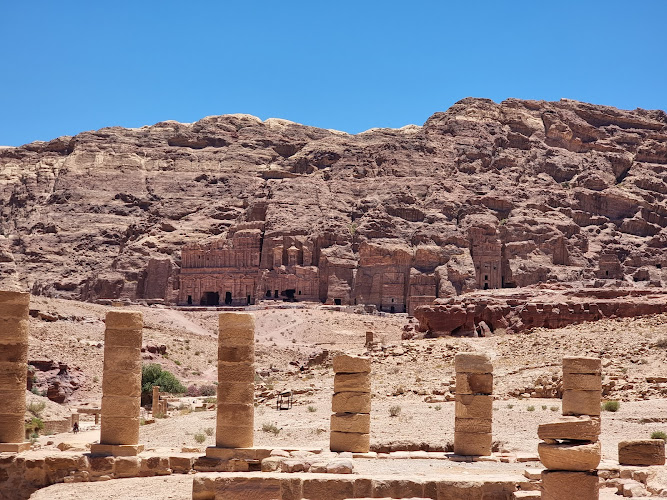
Unlike Petra’s rock-cut Treasury, the Great Temple was built from freestanding masonry on engineered terraces. Approach from Colonnaded Street to understand its commanding position above the commercial heart of the ancient city. The route climbs through a monumental entrance, or propylaeum, toward the lower precinct and then the upper complex. Sandstone columns, fragments of stucco decoration, and carved architectural blocks reveal how much richer these buildings once looked than their exposed stone suggests today.
Brown University began major excavations here in 1993 under archaeologist Martha Sharp Joukowsky. The discoveries included a small theater-shaped assembly space, often estimated at around 600 seats, within the upper building. Its presence supports interpretations involving civic gatherings or council business rather than an exclusively religious function. Look closely at the elephant-headed capitals associated with the lower colonnades: they illustrate the international artistic connections of Nabataean Petra, a trading city linking Arabia with the Mediterranean world.
- Monumental approach: Broad stairs and successive terraces make the original processional arrangement legible even without intact walls.
- Lower precinct: Colonnaded edges frame an expansive gathering area above the ancient street.
- Elephant capitals: Distinctive carved elephant heads distinguish this complex from Petra’s more familiar classical capitals.
- Upper assembly chamber: Curving seating exposes the building’s debated civic and ceremonial roles.
- City-center views: Elevated positions connect the ruins visually with Colonnaded Street and the surrounding sandstone mountains.
Great Temple at a Glance
| Detail | Information |
|---|---|
| Address | 8CHR+FWF, Petra Archaeological Park, Wadi Musa, Jordan; no street number |
| Neighborhood / Area | Ancient Petra city center, south of Colonnaded Street |
| Operating Hours | Daily during Petra’s opening hours; generally 6am–6pm in summer and 6am–4pm in winter. Check seasonal arrangements before visiting. |
| Admission / Price Range | Paid Petra admission; no separate Great Temple ticket. $$; ticket categories depend on residency and length of stay. |
| Recommended Visit Duration | 30–45 minutes at the complex, excluding the approach through Petra |
| Nearest Transit / Parking | No public transit inside Petra; visitor parking is outside the archaeological park near the Wadi Musa entrance. |
| Official Website & Phone | Official Great Temple visitor information; Petra Visitor Centre: +962 3 215 6044 |
Visiting Tips, Getting There & Nearby Pairings
Enter Petra early and allow approximately 60–90 minutes to reach the Great Temple from the Visitor Centre, longer with Treasury and tomb stops. The approach follows the Siq, Street of Facades, and Colonnaded Street; it is roughly four kilometers each way. Intercity coaches and taxis reach Wadi Musa, not the monument itself. Park outside the entrance and carry water, sun protection, and grippy shoes. Book a licensed guide through the Visitor Centre if you want the site’s competing interpretations explained in context.
The terraces involve worn stairs, loose surfaces, and substantial level changes; there is no elevator or continuous step-free route through the complex. Wheelchair users and families with strollers should discuss the wider Petra approach with the Visitor Centre before setting out. Shade is limited, and this is not a serviced indoor attraction. Pair the visit with Qasr al-Bint, approximately 5–10 minutes west, the Temple of the Winged Lions across the valley, or the Byzantine Church and its mosaics, roughly 10–15 minutes uphill. Walking times depend on the route and footing.
Frequently Asked Questions
When is the Great Temple open, and when should I visit?
Access follows Petra’s daily archaeological-park hours, which change seasonally. An early park entry gets you to the complex before the strongest midday heat; spring and autumn generally offer more comfortable walking conditions.
Do I need a separate ticket or reservation?
No separate reservation or monument ticket is needed beyond valid Petra admission. Check the official Petra website for current ticket categories and conditions, especially for day visitors entering Jordan without an overnight stay.
How long should I allow?
Allow 30–45 minutes to explore the terraces and assembly chamber without rushing. Budget most of a day for the wider Petra visit, including the long return walk and neighboring monuments.
Is the Great Temple suitable for children or visitors with limited mobility?
School-age children who enjoy ruins can explore with close supervision around steps and exposed edges. The stepped terraces are challenging for limited mobility; never climb columns or unstable masonry.
When planning your Petra travel guide or comparing verified attractions and archaeological site in Petra, pair this stop with standout local spots including Qasr al-Bint, Petra Palace Hotel, Family kitchen, and Winged Lion Temple (0.2 km away).