
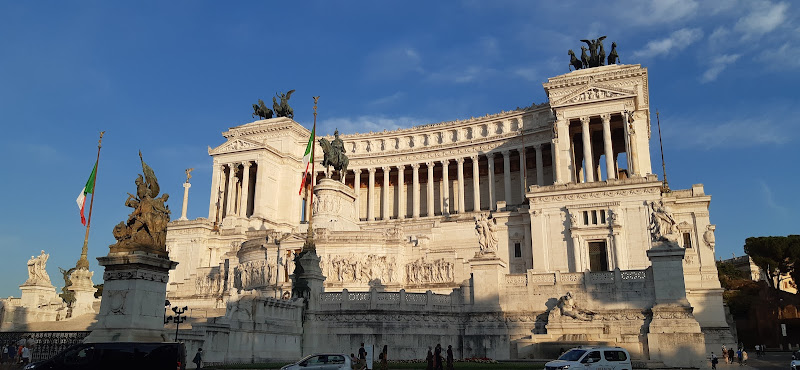
Piazza Venezia is Rome’s monumental crossroads at Piazza Venezia, 00187 Roma RM, between the Capitoline Hill, Via del Corso and Via dei Fori Imperiali. Recast after Rome became capital of unified Italy, the square is visited for the vast white Vittoriano, Renaissance Palazzo Venezia, direct views toward the Roman Forum and one of central Rome’s most consequential urban scenes.
What to Expect at Piazza Venezia
The square’s commanding presence comes from the Monumento Nazionale a Vittorio Emanuele II, commonly called the Vittoriano or Altare della Patria. Designed by Giuseppe Sacconi and constructed from 1885 to 1935, its bright Botticino marble stairways, Corinthian colonnade, bronze equestrian statue of Victor Emmanuel II and winged Quadriga sculptures embody the ambitious language of the newly unified Italian state. At the foot of the central stairs, the Tomb of the Unknown Soldier has burned an eternal flame since 1921 and is guarded by soldiers.
Walk around the perimeter rather than treating the piazza as only a traffic junction. Palazzo Venezia, begun in 1455 for Venetian cardinal Pietro Barbo, later Pope Paul II, gives the square its name; its severe travertine façade contrasts sharply with the Vittoriano. The palace’s balcony is associated with Benito Mussolini’s public addresses during the Fascist period. Within the Vittoriano, the Central Museum of the Risorgimento traces Italian unification from the late eighteenth century through the First World War, while paid panoramic lifts rise to the Terrazza delle Quadrighe for a broad rooftop perspective over Rome.
- Altare della Patria: Monumental central stairs, colonnades and sculptural program honoring Victor Emmanuel II, Italy’s first king.
- Tomb of the Unknown Soldier: National memorial with an eternal flame and military guard at the monument’s lower center.
- Terrazza delle Quadrighe: Panoramic-lift terrace beneath the bronze chariot groups, looking across Forum ruins, Capitoline Hill and domes.
- Palazzo Venezia: Fifteenth-century papal palace built for Pietro Barbo, with the Basilica di San Marco immediately alongside.
- Via dei Fori Imperiali axis: A direct walking route from the piazza toward the Roman Forum and Colosseum.
Piazza Venezia at a Glance
| Detail | Information |
|---|---|
| Address | Piazza Venezia, 00187 Roma RM, Italy |
| Neighborhood / Area | Centro Storico, at the foot of the Campidoglio |
| Operating Hours | The public piazza is open 24 hours daily; museum and terrace hours operate separately. |
| Admission / Price Range | The square and Vittoriano exterior grounds are free; the panoramic lift and museum experiences are paid admission. |
| Recommended Visit Duration | 30 to 45 minutes; allow longer for the panoramic terrace or Risorgimento museum. |
| Nearest Transit / Parking | Bus routes 40, 64, 70, 81, 87, 160 and 170 stop on or near the piazza; Tram 8 terminates nearby. Metro B Colosseo is about a 12-minute walk. |
| Official Website & Phone | Turismo Roma | +39 06 0608 |
Visiting Tips, Getting There & Nearby Pairings
Arrive early, before coach groups and rush-hour traffic fill the approaches, for the clearest photographs of the Vittoriano façade. The piazza itself requires no ticket or reservation, but reserve panoramic-lift entry through the official Vittoriano channels when rooftop views are central to your plan. The public square is especially effective at blue hour, when the marble monument is illuminated; use marked crossings carefully, as this remains a busy traffic interchange.
For transit, buses are generally more convenient than the metro, and Tram 8 is useful from Trastevere. There is no visitor parking at the square; central Rome’s restricted-traffic zones and congested streets make walking, taxis and public transport the sensible choices. The piazza’s main surfaces are open and broadly navigable, though cobbles, kerbs and wide road crossings demand care for wheelchairs and strollers. The Vittoriano’s panoramic terrace is reached by elevators after security screening, while other monument levels involve substantial stairs. Pair a visit with the Capitoline Museums, a five-minute uphill walk, the Roman Forum entrance near Via dei Fori Imperiali, or the Teatro di Marcello and Jewish Ghetto, roughly 10 minutes away on foot.
Frequently Asked Questions
When is Piazza Venezia open, and what is the best time to go?
Piazza Venezia is a public square open around the clock. Visit early in the morning for easier photographs and a calmer walk, or return at dusk to see the Vittoriano illuminated; museum and terrace schedules are separate from the square.
Does Piazza Venezia cost anything to visit?
No admission is required to walk through the piazza, view the Tomb of the Unknown Soldier or see the Vittoriano from its exterior grounds. The Terrazza delle Quadrighe panoramic lift and indoor museum offerings require paid tickets; check the official site for current options.
How long should I spend at Piazza Venezia?
Budget 30 to 45 minutes for the square, monument exterior and Palazzo Venezia views. Add roughly an hour for the rooftop terrace and more time if you visit the Central Museum of the Risorgimento before continuing toward the Forum.
Is Piazza Venezia accessible for wheelchairs and families?
The open piazza can be visited with a stroller or wheelchair, but its paving, kerbs and heavy traffic require attention. The panoramic terrace uses elevators, whereas the Vittoriano’s stairways are not step-free; families should keep children close near the road crossings.
When planning your Rome travel guide or browsing verified attractions in Rome, pair this stop with standout local spots including Campo de' Fiori, Palatine Hill, Trattoria Della Stampa, and pazzavenezia (nearby).


