
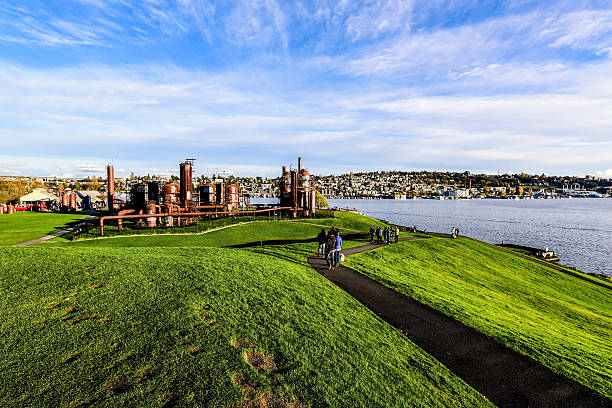
Gas Works Park is Seattle’s most recognizable industrial landscape: a 19.1-acre public park on Lake Union’s north shore where monumental early-20th-century gas plant machinery rises above lawns and paths. In Wallingford, the preserved towers make an immediate, unmistakably Seattle contrast with sailboats, houseboats, seaplanes, and the downtown skyline across the water.
The site operated as the Seattle Gas Light Company plant from 1906 to 1956 before landscape architect Richard Haag reworked it into a park that opened in 1975. Rather than erase the old works, the design made their pipes, tanks, rivets, and steel frames the centerpiece. The result is both a National Register-listed industrial landmark and an easygoing place to picnic, play, walk, and watch the city.
Standout Highlights & What Not to Miss
This is a park that rewards a slow circuit rather than a single viewpoint. Start near the towers, continue along the shore-facing paths, then climb the mound for the wide reveal. Light changes the experience: gray weather heightens the industrial drama, while clear late-day conditions bring out the water and skyline.
- Gasification towers: The fenced but highly visible steel structures are the park’s signature. Photograph their layered pipes and weathered geometry from several angles rather than expecting access inside.
- Great Mound and sundial: This broad hill, built during the park conversion, is the best elevated lookout. A spiral route leads toward the summit and its ground-set sundial.
- Lake Union panorama: Face south for downtown towers, the Space Needle, active water traffic, and a particularly open sense of Seattle’s geography.
- Play Barn: Families should seek out the former pump house, where painted compressor machinery is incorporated into a distinctive play setting.
- The Prow and open lawns: The former boiler house now serves as a covered picnic shelter, while surrounding grass gives groups room to settle in without losing the view.
Visitor Strategy & Planning Snapshot
| Planning Factor | What to Expect | Practical Strategy |
|---|---|---|
| Ideal Arrival Window | Morning feels calmer; late afternoon often gives the most photogenic skyline light. | Arrive early for quieter tower photographs, or allow time before sunset for the mound view. |
| Typical Time Needed | Most visitors spend 1 to 2 hours walking, viewing, playing, or picnicking. | Plan one hour for a quick loop; add time for a meal, children, or a Burke-Gilman Trail ride. |
| Booking / Queue Reality | This is primarily an open public-park visit, not a timed museum experience. | Do not build a tight schedule around immediate access to a specific lawn or viewpoint; check local notices if visiting during a major event. |
| Terrain & Accessibility | Paved paths connect the parking area, restrooms, shelters, and shoreline; the Great Mound is steep and grassy. | Use the lower paved network for the most accessible route. Treat the mound climb as optional, especially for wheelchairs or anyone avoiding slopes. |
| Weather / Seasonal Fit | The site is exposed to wind and rain, but changing clouds can make the industrial forms especially atmospheric. | Bring a wind layer and rain protection in unsettled weather; on clear days, keep extra time for views and photos. |
Honest Trade-Offs: Best For vs. Who Might Skip
Gas Works Park is an excellent match for first-time Seattle visitors, photographers, picnickers, families, architecture fans, and anyone who enjoys an unconventional city view. Its unusual appeal lies in atmosphere, scale, and setting—not in a curated indoor interpretation or a long menu of formal activities. The machinery is viewed from outside its fenced areas, and the park can feel exposed when wind or rain moves across Lake Union. Visitors seeking a sheltered attraction, extensive interpretive exhibits, or a flat route all the way to the top viewpoint may prefer another stop. For most people, however, the lower paths and waterfront-facing perspectives still provide the essential experience.
Neighborhood Context & How to Pair Your Visit
Use Gas Works Park as a scenic anchor for time in Wallingford and along Lake Union. The Burke-Gilman Trail runs by the park’s northern edge, making it easy to arrive or depart on foot or by bicycle and to extend the outing beside the water. A satisfying visit pairs a tower-and-mound circuit with a picnic on the lawn, then a neighborhood stroll for food or coffee. If you are building a broader Seattle day, come here when you want breathing room between denser sightseeing stops: the view frames downtown from a distance and gives the city’s working waterfront, residential shorelines, and industrial history equal billing.
When planning your Seattle travel guide or comparing verified attractions and city park in Seattle, pair this stop with standout local spots including Ballard (Hiram M. Chittenden) Locks, Pike Place Chowder, Six Seven Restaurant, and Gas Works – Lake View Point (0.1 km away).


