Palazzo Pubblico is Siena’s Gothic civic palace, rising from the lower curve of Piazza del Campo with a brick façade shaped to the famous shell-like square. Begun in 1297 for the Council of Nine, it remains a working symbol of the city’s public life while housing the Museo Civico, one of Tuscany’s essential stops for medieval painting and political history.
This is not a palace of private dynastic splendor: its rooms were designed for government, ceremony, justice, and the visual education of citizens. The experience moves from the drama of the piazza into chambers where Siena’s rulers commissioned art with a public purpose. Beside it, the slender Torre del Mangia adds a separate, more physical challenge and a commanding viewpoint over the city.
Standout Highlights & What Not to Miss
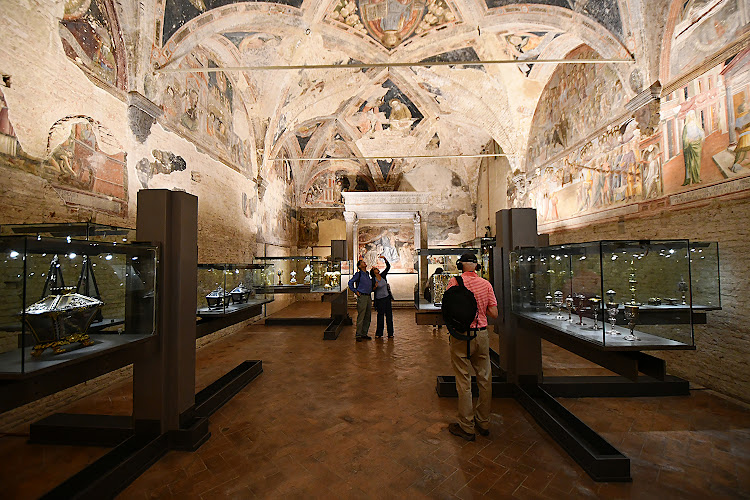
Give the interior more attention than a quick look from the Campo suggests. The palace’s great rooms are most rewarding when approached as a sequence: each fresco speaks to Siena’s civic ideals, rivalries, religious culture, and identity as an independent medieval republic. If climbing the tower is part of your plan, treat it as an additional experience rather than a substitute for the museum rooms.
- Sala della Pace: Ambrogio Lorenzetti’s Allegory and Effects of Good and Bad Government is the defining work. Study both the ordered city and countryside under good rule and the damaged world under tyranny; the fresco cycle is unusually direct in linking politics to everyday life.
- Sala del Mappamondo: Look for Simone Martini’s monumental Maestà, an elegant, courtly vision of the Virgin, and the equestrian portrait of Guidoriccio da Fogliano. Stand back first to grasp the compositions, then move closer for the fine decorative detail.
- The civic interiors: Ceiling decoration, heraldry, carved details, and the progression of chambers make clear that this was a seat of government, not simply a picture gallery. Slow down in the transition spaces as well as at the headline frescoes.
- Torre del Mangia: The 88-metre tower is the visual counterpoint to the palace. Its ascent is for visitors comfortable with narrow stairs and enclosed passages; the payoff is a high, memorable perspective over the Campo’s geometry and Siena’s tiled roofs.
- Cappella di Piazza and the exterior: At the tower’s base, this small marble-and-stone chapel was built in fulfillment of a vow after the Black Death. Take time to read the palace, chapel, and piazza together from several points around the square.
Visitor Strategy & Planning Snapshot
| Planning Factor | What to Expect | Practical Strategy |
|---|---|---|
| Ideal Arrival Window | The Campo is a focal point for day visitors, and the palace is most enjoyable before the square reaches its busiest rhythm. | Start with the museum early in your Siena sightseeing day, then return to the piazza later for its changing light and atmosphere. |
| Typical Time Needed | A focused museum visit commonly takes 1.5 to 2.5 hours; adding the tower and a slower look at the square extends the stop. | Allow extra time if medieval art is a priority. Do not schedule a tight onward connection immediately after a tower climb. |
| Booking / Queue Reality | Interest concentrates around the major frescoes and the tower, particularly in high visitor periods. | Check current entry arrangements before setting out, and keep the palace flexible within your day in case of a wait or timed access. |
| Terrain & Accessibility | Museum floors are reachable by lift, and accessible video guides are available; the Torre del Mangia is reached only by narrow stairs. | Choose the museum for the art and civic history if stairs are unsuitable. Separate companions can meet afterward in the Campo. |
| Weather / Seasonal Fit | The interior is a strong all-weather cultural stop, while the tower and time in the piazza are more exposed to heat, rain, and wind. | Use the rooms as a midday refuge in warm weather or a rainy-day anchor; save an exterior circuit for more comfortable conditions. |
Honest Trade-Offs: Best For vs. Who Might Skip
Palazzo Pubblico is especially rewarding for history buffs, art lovers, architecture enthusiasts, and first-time visitors who want to understand why Siena feels different from Florence. The Lorenzetti frescoes alone justify a serious visit, while the tower suits travelers seeking a panoramic accomplishment. It is less ideal for visitors who want a rapid, object-by-object museum, dislike dim medieval interiors, or have limited mobility and are mainly interested in the tower. Families may find the visual storytelling engaging, but younger children may respond more to the piazza and tower than to prolonged fresco viewing. The key trade-off is pace: this is a place to look, compare, and think, not merely collect a view.
Neighborhood Context & How to Pair Your Visit
Make Palazzo Pubblico the center of a compact old-town walk. Begin in Piazza del Campo, tracing its slope and nine-part paving before going inside; afterward, walk uphill through Siena’s dense lanes toward the cathedral precinct, pausing at viewpoints and small contrade details along the way. Alternatively, visit the palace after an early circuit of the Duomo area, then let the Campo become your afternoon pause. The square’s cafés and open edges make it easy to regroup, but the best pairing is architectural: compare the palace’s civic Gothic severity with the cathedral district’s more overtly religious grandeur. At dusk, return to see how the tower continues to organize Siena’s skyline.
When planning your Siena travel guide or comparing verified attractions and museums in Siena, pair this stop with standout local spots including Osteria degli Svitati, Osteria Nonna Gina, Opera delle Metropolitana, and Torre del Mangia (nearby).