
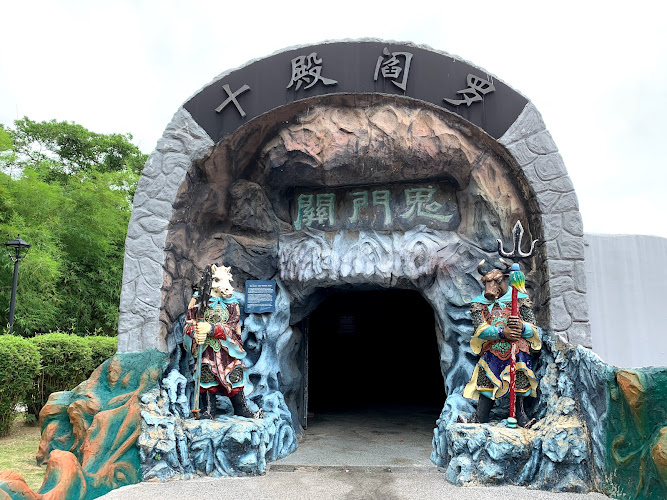
Along a quiet stretch of Pasir Panjang Road, far from the glass towers that define most visitors’ mental image of Singapore, sits a hillside of eight hundred concrete statues depicting torture, morality, and myth. Haw Par Villa is not a theme park in any conventional sense — it is a physical manifesto built by two brothers who made their fortune selling menthol ointment, and it remains the strangest, most argued-about attraction in the country.
Haw Par Villa sits at 262 Pasir Panjang Road, Singapore 118628, built in 1937 by Tiger Balm creators Aw Boon Haw and Aw Boon Par as a moral instruction garden. Park entry remains free; the Ten Courts of Hell exhibit inside Hell’s Museum costs from S$20. Note: as of December 2025 the outdoor statue park is partially closed, though Hell’s Museum stays open. Arrive early morning for shade and near-empty photo compositions.
At A Glance
| Category | Details |
|---|---|
| Address | 262 Pasir Panjang Road, Singapore 118628 |
| Operating Hours | Daily, 9am – 8pm (last entry 7:30pm); Hell’s Museum hours may vary during renovation period |
| Price Range / Admission | Park entry: Free (partial closure in effect since Dec 2025). Hell’s Museum: from S$20 per adult |
| Highlights | Ten Courts of Hell, Legend of the White Snake diorama, Journey to the West tableau, giant crab and tiger statues, Hell’s Museum interactive galleries |
| Transport/Transit Access | Haw Par Villa MRT Station (Circle Line), direct exit into the park grounds |
Deep Origins, Architectural Evolution & Cultural Significance
Haw Par Villa began as a private residence built in 1937 by Aw Boon Haw for his younger brother Aw Boon Par, the pair having built a pharmaceutical empire around Tiger Balm — a camphor-and-menthol ointment that remains a household staple across Southeast Asia today. What separates this property from any ordinary mansion garden is the elder Aw’s decision to turn the surrounding grounds into an open-air teaching tool grounded in Confucian ethics, Buddhist cosmology, and Chinese folklore. Aw commissioned local and Chinese-trained sculptors to construct roughly one thousand statues and 150 giant dioramas across the 8.5-hectare hillside, each one illustrating a fable, a punishment, or a moral lesson meant to be absorbed visually rather than read.
The original villa itself was destroyed during the Japanese Occupation of Singapore in World War II, but the surrounding statue garden survived largely intact and was expanded through the 1950s and 1960s. Ownership eventually passed to the Singapore Tourism Board, which has managed preservation and periodic renovation since the 1980s. In 2016, the government-backed operator Journeys introduced Hell’s Museum, an air-conditioned indoor extension built around the park’s most famous section — the Ten Courts of Hell — reframing the graphic imagery with academic context about Chinese death rites, ancestor worship, and comparative religious views on the afterlife. This hybrid model, blending free heritage-park access with a ticketed curated museum, has defined the site’s operating structure for the past decade.
Culturally, Haw Par Villa occupies a strange position in Singapore’s civic identity. It is neither a polished national monument like the Botanic Gardens nor a religious site with active worship, yet it functions as one of the only physical records of pre-independence Chinese diaspora values rendered at monumental scale. Local commentators have called it kitsch, others call it the country’s most honest piece of public art — unsanitized, occasionally grotesque, and entirely unconcerned with modern branding polish. As of December 2025, the park entered a partial closure for structural conservation work on aging statues, with Hell’s Museum continuing to operate independently, a detail worth confirming before any 2026 visit.
Signature Highlights & Detailed Offerings
The park’s centerpiece remains the Ten Courts of Hell, a sequence of dioramas depicting Chinese Buddhist and Taoist punishments meted out to sinners in the underworld — tongues pulled out with pliers for gossips, bodies sawn in half for tax evaders, disembowelment for the disrespectful. These scenes, rendered in painted plaster with visible cracking from decades of tropical humidity, are now housed inside the climate-controlled Hell’s Museum alongside supplementary galleries explaining funerary customs, joss paper offerings, and comparative death traditions from Egyptian, Christian, and Hindu cosmology.
Outside, when open, the hillside trail winds past a giant crab shell you can climb inside, a ten-story pagoda replica, and dioramas retelling the Journey to the West saga featuring the Monkey King battling demons. The Legend of the White Snake sequence, one of the most photographed corners of the park, depicts the shapeshifting snake spirit’s tragic romance across several linked tableaux. A statue of a fat, laughing tiger — a nod to the Tiger Balm branding itself — anchors one of the lower terraces and remains a favorite photo stop for visitors who arrive without prior knowledge of the park’s moral-instruction intent.
- Ten Courts of Hell — graphic punishment dioramas, now indoors within Hell’s Museum
- Journey to the West statue sequence — Monkey King and demon battle scenes
- Legend of the White Snake — multi-panel romantic tragedy in painted concrete
- Giant crab structure — climbable shell sculpture, popular family photo point
- Ten-story pagoda replica and surrounding koi ponds
- Laughing tiger statue tied to the Tiger Balm brand origin
Sensory & Spatial Walkthrough
Entering from the MRT-side gate, the first sensation is thermal — direct equatorial sun on exposed concrete paths with almost no canopy cover until midway up the hillside. Statues in faded reds, mustard yellows, and chalky whites dominate the palette, their paint stripped by decades of monsoon rain into a patina that feels intentionally aged even though it is simply weathering. Cicada noise and distant traffic from Pasir Panjang Road provide the only ambient soundtrack; there is no piped music, no retail chatter, which gives the walk an oddly meditative, occasionally eerie quality especially on overcast weekday mornings when visitor numbers are low.
By late morning the concrete radiates heat and the upper terraces become uncomfortable without a hat or umbrella. Inside Hell’s Museum, the environment flips entirely — cool, dim, spotlit dioramas set against black walls, with recorded narration in English and Mandarin looping at low volume. Bench seating is sparse throughout the outdoor sections, mostly clustered near the koi ponds and the pagoda base, so visitors doing a full circuit should plan water breaks accordingly. Late afternoon light, arriving low and golden around 5:30pm, produces the most dramatic photography conditions on the statues’ weathered surfaces, particularly on the crab structure and the hillside Buddha figures.
Insider Visitor Strategy & Pro Tips
Confirm current access status before traveling — the outdoor statue park has been under partial closure since December 2025 for conservation work, with no confirmed full reopening date at time of writing, though Hell’s Museum has continued normal operations throughout. Weekday mornings between 9am and 10:30am offer the lowest visitor density and the coolest walking temperatures; weekends see moderate upticks from local families and photography hobbyists rather than tour buses, since this site rarely appears on mainstream group itineraries. Bring a hat, water, and sun protection regardless of season — there is minimal shaded seating on the upper terraces. Photography is unrestricted throughout the outdoor grounds and encouraged inside Hell’s Museum except in specifically marked no-flash zones near fragile older dioramas. For the most striking wide-angle shots, position at the base of the pagoda looking upward, or from the crab structure’s mouth looking out toward the hillside statues. Tickets for Hell’s Museum can be booked directly through the official Haw Par Villa website or via Klook and similar platforms, occasionally at a small discount versus walk-up pricing; booking ahead is advisable on weekends and school holidays even though queues rarely exceed fifteen minutes.
Curated Half-Day Neighborhood Pairing Itinerary
Begin at Haw Par Villa itself, allowing 60–90 minutes for the outdoor circuit (where accessible) plus Hell’s Museum. Exit toward Pasir Panjang Road and walk roughly ten minutes to Kent Ridge Park, a former WWII battle site with elevated boardwalks through secondary rainforest and views toward the southern islands — a useful green counterpoint to the concrete intensity of Haw Par Villa. From Kent Ridge Park, a short ride or fifteen-minute walk leads to the HortPark area, a horticultural showcase garden with a casual café suitable for a mid-afternoon coffee break. To close the loop, head toward VivoCity via a short MRT hop from Haw Par Villa station along the Circle Line interchange at HarbourFront, where waterfront dining, Sentosa Boardwalk access, and retail options provide a complete change of pace to end the half-day circuit.
Practical Logistics & Universal Accessibility
Haw Par Villa MRT Station on the Circle Line opens directly into the park grounds, making this one of the most transit-convenient heritage sites in Singapore — no bus transfer or long walk required. Step-free access exists at the MRT exit and throughout the lower terraces near Hell’s Museum, though the upper hillside statue sections involve inclined paths and stairs that may challenge wheelchair users or those with mobility limitations; check with staff about alternate accessible routes during any visit. Limited surface parking is available near the park entrance at standard public car park rates (approximately S$0.60 per half hour during peak hours), though most visitors arrive via MRT given the direct station access. There is no formal dress code, though modest clothing suitable for outdoor walking in tropical heat is recommended. Payment inside Hell’s Museum and at ticket counters accepts cash, credit cards, and major e-payment apps standard across Singapore attractions (source: [Haw Par Villa](https://www.hawparvilla.sg/)).
Frequently Asked Questions
Is Haw Par Villa free to enter? Yes, the outdoor statue park has always operated on free admission; only Hell’s Museum requires a paid ticket starting from S$20 (source: [Honeykids Asia](https://honeykidsasia.com/haw-par-villa-singapore/)).
Is the park currently open? As of December 2025, the outdoor park is partially closed for conservation work until further notice, while Hell’s Museum remains open to visitors (source: [TripAdvisor](https://www.tripadvisor.com.sg/Attraction_Review-g294265-d324758-Reviews-Haw_Par_Villa-Singapore.html)).
How much time should I budget? Plan for 1.5 to 2 hours to cover Hell’s Museum thoroughly plus any accessible outdoor sections at a relaxed pace.
Is it suitable for young children? Some imagery, particularly in the Ten Courts of Hell, depicts graphic violence and may unsettle very young or sensitive children; parental discretion is advised.
How do I get there by public transport? Take the Circle Line MRT directly to Haw Par Villa Station, which opens straight into the park grounds with no additional walking required.
Are there food options inside the park? Food offerings are minimal on-site; visitors typically eat before or after at nearby hawker centers or at VivoCity, a short MRT ride away via HarbourFront interchange.


