
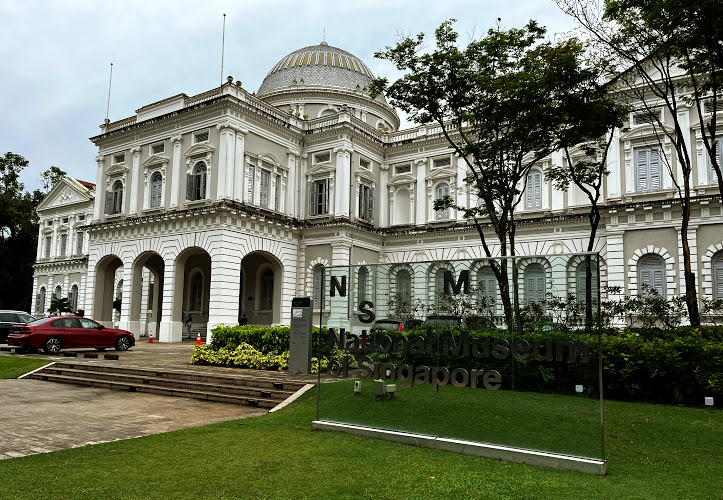
The National Museum of Singapore occupies a limestone-and-glass compound at 93 Stamford Road, a few steps from Bras Basah Road and the edge of the Civic District. It is the oldest museum in the country, dating its institutional roots to 1887, and today functions as both a repository of the nation’s founding narratives and a live venue for contemporary art, film, and design. Visitors arrive expecting a static history lesson and instead find a building that argues, gallery by gallery, that Singapore’s identity was never fixed.
The National Museum of Singapore sits at 93 Stamford Road in the Civic District, a five-minute walk from Bras Basah MRT. Built in 1887 with a 2006 glass extension, it anchors the Singapore History Gallery and rotating art exhibitions. Standard admission runs SGD 15–25 for adults; locals with the Sunday free-entry scheme pay nothing. Budget two hours, arrive on weekday mornings, and wear comfortable shoes for the sloped Rotunda ramp.
At A Glance
| Address | 93 Stamford Road, Singapore 178897 |
| Operating Hours | Daily, 10am–7pm (Singapore History Gallery to 6pm; last admission 30 mins before close) |
| Price Range / Admission | Adults SGD 15–25 (varies by exhibition bundle); Singapore Citizens/PRs free for permanent galleries; children under 6 free |
| Highlights | Singapore History Gallery, Glass Rotunda, Goodman Arts Centre collaborations, Stamford Green lawn, museum shop and Food For Thought café |
| Transport/Transit Access | Bras Basah MRT (CC2) Exit A, Dhoby Ghaut MRT (NS24/NE6/CC1) 8-min walk, SBS buses 7, 14, 16, 36, 77, 106, 111, 124, 128, 162, 175, 190 |
Origins, Architectural Evolution & Cultural Significance
The museum’s lineage traces back to 1849, when a small collection was housed inside the Singapore Institution Library. It moved to its current site in 1887 under British colonial administration, opening as the Raffles Library and Museum, named for Stamford Raffles, the East India Company official credited with establishing a British trading post on the island in 1819. The original Neo-Palladian structure, designed by colonial architect Henry McCallum, features a copper dome, thick masonry walls built to withstand tropical humidity, and a symmetrical façade oriented toward what was then a parade ground, now Fort Canning Park’s lower slopes.
Through the twentieth century the building weathered Japanese occupation, when its collections were partially looted or hidden, and post-independence neglect, when Singapore’s cultural funding prioritized economic infrastructure over heritage preservation. The turning point came in 2003, when the National Heritage Board closed the museum for a four-year, SGD 132 million renovation. Architects CPG Consultants and W Architects added a contemporary glass-and-steel extension on the building’s rear flank, completed in 2006, which introduced the now-iconic Glass Rotunda: a four-storey atrium lit by an angular glass canopy that filters daylight into shifting geometric patterns across the polished stone floor below.
This architectural pairing, colonial dome facing modernist glass, was a deliberate curatorial statement. The museum’s leadership wanted physical proof that Singapore’s history is additive rather than replaced: British colonial infrastructure, Japanese occupation trauma, Malay and Peranakan cultural threads, Chinese immigrant labor, and post-1965 nation-building all coexist in one structure rather than being demolished and rebuilt. The building itself was gazetted a National Monument in 2006, cementing its dual role as both artifact and container for artifacts.
Signature Highlights & Detailed Offerings
The centerpiece is the Singapore History Gallery, a 4,000-square-metre permanent exhibition organized chronologically from the 14th-century Temasek settlement through the 2015 death of founding prime minister Lee Kuan Yew. Visitors are handed an audio-guide headset (included in admission) that triggers location-based narration as they move through nine chronological zones. Standout objects include the Singapore Stone, a fragment of an inscribed sandstone slab dated to somewhere between the 10th and 14th centuries whose script remains undeciphered, and a full-scale reproduction of a 1950s Bugis Street shophouse interior, complete with period furniture sourced from private Peranakan family donations.
The Goh Seng Choo Gallery on Level 1 houses the William Farquhar Collection of Natural History Drawings, 477 watercolor paintings of Malayan flora and fauna commissioned by Farquhar, Singapore’s first Resident, between 1819 and 1823. These works, painted by unnamed Chinese artists under Farquhar’s direction, rotate in batches of roughly 20 to protect the pigments from light damage, meaning repeat visitors see different works each year.
Beyond the permanent collection, the museum programs two to three ticketed special exhibitions annually, often in partnership with international institutions such as the Musée d’Orsay or the Victoria and Albert Museum, with admission for these bundled at SGD 20–25 for adults. The Salon and Atrium spaces on the ground floor host free contemporary art commissions, frequently video or light installations by Singaporean artists like Ho Tzu Nyen or Robert Zhao Renhui, changing every four to six months.
Food For Thought, the museum’s café tucked beside the Rotunda, serves a menu of Western-Asian fusion plates; a signature laksa pesto pasta runs around SGD 18, and their scones with kaya butter, a nod to Singapore’s breakfast toast culture, cost roughly SGD 8. The museum shop stocks locally designed stationery, Peranakan tile coasters, and reprinted Farquhar botanical prints starting at SGD 12.
Sensory & Spatial Walkthrough
Entering from Stamford Road, visitors pass under the original portico into a cool, echo-heavy lobby where marble floors and high ceilings mute street noise almost instantly. The transition into the Glass Rotunda is the building’s most photographed moment: morning light around 10–11am casts sharp diagonal shadows through the canopy’s triangular panes onto the ground-floor stone, while afternoon light softens into a diffuse wash by 3pm. The Rotunda’s acoustics amplify footsteps and conversation into a low hum that carries up through all four levels, giving the space a cathedral-like presence despite its modern materials.
The Singapore History Gallery, by contrast, is deliberately dim, with spotlighting on individual artifacts and dark carpeted floors that absorb sound, creating an intimate, almost hushed viewing experience distinct from the Rotunda’s openness. Seating is sparse inside galleries but plentiful in the Rotunda’s ground floor and the rear Stamford Green lawn, a grassy slope facing Fort Canning where museum-goers picnic or attend outdoor film screenings during the Singapore Night Festival in August.
Insider Visitor Strategy & Pro Tips
- Arrive at opening (10am) on a weekday; school groups typically flood in after 11am and tour buses arrive by noon.
- Book special exhibition tickets online through the museum’s official site to skip the walk-up queue, especially during school holidays (June and November-December in Singapore).
- Photography without flash is permitted throughout permanent galleries; flash and tripods are restricted in the Farquhar Collection room to protect the watercolors.
- The best photo angle for the Glass Rotunda is from the second-floor bridge looking down, capturing both the canopy pattern and ground floor symmetry.
- Large backpacks and umbrellas must be checked at the lockers near the main entrance, free of charge with a coin deposit refunded on return.
- Sundays offer free admission to the permanent galleries for Singapore Citizens and Permanent Residents only; tourists still pay standard rates.
Curated Half-Day Neighborhood Pairing Itinerary
Start at the National Museum for opening hour, spending 90 minutes to 2 hours on the Singapore History Gallery and Farquhar drawings. Exit onto Stamford Road and walk five minutes to the Singapore Art Museum’s Tanjong Pagar Distripark satellite is too far, so instead head to the Peranakan Museum on Armenian Street, an eight-minute walk past Fort Canning’s base, to see three centuries of Straits Chinese material culture in a former school building. From there, walk six minutes to Prinsep Street for lunch at Group Therapy Coffee or Windowsill Pies, independent cafés known for specialty coffee and flaky savory pies priced around SGD 8–12. Finish the circuit with a ten-minute walk to Fort Canning Park itself, climbing to the Battle Box and the ASEAN Sculpture Garden for skyline views over the Civic District before the afternoon heat sets in around 2pm.
Practical Logistics & Universal Accessibility
The nearest MRT station is Bras Basah (Circle Line, CC2), Exit A, a flat five-minute walk with no stairs required. Dhoby Ghaut (North-South, North-East, and Circle Lines) is a wheelchair-accessible alternative eight minutes away via covered walkways. The museum itself is fully wheelchair accessible, with ramps replacing stairs at the Stamford Road entrance and lifts connecting all four levels, including the Rotunda bridges. Wheelchairs are available for loan at the information counter free of charge.
Parking is available at the SMU basement car park on Stamford Road (approximately SGD 2.50 per half-hour) or the Winsland House II car park nearby, both a five-minute walk. There is no dress code; the museum is air-conditioned throughout, so a light jacket is advisable for temperature-sensitive visitors. Payment for admission and the café is accepted via cash, all major credit cards, and Singapore’s PayNow/NETS mobile systems; no cash-only restrictions apply.
Frequently Asked Questions
How much time should I budget for the National Museum of Singapore? Most visitors need 1.5 to 2 hours for the Singapore History Gallery and Rotunda; add another hour if a special exhibition is running.
Is the museum free for tourists? No. Free admission to permanent galleries applies only to Singapore Citizens and Permanent Residents; foreign visitors pay standard adult rates of roughly SGD 15–25 depending on exhibition bundling.
Can I bring food or drinks inside? Outside food and drink are not permitted in gallery spaces, though the Stamford Green lawn outside allows picnicking, and Food For Thought café is available inside.
Is the museum suitable for young children? Yes, the Kids at the Museum trail and interactive stations in the Singapore History Gallery are designed for ages 5 and up, though strollers navigate the Rotunda ramps more easily than the older wing’s tighter corridors.
What is the closest MRT station? Bras Basah station on the Circle Line, Exit A, is a flat five-minute walk with no stairs.
Are guided tours available? Free docent-led tours run daily at scheduled times (typically 11am and 2pm) in English, with additional language tours on weekends; check the museum’s official schedule board at the entrance on arrival.


