Tobacco & Salt Museum (Tabako to Shio no Hakubutsukan) is a specialized cultural and industrial history museum located at 1 Chome-16-3 Yokokawa in Sumida City, Tokyo, Japan. Originally founded in Shibuya in 1978 by the Japan Tobacco and Salt Public Corporation (now Japan Tobacco Inc., or JT) to preserve the heritage of two commodities long regulated under state monopoly, the institution relocated to a purpose-built, five-story facility in Sumida City on April 25, 2015. Today, travelers visit the museum to explore everything from ancient Mayan ritual reliefs and massive Polish rock-salt sculptures to Edo-period smoking paraphernalia, vintage cigarette packaging, and the chemical science of salt production.
What to Expect at Tobacco & Salt Museum
The museum divides its permanent galleries cleanly across its second and third floors, with temporary exhibition halls, a reading room, a museum shop, and visitor amenities distributed throughout the remaining levels. On the second floor, the Permanent Salt Exhibition examines how human civilizations have harvested, traded, and used sodium chloride across millennia. Because Japan lacks natural terrestrial rock salt deposits, a major portion of the gallery focuses on indigenous Japanese seawater-boiling techniques, tracing the evolution from ancient clay-pot evaporation and Edo-period irihama-shiki (tidal salt fields) to 20th-century ion-exchange membrane technology. Visitors can touch genuine multi-ton rock salt blocks imported from around the world, inspect salt-carved statues from Poland’s Wieliczka Salt Mine, and engage with interactive stations in the Science of Salt zone that demonstrate how salt regulates human physiology and food preservation.
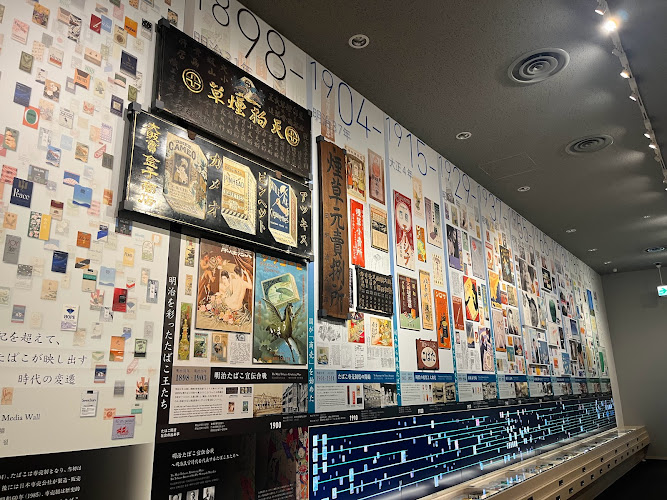
Upstairs on the third floor, the Permanent Tobacco Exhibition charts the journey of tobacco from its origins in the indigenous societies of the Americas to its global dissemination across Europe, the Middle East, and Asia during the 16th and 17th centuries. The gallery opens with a full-scale replica of a stone relief from the Mayan Temple of the Cross at Palenque, Mexico, depicting a deity smoking a tubular pipe. From there, the narrative shifts to Japan’s Edo period, showcasing ornate kiseru (slender metal and bamboo pipes), intricately lacquered tabako-bon (smoking trays), netsuke toggles, and ukiyo-e woodblock prints illustrating teahouse and kabuki smoking customs. Modern history comes alive through reconstructed 20th-century neighborhood tabako-ya (corner tobacco kiosks) and an interactive Tobacco Media Wall displaying hundreds of historic Japanese cigarette packages and commercial posters.
- Worlds Salt Resources Gallery (2F): Features crystalline halite formations from Bolivia’s Uyuni salt flats, desert salt roses, and a carved Saint Kinga statue crafted from Polish rock salt.
- Japanese Coastal Salt-Making Dioramas (2F): Detailed scale models and historical tools illustrating how Japanese coastal communities extracted salt from seawater over the centuries.
- Palenque Mayan Relief & Origins of Tobacco (3F): Life-size Mesoamerican temple reproductions and ethnographic artifacts tracing ceremonial tobacco use in the pre-Columbian Americas.
- Edo-Period Smoking Accoutrements (3F): Masterwork decorative arts including silver and gold-inlaid kiseru pipes, embroidered pouches (tabako-ire), and portable smoking chests.
- Rotating Special Exhibitions & Miniature Craft Collections (2F): Curated seasonal exhibitions spotlighting subjects like master miniaturist Rekisei Kobayashi’s intricate craftworks and South American indigenous ethnography.
Tobacco & Salt Museum at a Glance
| Detail | Information |
|---|---|
| Address | 1 Chome-16-3 Yokokawa, Sumida City, Tokyo 130-0003, Japan |
| Neighborhood / Area | Yokokawa / Oshiage (Tokyo Skytree District), Sumida City |
| Operating Hours | Tuesday–Sunday: 10:00 AM – 5:00 PM (last admission at 4:30 PM); Closed Mondays (or the following weekday if Monday is a national holiday) and New Year holidays |
| Admission / Price Range | Adults & University Students: ¥300; Elementary, Junior High & High School Students: ¥100; Seniors (65+): ¥150 |
| Recommended Visit Duration | 1.5 to 2 hours |
| Nearest Transit / Parking | Toei Asakusa Line (Honjo-azumabashi Station, 10-min walk); Tobu Skytree Line (Tokyo Skytree Station, 10-min walk); Oshiage Station (12-min walk). No general public car parking on site. |
| Official Website & Phone | tabashio.jp | +81 3-3622-8801 |
Visiting Tips, Getting There & Nearby Pairings
With adult admission priced at just ¥300, the Tobacco & Salt Museum is one of Tokyo’s highest-value cultural attractions. Weekday mornings between 10:00 AM and noon offer the quietest conditions for browsing the interactive media walls and reading displays. Visitors can access the museum’s smartphone audio guide service on site and borrow free English exhibition pamphlets at the first-floor reception desk, where coin-operated returnable lockers and a ground-level museum shop selling specialty gourmet salts, books, and historical postcards are also located. Note that despite the museum’s subject matter, smoking is strictly prohibited inside all exhibition galleries.
Because the museum does not maintain a public parking lot for passenger cars or large motorcycles, arriving by train is strongly recommended. From Honjo-azumabashi Station on the Toei Asakusa Line, take Exit A0 or A5 for elevator access to street level and walk 10 minutes east along Kasuga-dori; from Oshiage Station, take Exit B2 (escalator equipped) or walk alongside the Kitajukken River and cross the Tobu Bridge south for 12 minutes. The entire five-story building is wheelchair and stroller accessible, equipped with wide elevators, step-free entrances, accessible multi-purpose restrooms on every floor, nursing rooms, and complimentary wheel-chair loans. Pair your visit with a 10-minute walk north to Tokyo Skytree Town and the Sumida Aquarium, or head 15 minutes southwest to the Sumida Hokusai Museum in Ryogoku to admire woodblock masterpieces by Katsushika Hokusai.
Frequently Asked Questions
What are the opening hours for the Tobacco & Salt Museum?
The museum is open Tuesday through Sunday from 10:00 AM to 5:00 PM, with final entry at 4:30 PM. It closes every Monday, unless Monday falls on a Japanese national holiday, in which case the museum remains open on Monday and closes the following weekday.
How much do tickets cost and are reservations required?
General admission costs ¥300 for adults and university students, ¥150 for seniors aged 65 and over, and ¥100 for elementary, junior high, and high school students. Advance reservations are not required for individual visitors, and tickets can be purchased directly at the first-floor lobby desk upon arrival.
How much time should I budget for a visit?
Most travelers spend between 1.5 and 2 hours exploring the permanent salt galleries on the second floor, the tobacco history halls on the third floor, and the seasonal special exhibition space. Enthusiasts of Edo-period decorative arts or industrial science may wish to add 30 minutes to browse the fourth-floor reading room and ground-floor shop.
Is the Tobacco & Salt Museum suitable for families and wheelchair users?
Yes, the second-floor Science of Salt interactive experiments and giant touchable rock-salt specimens are popular with school-aged children and families. The modern Sumida facility offers step-free access throughout, spacious elevators connecting all floors, accessible restrooms, and free stroller and wheelchair rentals at the entrance.
When planning your Surprise travel guide or comparing verified attractions and museums in Surprise, pair this stop with standout local spots including Tamarind Tree, Hampton Inn & Suites Phoenix-Surprise, Djan's Dining Thai Restaurant, and Ivar's Fish Bar (nearby).