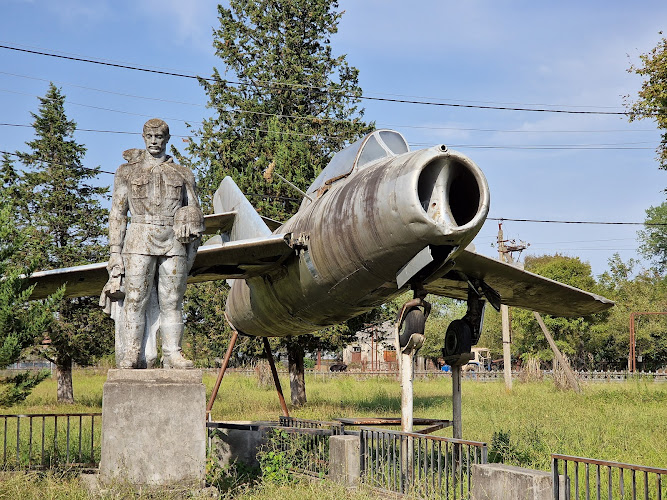
WWII Memorial Stand is a compact open-air memorial in Kveda Bashi, in Georgia’s western Imereti region, where a Soviet-built MiG-15UTI jet trainer is mounted above a roadside stand. Its silhouette—swept wings, pointed nose and two-seat canopy—makes an unexpectedly striking landmark in a rural village setting. This is not a conventional history museum with galleries or collections; it is a brief, visual and reflective stop centered on an aircraft and local remembrance.
The monument commemorates fallen warriors remembered locally from World War II, widely known across the former Soviet sphere as the Great Patriotic War. There is an important historical nuance in the display: the MiG-15UTI was developed after the war, so it should be read as a Soviet-era aviation monument placed within a World War II memorial tradition, rather than as an aircraft from the conflict itself. For road-trippers, it offers a revealing glimpse of how memory, civic symbolism and military imagery meet in rural Georgia.
Standout Highlights & What Not to Miss
The appeal is concentrated and immediate: arrive, take in the aircraft’s scale, look closely at its form, and consider the memorial in its village context. A patient 15 to 30 minutes is usually enough for photographs and a respectful look, though aviation-minded visitors may linger longer over the trainer’s design details.
- The elevated MiG-15UTI: Step back far enough to appreciate the complete profile, including the swept wings and the elongated, twin-seat canopy associated with this training variant.
- Aviation detail without a museum barrier: The aircraft is the exhibit. Bring binoculars or use a camera zoom to study features that may be difficult to see from ground level.
- Rural roadside photographs: Wide shots work particularly well because they place the jet against the low-rise village landscape rather than isolating it like an indoor display.
- A local remembrance site: Pause for the commemorative purpose as well as the unusual photo opportunity. Avoid climbing on the aircraft, base or memorial elements.
- A useful Vani add-on: Treat the stand as a small but distinctive stop when exploring the better-known archaeological and cultural attractions around Vani.
Visitor Strategy & Planning Snapshot
| Planning Factor | What to Expect | Practical Strategy |
|---|---|---|
| Ideal Arrival Window | Daylight is essential for viewing and photography at this outdoor monument; light is softer early or later in the day. | Build it into daytime driving and leave room to pull over safely before focusing on photos. |
| Typical Time Needed | This is a focused roadside stop rather than a multi-room museum visit. | Allow 15 to 30 minutes, adding time only if you enjoy aircraft photography or quiet observation. |
| Booking / Queue Reality | The memorial is an open-air site with no formal tour desk, ticket counter or timed-entry experience. | No advance reservation should be needed; keep plans flexible and be considerate if locals are using the area. |
| Terrain & Accessibility | There is no marked accessible parking, paved visitor route, ramps, toilets or seating, and nearby ground can be uneven. | Wear stable footwear, assess the surface on arrival, and regard this as a limited-access stop for visitors with mobility needs. |
| Weather / Seasonal Fit | Exposure to sun, rain and muddy or slippery ground can shape an otherwise short visit. | Choose dry conditions when possible, carry water in warm weather, and protect cameras from rain. |
Honest Trade-Offs: Best For vs. Who Might Skip
This is best for history buffs, aviation enthusiasts, solo travelers and curious road-trip explorers who value an unusual, locally meaningful landmark. It rewards visitors who can find interest in context: a postwar-designed trainer serving as a visual memorial within a community’s World War II remembrance culture. It is less suitable for travelers expecting extensive interpretation, restored cockpit access, indoor exhibits, a guided narrative, refreshments or a destination that fills an afternoon. Families can make a quick photo stop, but there are no facilities or interactive elements to sustain a long visit. Those with significant mobility limitations should weigh the unpaved, potentially uneven approach carefully. The modest scale is part of the experience, not a shortcoming to be solved: arrive with realistic expectations and it can be memorable.
Neighborhood Context & How to Pair Your Visit
Kveda Bashi is best approached as part of a wider western Georgia itinerary rather than as a stand-alone excursion. Pair the memorial with time in and around Vani, whose archaeological heritage provides a much broader view of the region’s past, then use the drive through the village landscape to notice the quieter rhythms beyond major tourist centers. Because the memorial itself is so concise, it fits naturally between longer stops: plan a daylight photo break, continue toward Vani’s cultural sights, and reserve meals, restrooms and longer walks for larger nearby towns or established attractions. Drive slowly on approach, remain alert to local traffic, and photograph from a position that does not obstruct the road. The strongest visit combines curiosity about Soviet-era aviation, respect for commemoration, and an appreciation for the unexpected landmarks that give an Imereti road journey its character.
When planning your Svaneti travel guide or browsing verified attractions in Svaneti, pair this stop with standout local spots including ექვთიმეს მუზეუმი • Ekvtime's Museum, Zemo Svaneti Planned National Park, The Tower of Love, and Otia Ioseliani's Museum (20.8 km away).