
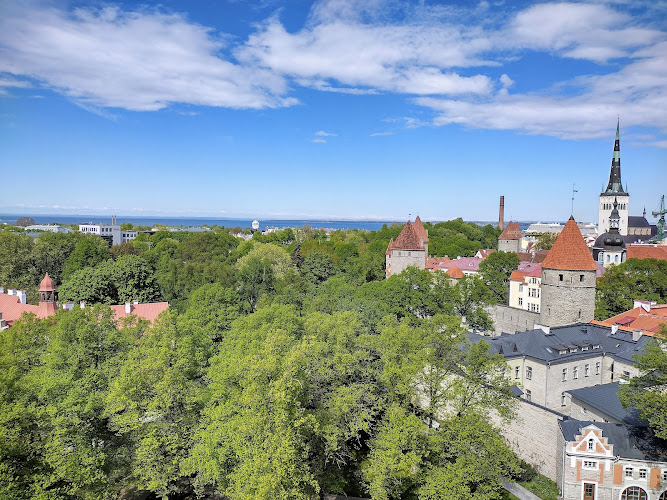
Danish King’s Garden, known locally as Taani Kuninga aed, is a compact green terrace tucked against Tallinn’s medieval fortifications. It is one of Old Town’s most atmospheric pauses: a lawn-and-path space enclosed by pale limestone walls, towers and the steep historic route between the Lower Town and Toompea Hill. The scale is intimate rather than park-like, but the setting compresses much of Tallinn’s identity into one short stop—Danish history, defensive architecture and roofscape views.
The garden is traditionally identified as the place where the Dannebrog, Denmark’s red-and-white flag, fell from the sky during the 1219 Battle of Lyndanisse, aiding King Valdemar II’s forces. Whether approached for that legend or for photographs, visitors find a deliberately quiet counterpoint to the busier Old Town lanes. Bronze hooded figures, old walls and changing views over tiled roofs reward a slower look, especially when you notice how sharply the hill drops toward the streets below.
Standout Highlights & What Not to Miss
Think of Danish King’s Garden as an outdoor historical scene rather than a destination requiring a long itinerary slot. Walk its edges, look through the openings in the fortifications and take time to read the landscape: towers, walls and lanes here explain why Toompea was such an important stronghold. The garden is particularly effective as a visual bridge between Tallinn’s political hilltop and mercantile Lower Town.
- The Dannebrog legend: Stand at the traditional site associated with the 1219 origin story of Denmark’s national flag. It gives a historical thread to what might otherwise seem like a small scenic garden.
- Hooded bronze monks: The three faceless sculptures are the garden’s signature photographic detail. Their dark, simplified forms create a striking contrast with grass, stone and the pale city walls.
- Medieval fortifications: Follow the line of the walls and look for the defensive towers nearby, including the structures associated with the Maiden Tower and Kiek in de Kök complex.
- Old Town roof views: From the garden’s outer edge, scan the red roofs and church spires below. The outlook is less formal than a major viewpoint and therefore feels more discovered than staged.
- The Short Leg approach: The old lane linking the two levels of the city is part of the experience. Its cobbles and slope make the transition between neighborhoods tangible.
Visitor Strategy & Planning Snapshot
| Planning Factor | What to Expect | Practical Strategy |
|---|---|---|
| Ideal Arrival Window | The garden is most enjoyable when Old Town lanes are quieter and light reveals the texture of the walls and sculptures. | Visit earlier in the day for calmer photographs, or fold it into an evening Old Town walk for a more dramatic atmosphere. |
| Typical Time Needed | Most visitors need 20 to 40 minutes to walk the paths, see the sculptures and take in the outlook. | Allow longer only if using it as a rest stop or combining it immediately with nearby fortification museums and viewpoints. |
| Booking / Queue Reality | The garden itself is best treated as an informal outdoor stop rather than a timed attraction. Nearby museums operate separately. | Do not build the day around a garden queue; check current arrangements independently if entering Kiek in de Kök, the Maiden Tower or other paid interiors. |
| Terrain & Accessibility | Paths and surrounding approaches include uneven surfaces, with steep stepped cobbles on Lühike jalg. | Visitors using wheelchairs should approach via Komandandi tee and plan for uneven paths. Sturdy footwear is useful for everyone, particularly in wet conditions. |
| Weather / Seasonal Fit | This is an exposed outdoor garden where stone, grass and panoramic views change character with the season. | Choose dry conditions for safer cobbles and clearer views. In colder months, slow down on slick or icy surfaces and prioritize footing over the steep shortcut. |
Honest Trade-Offs: Best For vs. Who Might Skip
This is an excellent stop for history-minded first-time visitors, photographers, couples and anyone who enjoys small places with a strong sense of setting. It is not a destination for elaborate gardens, playgrounds, extensive interpretation or a long activity list. The reward comes from context: knowing the flag legend, seeing the monk sculptures and reading the walls as part of Tallinn’s larger medieval landscape. Travelers with limited mobility or little interest in cobbled, sloping Old Town routes may prefer to admire the fortifications from more accessible nearby streets instead.
Neighborhood Context & How to Pair Your Visit
Build Danish King’s Garden into a walk between the Lower Town and Toompea rather than making a special round trip. Start among the merchant-house streets and Town Hall area, climb toward the garden, then continue along the fortifications toward Kiek in de Kök and the Maiden Tower. From there, Toompea’s lookout terraces, cathedral area and government quarter are within the same hilltop circuit. Alternatively, descend again through the old lanes and let the garden serve as a quiet interlude before cafés, galleries or dinner in the Lower Town. The pairing works because the route turns Tallinn’s vertical geography into the story of the day.
When planning your Tallinn travel guide or comparing verified attractions and parks in Tallinn, pair this stop with standout local spots including Swissôtel Tallinn, Restaurant Pegasus, Hotel Telegraaf, and Alexander Nevsky Cathedral (nearby).


