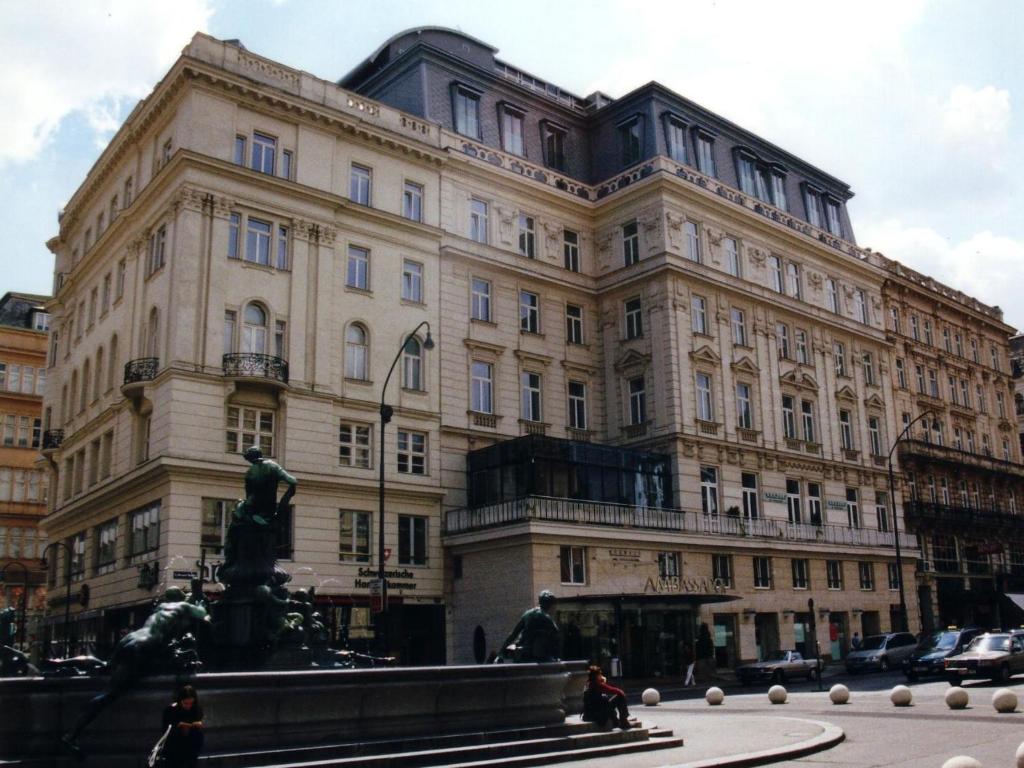
Hotel Ambassador Wien occupies one of the most recognizable corner addresses in Vienna’s First District, standing where Kärntner Straße meets Neuer Markt just steps from the Vienna State Opera. Though technically a working five-star hotel rather than a museum or monument, the Ambassador has functioned as a de facto cultural landmark since 1866, hosting emperors, opera stars, and literary figures, and its ornate Ringstraße-era facade makes it a fixture on any architectural walk through central Vienna.
Hotel Ambassador Wien sits at Kärntner Straße 22, Vienna’s inner city, a 450-metre walk from St. Stephen’s Cathedral and six minutes from the State Opera. Opened in 1866 on the site of a former bakery, it has hosted Mark Twain, Marlene Dietrich, and Karl Lagerfeld. Rooms run roughly €250–€600 per night; the on-site restaurant serves classic Viennese fare from about €25–€45 per main. Book directly for the best rates and arrive after 3pm for smooth check-in.
At A Glance
| Address | Kärntner Straße 22 / Neuer Markt 5, 1010 Vienna, Austria |
| Operating Hours | Reception 24 hours; restaurant and café generally 7:00–23:00 |
| Price Range | Rooms approx. €250–€600/night; dining approx. €15–€45 per dish |
| Highlights | Historic facade, Emperor’s Suite, guest history (Mark Twain, Dietrich, Lagerfeld), central location, in-house restaurant and winter garden |
| Transport/Transit | U1/U3 Stephansplatz (5-min walk); Karlsplatz U1/U2/U4 (6-min walk); Tram lines 1, 2, 71 at Kärntner Ring/Oper |
Deep Origins, Architectural Evolution & Cultural Significance
The Ambassador’s site has carried commercial weight since the medieval period, when Neuer Markt functioned as Vienna’s grain and flour market. The building that stands today rose in 1866, replacing an older bakery and residential block, during the decade when Vienna tore down its medieval fortifications to build the Ringstraße. This was the era of Historicism, when Viennese architects borrowed freely from Renaissance, Baroque, and Neoclassical vocabularies to project the confidence of a rapidly modernizing imperial capital. The Ambassador’s facade reflects that eclecticism: rusticated stonework at street level, tall arched windows on the piano nobile, and a mansard roofline that echoes Parisian models fashionable among Central European elites of the period.
By the late nineteenth century the building had converted into a hotel catering to the growing class of railway-borne travelers, diplomats, and touring performers drawn to Vienna’s opera houses and concert halls. Its proximity to the State Opera, completed in 1869, made it a natural lodging choice for singers and conductors, and hotel lore holds that numerous opera stars stayed there during premieres. The twentieth century brought both damage and restoration; like much of central Vienna, the building suffered during the Second World War and underwent postwar repair that preserved its historic shell while modernizing interior systems. Subsequent renovations through the late twentieth and early twenty-first centuries have kept the property operating continuously as a five-star hotel, making it one of the longer-running hospitality addresses in the inner city.
Culturally, the Ambassador matters less for a single dramatic event than for its cumulative role as a stage for Vienna’s social and artistic life. It sits within the pedestrian shopping corridor of Kärntner Straße, one of the busiest retail streets in the city, while its Neuer Markt facade overlooks the Donner Fountain and the entrance to the Kapuzinergruft, the Capuchin Crypt where generations of Habsburg emperors are interred. That juxtaposition—a commercial hotel facade standing over the resting place of an imperial dynasty—captures something essential about Vienna itself: layers of grandeur folded into everyday urban function.
Signature Highlights & Detailed Offerings
Guests and passersby alike recognize the Ambassador by its ground-floor arcade, lined with polished brass shopfronts and awnings, and by the gilded lettering above the entrance. Inside, the lobby retains marble flooring, crystal chandeliers, and a curved reception desk finished in dark wood veneer. The hotel’s most requested accommodation is the suite associated with Mark Twain, who reportedly stayed at the property during an extended Vienna sojourn in the 1890s; the room is furnished with period-style writing desks and framed archival photographs referencing his visit. Marlene Dietrich and, in more recent decades, Karl Lagerfeld are also cited among documented guests, reinforcing the hotel’s identity as a waypoint for cultural figures passing through the city.
The in-house restaurant serves Austrian classics alongside international dishes. Typical menu items include Wiener Schnitzel vom Kalb (veal schnitzel) served with parsley potatoes and lingonberry, priced around €32–€38; Tafelspitz, the boiled beef dish associated with Emperor Franz Joseph’s own dining habits, at roughly €28; and a Kaiserschmarrn dessert with plum compote for about €14. The hotel’s café section offers Viennese Melange coffee and Sachertorte-style cakes, catering to the steady foot traffic from Kärntner Straße shoppers and opera-goers seeking a pre-performance meal. A winter garden space, glass-roofed and filled with potted greenery, provides a quieter alternative to the street-facing dining room, often used for breakfast service and small private events.
Sensory & Spatial Walkthrough
Approaching from Kärntner Straße in late morning, the Ambassador announces itself with reflected light bouncing off brass shop fixtures and the pale stone of its lower facade, while pedestrian noise from the shopping street softens once you step under the entrance canopy. The lobby interior shifts the acoustic register immediately: marble floors carry footsteps at a controlled volume, and soft piano or ambient recordings often play at low levels near the reception desk. Natural light filters in modestly through the front doors and side windows, supplemented by chandelier illumination that gives the space a warm, amber cast even at midday.
By early evening, the character of the building changes again. The Neuer Markt-facing rooms catch the last low sun over the square, illuminating the Donner Fountain directly opposite, while inside, the restaurant’s table lamps and wall sconces take over as the primary light source. Seating throughout tends toward heavy upholstered chairs and banquettes in deep reds and browns, a palette consistent with the historicist mood of the building rather than a contemporary minimalist update. Late at night, after the shops along Kärntner Straße close, the immediate street quiets considerably, and the hotel’s exterior lighting becomes one of the more prominent features on an otherwise dim pedestrian corridor.
Insider Visitor Strategy & Pro Tips
- Visit or photograph the exterior in mid-morning (9:00–10:30) before Kärntner Straße’s pedestrian traffic peaks, especially in July and August.
- Book directly through the hotel’s official website for package rates that sometimes beat third-party OTAs, particularly for multi-night stays.
- If not staying overnight, request a table at the restaurant or winter garden for a relatively quiet lunch; dinner service fills quickly during State Opera performance nights.
- December brings Christmas market crowds to nearby Stephansplatz and Am Hof; arrive before 10am if photographing the facade without holiday market stalls blocking sightlines.
- The best exterior photography angle is from the diagonal corner of Neuer Markt near the Donner Fountain, capturing both the hotel’s rounded corner facade and the fountain sculpture in frame.
- Formal dress is not strictly required, but smart-casual attire is expected in the restaurant, particularly for dinner.
Curated Half-Day Neighborhood Pairing Itinerary
Start at the Ambassador’s Neuer Markt entrance around 9:30am and walk two minutes to the Kapuzinergruft (Capuchin Crypt), where entry costs approximately €8.50 and the visit runs about 30–40 minutes among Habsburg imperial tombs. From there, walk six to seven minutes north along Kärntner Straße toward Stephansplatz to view St. Stephen’s Cathedral; entry to the nave is free, though the South Tower climb (€6.50) or catacombs tour add roughly 30–45 minutes if time allows. Conclude the loop with a ten-minute walk to Café Diglas or Demel on Kohlmarkt for a coffee and pastry break, both serving classic Viennese cakes in the €6–€9 range, before returning to the Ambassador area via Graben, a five-minute walk. The full circuit covers under two kilometers and fits comfortably into a three-hour window.
Practical Logistics & Universal Accessibility
The nearest metro stations are Stephansplatz (U1, U3) and Karlsplatz (U1, U2, U4), both roughly a five- to six-minute walk. Tram lines 1, 2, and 71 stop at Kärntner Ring/Oper, adjacent to the State Opera, a similarly short walk away. The hotel entrance on Kärntner Straße is step-free from the pedestrian zone, though guests with mobility needs should confirm elevator access to upper floors directly with reception, as historic buildings in this district sometimes retain narrower corridors on upper levels. Public parking is available at the Kärntner Ring garage and the Am Hof garage, both within a 10-minute walk, with rates typically around €4–€5 per hour or €30–€40 per day. Payment at the hotel is accepted via major credit cards, and the property does not enforce a strict formal dress code outside its dining venues, though smart-casual attire is customary in public areas.
Practical Visitor FAQs
Is Hotel Ambassador Wien open to non-guests? Yes, the ground-floor restaurant, café, and lobby areas are accessible to the public, though guest rooms and upper floors remain private.
How far is it from St. Stephen’s Cathedral? Approximately 450 metres, a five- to seven-minute walk along Kärntner Straße.
What is the average nightly room rate? Standard rooms typically range from €250 to €400 per night, with suites reaching €500–€600 depending on season and demand around opera performances or Christmas markets.
Which historical figures stayed at the hotel? Documented guests include Mark Twain, Marlene Dietrich, and Karl Lagerfeld, among other performers and dignitaries tied to Vienna’s opera and diplomatic circles.
Is the restaurant reservation required? Reservations are recommended, particularly for dinner during State Opera season (September through June) when nearby performance schedules increase demand.
What is the closest public transit stop? Stephansplatz station (U1/U3) is the closest metro stop, roughly five minutes on foot; the Kärntner Ring/Oper tram stop is similarly close.