
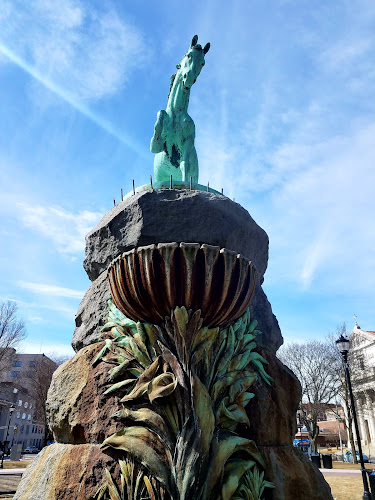
Waterbury Green is the compact historic common at the center of downtown Waterbury, Connecticut: a shaded civic park where paths, memorials, lawns, and a ring of older city buildings make a useful pause in the Brass City. It is not a destination for trails or active recreation. Its appeal is the chance to read Waterbury’s public history at walking pace, with substantial monuments standing only a few minutes apart.
The Green follows the long New England tradition of a town common, but its strongest visual character comes from Waterbury’s nineteenth-century civic ambition. Mature trees soften the urban setting, benches invite a break, and the surrounding downtown streets keep the park connected to transit, churches, storefronts, and architecture. For visitors arriving to explore the city rather than simply pass through, it is an easy, free introduction to the historic core.
Standout Highlights & What Not to Miss
Plan to stroll rather than rush. The Green is small enough to cover quickly, yet the monuments reward a slow circuit: step back for the overall compositions, then move closer to inspect inscriptions, bronze work, stone details, and the changing views framed by trees and downtown façades.
- Soldiers’ Monument: The park’s major Civil War memorial is its essential stop. Dedicated in 1884 and created by sculptor George Edwin Bissell, it commemorates Waterbury’s Civil War service. Walk around the pedestal instead of viewing it from only one direction; the scale and sculptural program are best understood in the round.
- Carrie Welton Fountain: At the other end of the Green, this distinctive bronze horse fountain provides the park’s most memorable silhouette. Dedicated in 1888 and designed by Karl Gerhardt, it honors Knight, the beloved horse of Waterbury philanthropist and animal advocate Carrie Welton.
- Shaded pause points: Benches beneath mature deciduous trees make this a practical reset between downtown sights. Bring coffee, a snack, or a guidebook, but treat the Green as a civic landscape rather than a picnic lawn designed for day-long recreation.
- Architecture at the edges: Look outward as often as inward. Commercial blocks, church architecture, and the broader historic streetscape explain why the monuments feel rooted here rather than isolated in a modern plaza.
- Short photo walk: The horse fountain, monument, tree canopy, and street-facing views offer varied images in a very compact area. Morning or later-afternoon light can help reveal surface detail while reducing the harsh contrast common around pale stone and pavement.
Visitor Strategy & Planning Snapshot
| Planning Factor | What to Expect | Practical Strategy |
|---|---|---|
| Ideal Arrival Window | A downtown outdoor stop that is most enjoyable when you can look closely at memorials and linger on a bench. | Build it into a daytime walking route, allowing time to circle both landmark ends of the Green. |
| Typical Time Needed | Most visitors need 30 to 45 minutes for an unhurried circuit, photographs, and a short rest. | Allow longer if you enjoy monument inscriptions, public sculpture, or architectural observation. |
| Booking / Queue Reality | This is a public green, not a ticketed museum attraction; the experience is self-guided. | No advance reservation is part of a normal visit. Pair it with nearby indoor stops if your schedule needs structure. |
| Terrain & Accessibility | Relatively level paved paths, perimeter curb ramps, and benches support wheelchair and stroller use. | Proceed carefully around uneven paving and, in winter, possible ice. A slow perimeter-to-interior route is the simplest approach. |
| Weather / Seasonal Fit | Tree shade is an asset in warmer weather; winter makes the monuments more exposed and paving conditions more important. | Choose comfortable walking shoes, dress for an open urban setting, and use nearby indoor downtown options during poor weather. |
Honest Trade-Offs: Best For vs. Who Might Skip
Waterbury Green is best for Civil War history enthusiasts, public-art walkers, budget-conscious families, and travelers who like discovering a city through its civic spaces. It works especially well as a short cultural stop because the principal sights are close together and the visit costs nothing. On the other hand, visitors seeking playgrounds, sports facilities, long nature walks, major museum-style interpretation, or a programmed attraction may find it too quiet and compact. The reward here is observation: sculpture, civic memory, shade, and downtown context rather than entertainment infrastructure.
Neighborhood Context & How to Pair Your Visit
Use the Green as the anchor for a walk through downtown Waterbury. Start with the Soldiers’ Monument, follow the paths toward the Carrie Welton Fountain, then continue along the surrounding blocks to study church towers, historic commercial architecture, and the city’s changing streetscape. Nearby bus connections make the area workable without a car, while the compact setting suits visitors who want to connect several short stops on foot. For the most satisfying itinerary, combine a monument circuit with a meal or coffee downtown and an indoor cultural or architectural stop, giving the Green a clear role as the outdoor chapter of a broader Waterbury visit.
When planning your Waterbury travel guide or browsing verified parks in Waterbury, pair this stop with standout local spots including Waterbury Center State Park, Hamilton Park, Urban Air Trampoline and Adventure Park, and Mattatuck Museum (0.2 km away).


