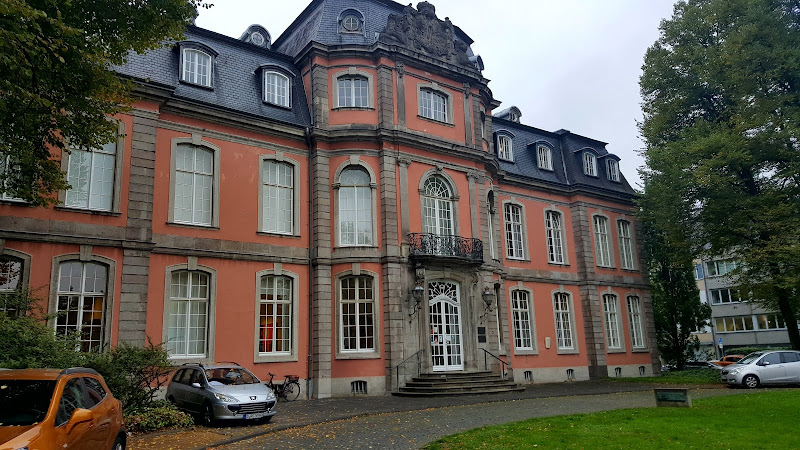
Schloss Jägerhof is an eighteenth-century hunting palace housing Düsseldorf’s Goethe-Museum at Jacobistraße 2, 40211 Düsseldorf, in Pempelfort beside the Hofgarten. Commissioned by Elector Carl Theodor and built between 1752 and 1763 to designs by Johann Joseph Couven, the palace combines Rococo architecture with a substantial literary collection. Visit for Goethe’s manuscripts, early editions, portraits, and the chance to explore a quieter cultural landmark beyond the Altstadt.
What to Expect at Schloss Jägerhof
This is a literary museum inside a palace, rather than a sequence of furnished royal apartments. The Goethe-Museum opened in 1956 and moved into Schloss Jägerhof in 1987. Its foundation is the collection assembled by publisher Anton Kippenberg and his wife Katharina, preserved through their namesake foundation. Manuscripts, letters, books, graphic works, and decorative objects trace Johann Wolfgang von Goethe’s life, relationships, and intellectual interests. Familiar titles such as The Sorrows of Young Werther and Faust provide useful starting points even if German literature is not your specialty.
The displays extend beyond Goethe the author to his engagement with art, music, and natural science. Portraits and silhouettes give faces to his circle, while illustrated editions demonstrate how successive generations interpreted his writing. Outside, study the palace’s symmetrical composition, projecting central section, tall windows, and mansard roof. Wartime damage and subsequent reconstruction mean the building should not be mistaken for an untouched eighteenth-century interior. Begin with the biographical displays, continue through the thematic material, then leave time for temporary exhibitions and the museum’s book selection.
- Kippenberg collection: A publisher’s extensive Goethe collection anchors the museum’s literary and cultural displays.
- Letters and manuscripts: Handwritten documents bring Goethe’s working life and personal connections into focus.
- Early and illustrated editions: Books reveal the publication history and visual interpretation of works including Faust.
- Rococo palace exterior: Couven’s design offers a compact architectural counterpoint to Düsseldorf’s larger civic monuments.
- Hofgarten setting: The adjoining public park makes it easy to combine concentrated museum time with an outdoor walk.
Schloss Jägerhof at a Glance
| Detail | Information |
|---|---|
| Address | Jacobistraße 2, 40211 Düsseldorf, Germany |
| Neighborhood / Area | Pempelfort, eastern edge of the Hofgarten |
| Operating Hours | Tuesday–Friday and Sunday 11am–5pm; Saturday 1–5pm; Monday closed. Check holiday arrangements before traveling. |
| Admission / Price Range | Paid museum admission; budget tier ($). Consult the official website for current tickets and concessions. |
| Recommended Visit Duration | 60–90 minutes; around two hours with a park walk |
| Nearest Transit / Parking | Schloss Jägerhof tram stop, lines 701 and 705; paid Schauspielhaus underground parking near Gustaf-Gründgens-Platz |
| Official Website & Phone | Goethe-Museum Düsseldorf; +49 211 8996262 |
Visiting Tips, Getting There & Nearby Pairings
Arrive near opening on a weekday for an unhurried look at text-heavy displays; remember that Saturday opening is later. Check the official exhibition and events calendar before choosing your date, particularly if you want a guided tour. Ask reception about available language support or audio interpretation. Travel light, ask where larger bags should be stored, and check photography permissions before taking pictures of manuscripts or temporary loans. Treat the museum as the main activity rather than planning around an on-site meal.
Trams 701 and 705 stop close to the palace at Schloss Jägerhof; use Rheinbahn for current connections. Drivers can use the paid Schauspielhaus garage and walk through the surrounding cultural quarter. The historic building has entrance steps and exhibition spaces on different levels: wheelchair users should telephone before traveling to establish a workable access route, and stroller users should discuss storage at reception. For nearby pairings, walk five minutes into the Hofgarten’s central paths, about ten minutes to the Schauspielhaus, or roughly fifteen minutes to Kö-Bogen’s contemporary architecture and shops.
Frequently Asked Questions
What are Schloss Jägerhof’s hours, and when should I visit?
The museum opens Tuesday–Friday and Sunday from 11am to 5pm, and Saturday from 1pm to 5pm; Monday is closed. A weekday arrival at opening leaves ample time for both the collection and the Hofgarten.
Is admission free, and should I reserve?
Museum admission is paid and falls in the budget price tier. Check the official website for current rates, concessions, and any booking requirements for guided visits or special events.
How long should I allow?
Allow 60–90 minutes for the permanent displays and a temporary exhibition. Readers interested in manuscripts and publishing history may prefer two hours, excluding a park walk.
Is Schloss Jägerhof suitable for families and visitors with limited mobility?
The collection best suits older children interested in books, history, or art; the Hofgarten offers a useful outdoor break. Entrance steps and the historic multilevel layout make advance discussion of mobility needs important.