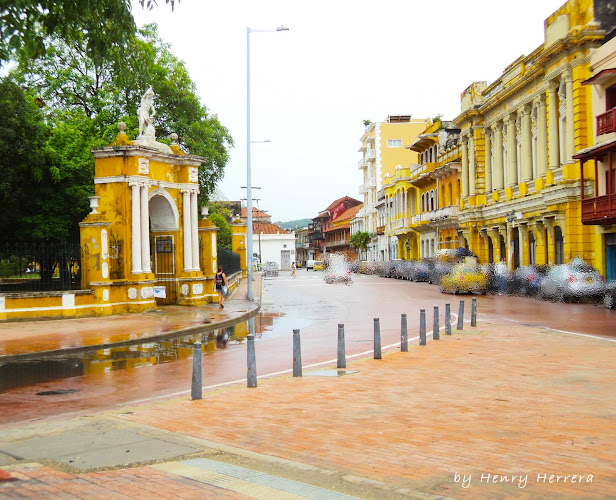
Ciudad Amurallada Cartagena is Cartagena de Indias’s historic walled center, entered at Boca del Puente s/n, Plaza de los Coches, in the Centro neighborhood, Bolívar, Colombia. Founded in 1533, colonial Cartagena became a fortified Caribbean port whose defenses and historic quarters earned UNESCO World Heritage status in 1984. Travelers come for coral-stone ramparts, balconied houses, churches, independent shops, and Caribbean sweets. This is a living urban district, not a shopping mall or an attraction in the coastal neighborhood of La Boquilla.
What to Expect at Ciudad Amurallada Cartagena
Start beneath the Torre del Reloj, the principal gateway linking the old center with the waterfront outside its walls. Beyond it, Plaza de los Coches opens onto arcaded buildings and the Portal de los Dulces. Streets lead toward Plaza de la Aduana, the cathedral’s distinctive tower, and Plaza de Bolívar. Timber balconies, heavy wooden doors, shaded courtyards, and thick masonry reflect a city shaped by tropical weather and maritime commerce, including its painful history as a major port in the transatlantic slave trade.
Shopping is dispersed through Centro and San Diego rather than concentrated in one building. Las Bóvedas, constructed in the late eighteenth century between the Santa Clara and Santa Catalina bastions, contains 23 vaulted chambers behind a long arcade. Originally military storage and accommodation, the complex now houses souvenir and handicraft shops. Compare woven bags, hammocks, hats, and jewelry carefully: goods come from across Colombia, not exclusively Cartagena. Around Calle de la Iglesia and Calle del Santísimo, boutiques offer a different experience from the market-style browsing at the vaults.
- Torre del Reloj: The historic gateway gives an immediate introduction to Cartagena’s enclosed street plan.
- Portal de los Dulces: Vendors sell coconut cocadas and caballitos, sweets made from shredded papaya.
- Las Bóvedas: Browse handicrafts inside former military vaults beneath the northern fortifications.
- Plaza de Santo Domingo: Look for Fernando Botero’s reclining bronze figure, commonly called Gertrudis, beside the church.
- Baluarte de Santo Domingo: This elevated stretch of wall overlooks the Caribbean and attracts sunset walkers.
Ciudad Amurallada Cartagena at a Glance
| Detail | Information |
|---|---|
| Address | Main gateway: Boca del Puente s/n, Plaza de los Coches, Centro, Cartagena de Indias, Bolívar, Colombia |
| Neighborhood / Area | Centro and San Diego, within Cartagena’s historic fortifications |
| Operating Hours | Public streets and plazas accessible daily, around the clock; individual shops, churches, museums, and wall sections have separate schedules |
| Admission / Price Range | Free access to public streets, plazas, and accessible ramparts; $$ for a moderate shopping-and-refreshment outing; purchases and museum admission extra |
| Recommended Visit Duration | 3 to 4 hours |
| Nearest Transit / Parking | Transcaribe’s La Bodeguita station near the clock-tower entrance; paid parking in neighboring La Matuna |
| Official Website & Phone | Cartagena municipal website; no single district visitor telephone |
Visiting Tips, Getting There & Nearby Pairings
Walk between 8 and 10 a.m. for cooler conditions and clearer architectural views; return after 4 p.m. for browsing and sunset. Midday heat and humidity make shaded breaks essential. Public-space access needs no reservation, but book popular restaurants directly. Carry Colombian pesos for small sweets and handicraft purchases; established boutiques commonly accept cards. Ask about materials, artisan origin, and receipts before buying higher-value goods, particularly emerald jewelry. There is no district-wide tax-refund, shipping, or workshop service: arrangements depend on each retailer.
Arrive via La Bodeguita or take a taxi to the clock-tower area, then continue on foot; central streets are narrow and vehicle access varies. Parking outside the walls avoids difficult circulation. Street-level routes connect the main plazas, but uneven paving, high curbs, and intermittent narrow sidewalks complicate wheelchair and stroller travel. Rampart access includes slopes and stairs, with no continuous step-free circuit. Plaza benches offer resting places; toilets are generally in cafés, restaurants, or museums. From the clock tower, pair your walk with Parque del Centenario, about five minutes away, and Getsemaní’s Plaza de la Trinidad, roughly 10–15 minutes away.
Frequently Asked Questions
What are the opening hours and best visiting times?
The district’s public streets do not have a single opening or closing time. Early morning suits walking and photography; late afternoon combines shopping with a cooler waterfront stroll.
Do I need a ticket or reservation?
No ticket or reservation is required to enter the walled city. Museums, guided tours, restaurants, and individual attractions charge separately; there is no compulsory general admission fee.
How long should I spend here?
Allow three to four hours for the principal plazas, Las Bóvedas, refreshments, and a rampart walk. Add another half-day for museums, a leisurely lunch, and more extensive shopping.
Is it suitable for families and visitors with limited mobility?
Families can explore at their own pace, but traffic, heat, and exposed rampart edges require attention. Visitors with limited mobility should prioritize street-level plazas; wear light clothing outside and cover shoulders and knees when entering active churches.
When planning your Cartagena travel guide or browsing verified attractions in Cartagena, pair this stop with standout local spots including Centenario Park, Pezetarian Cartagena, Casa Lola Luxury Collection, and Inkanto Cartagena (nearby).