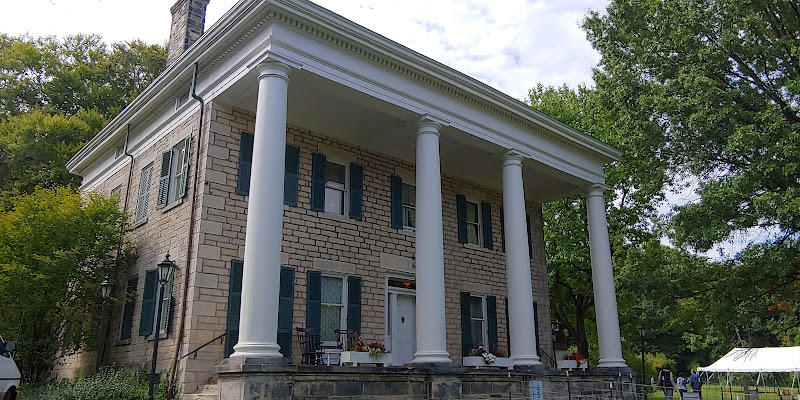
Simon Perkins Stone Mansion is an 1837 Greek Revival house museum in Akron’s historic Mutton Hill area, where substantial sandstone walls, a balanced classical façade, a columned entrance, and a rooftop cupola immediately set it apart from an ordinary neighborhood stop. Built for Colonel Simon Perkins, son of Akron cofounder General Simon Perkins, the house offers a focused introduction to the family whose landholdings, enterprises, and civic ambitions helped shape early Akron.
This is a place for looking closely rather than rushing through a long run of galleries. Guided tours move through furnished domestic interiors and family collections, using the rooms to trace nineteenth-century household life, business, agriculture, and local history. The mansion’s story also reaches beyond the family: abolitionist John Brown lived nearby and worked with Perkins in the wool trade, giving the visit an important connection to the region’s antislavery past.
Standout Highlights & What Not to Miss
The mansion is most rewarding when visitors treat architecture and interpretation as one experience. Pause outside before the tour, then use the interior rooms to understand how the Perkins family’s public influence was rooted in a working estate and a carefully ordered home. Ask questions: the guide’s context is what turns period furnishings and objects into a coherent Akron story.
- The sandstone exterior: Take time for the Greek Revival composition before entering. The masonry, symmetry, entrance treatment, and cupola make the mansion one of the clearest architectural encounters with prosperous early Ohio.
- Guided house tours: The visit is centered on interpretation rather than self-directed label reading. Listen for how individual rooms functioned and how domestic life related to the family’s wider business and civic world.
- Perkins family collections: Period furnishings and family-associated material give the house its texture. It is worthwhile to ask which pieces belonged to the family and which help furnish the broader nineteenth-century setting.
- The John Brown connection: Ask a guide to explain the nearby John Brown House, Brown’s relationship with Perkins, and the role of wool trading. This is a particularly valuable thread for visitors interested in abolitionist history.
- Mutton Hill’s agricultural legacy: Seasonal sheep programming recalls the area’s farming identity. When offered, it adds a tangible, family-friendly dimension to stories that can otherwise feel centered on formal rooms and influential residents.
Visitor Strategy & Planning Snapshot
| Planning Factor | What to Expect | Practical Strategy |
|---|---|---|
| Ideal Arrival Window | A house-museum visit works best when you can join a guided tour without needing to hurry onward. | Plan this as an anchor stop in a relaxed West Akron outing, and confirm tour availability before making a tight itinerary. |
| Typical Time Needed | Most visitors spend about 1 to 1.5 hours, including exterior viewing, the tour, and time for questions. | Allow extra time if you enjoy architecture, local history, or browsing the gift shop. |
| Booking / Queue Reality | Access and interpretation are organized around guided house tours rather than a large, continuously flowing museum floor. | Check ahead for current admission and tour procedures, especially for a weekend, group visit, or seasonal program. |
| Terrain & Accessibility | Historic thresholds and interior stairs affect navigation, and room-to-room movement reflects the building’s historic layout. | Call ahead to discuss step-free entry and accessible room routes so expectations can be matched to individual needs. |
| Weather / Seasonal Fit | The interior offers a worthwhile all-weather history stop; exterior appreciation and sheep programming are especially appealing in pleasant conditions. | Pair it with a fair-weather neighborhood walk, but keep the mansion on the list when rain or cold makes outdoor plans less inviting. |
Honest Trade-Offs: Best For vs. Who Might Skip
This mansion is a strong choice for early Ohio history enthusiasts, Greek Revival architecture admirers, historic-house regulars, and families with school-age children who can engage with a guided narrative. It is also a meaningful stop for travelers building an Akron itinerary around John Brown and abolitionist history. The trade-off is scale: this is an intimate house museum, not a major exhibition complex with broad interactive programming or a full day’s worth of galleries. Visitors seeking a quick photo stop, extensive hands-on activities, or fully barrier-free circulation may find it less suitable. Its best audience is curious and unhurried, willing to let a guide connect details of furnishings, farming, trade, and family life.
Neighborhood Context & How to Pair Your Visit
Build the mansion into a history-minded West Akron outing rather than treating it as an isolated detour. Start with the exterior and a guided tour, then ask about the nearby John Brown House to extend the story of Mutton Hill, wool commerce, and abolitionist connections. Leave room afterward for the Mutton Hill Gift Shop, where browsing can provide a useful local-history coda. The surrounding neighborhood is best approached at a walking pace: notice the contrast between this formal sandstone landmark and its residential setting, then continue to another Akron museum, park, or meal stop according to your interests. Because the mansion’s impact comes from context, pairing it with a short neighborhood walk and a second history-oriented stop makes the visit feel richer than simply checking off a single building.
When planning your Akron travel guide or comparing verified attractions and museums in Akron, pair this stop with standout local spots including LeBron James' Home Court, Blue Water Majesty Museum, The Lamp Post, and Akron Zoo (0.8 km away).