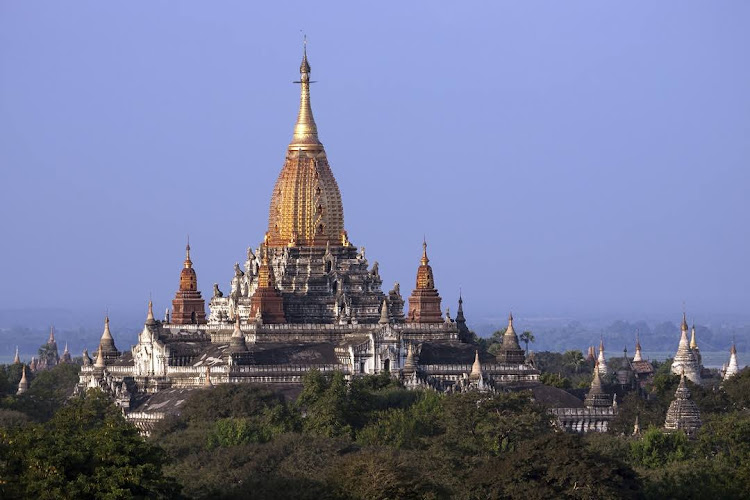
Shwezigon Pagoda is an active Buddhist pilgrimage complex on Shwezigon Pagoda Road in Nyaung-U, at the northeastern edge of Myanmar’s Bagan archaeological landscape. Its precinct has no numbered street address. Begun under King Anawrahta in the 11th century and completed under King Kyansittha, the monumental gilded stupa became a model for later Burmese pagodas. Travelers come for its bell-shaped silhouette, early Buddhist sculpture, and living traditions of offerings, circumambulation, and spirit worship.
What to Expect at Shwezigon Pagoda
The central stupa rises above three square terraces, with corner ornament, successive circular moldings, and an umbrella finial known as an hti. Unlike Bagan’s hollow temples, it is a solid reliquary: visitors explore the surrounding precinct rather than entering the monument. Buddhist tradition associates it with sacred tooth and bone relics. Walk clockwise around the base to appreciate the changing proportions and the glazed terracotta plaques illustrating the Jataka stories, accounts of the Buddha’s previous lives.
Four cardinal shrines contain standing bronze Buddhas associated with Kyansittha’s reign. Elsewhere, Mon-language inscriptions connect the complex with the kingdom’s religious and political history. A separate shrine to the traditional 37 nats reveals the relationship between Buddhism and Myanmar’s older spirit traditions. Covered entrance passages shelter stalls selling flowers, incense, and devotional goods; beyond them, the open courtyard is a working religious space, with worshippers kneeling beside offerings rather than following a museum-style route.
- Golden central stupa: The bell-shaped monument and tiered terraces established an influential Burmese pagoda form.
- Jataka plaques: Glazed narrative panels turn the lower monument into a sequence of Buddhist moral stories.
- Standing bronze Buddhas: Cardinal shrines preserve important examples of early Bagan-period metal sculpture.
- Nat shrine: Figures representing the 37 traditional spirits add another dimension to the precinct’s religious life.
- Mon inscriptions: Inscribed pillars illuminate Kyansittha’s patronage and the multilingual culture of the Bagan kingdom.
Shwezigon Pagoda at a Glance
| Detail | Information |
|---|---|
| Address | Shwezigon Pagoda Road, Nyaung-U, Mandalay Region, Myanmar; unnumbered precinct |
| Neighborhood / Area | Western Nyaung-U, northeastern Bagan archaeological landscape |
| Operating Hours | Monday–Sunday, 5:00 a.m.–9:00 p.m. |
| Admission / Price Range | Generally free temple entry; donations welcome. Separate Bagan archaeological-zone charges may apply. Budget tier: $. |
| Recommended Visit Duration | 45 to 75 minutes |
| Nearest Transit / Parking | No metro or railway stop at the pagoda; arrive by taxi, hotel-arranged car, or locally permitted e-bike. Vehicle parking is outside the entrance passages. |
| Official Website & Phone | Visitor inquiries by telephone: +95 61 60 262 |
Visiting Tips, Getting There & Nearby Pairings
Arrive around 6:00–8:00 a.m. for cooler paving and softer light on the gold surface; late afternoon also works well. The Tazaungdaing festival period, usually in October or November, can bring substantial pilgrimage crowds. Independent visits do not normally require timed reservations. Arrange a return pickup with your driver, and follow attendants’ directions for parking outside the sacred precinct. Check current travel restrictions and local access conditions before traveling around Bagan.
Remove both shoes and socks before entering, and cover shoulders and knees. Broad courtyard sections allow comparatively straightforward movement, but entrance steps, raised shrine thresholds, and terrace stairs interrupt step-free circulation; wheelchair users should arrange assistance rather than expect a fully accessible route. Shaded passages provide relief, while exposed paving becomes uncomfortable barefoot at midday. Pair the visit with Kyansittha Umin, a nearby tunnel sanctuary roughly 5–10 minutes away on foot, or continue toward Nyaung-U’s Ayeyarwady riverfront, approximately a 10–15-minute walk depending on the lane and landing.
Frequently Asked Questions
What are Shwezigon Pagoda’s hours, and when should I visit?
The pagoda opens daily from 5:00 a.m. to 9:00 p.m. Early morning offers cooler barefoot walking, while late afternoon brings gentler light; allow worshippers space during ceremonies.
Do I need a ticket or advance reservation?
Temple entry is generally free, with voluntary donations supporting religious activities and upkeep. Bagan archaeological-zone requirements are separate, so check local collection arrangements and carry any applicable zone ticket.
How long should I spend at Shwezigon Pagoda?
Allow 45–75 minutes for a clockwise circuit, the bronze Buddha shrines, and the nat shrine. Architecture enthusiasts or visitors observing devotional activity may prefer about 90 minutes.
Is the pagoda suitable for families and visitors with limited mobility?
Families can explore the courtyard together, but children need protection from hot paving and supervision around lamps and offerings. Steps and thresholds limit independent wheelchair access; modest clothing and bare feet are required in the sacred precinct.
When planning your Bagan travel guide or comparing verified attractions and buddhist temple in Bagan, pair this stop with standout local spots including Ananda Temple, Shwesandaw Pagoda, The Hotel @ Tharabar Gate, and Ananta Bagan (0.7 km away).