Royal Museums of Fine Arts of Belgium is Belgium’s national fine-art museum institution, with its principal entrance at Rue de la Régence 3, 1000 Brussels, Belgium, in the Royal Quarter beside Place Royale. Founded in 1801 under French rule, it holds more than 20,000 paintings, sculptures and drawings. Travelers come for Pieter Bruegel the Elder, Flemish masters and René Magritte, but should approach it as a group of collections with separate visiting arrangements, rather than one uninterrupted exhibition.
What to Expect at Royal Museums of Fine Arts of Belgium
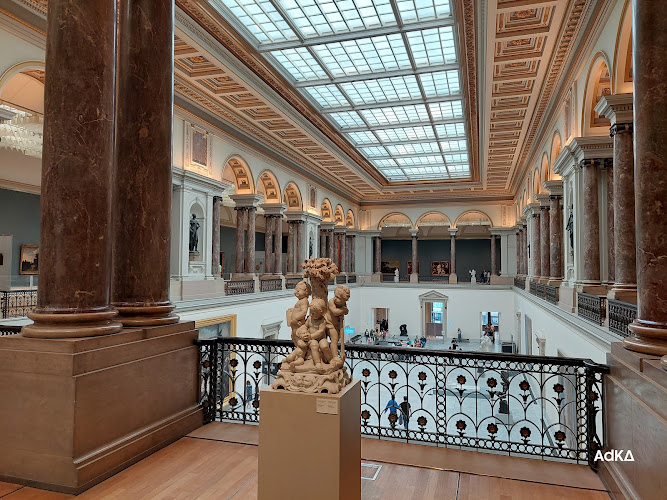
The Oldmasters Museum anchors the historic collection, tracing European painting from early Netherlandish religious panels to large-scale Baroque works. Bruegel’s The Fall of the Rebel Angels rewards close inspection: armored angels battle fantastical creatures assembled from animals, instruments and everyday objects. His The Census at Bethlehem places a biblical narrative inside a snowy village. Works by Rubens, Van Dyck and Jordaens broaden the Flemish story, while Jacques-Louis David’s The Death of Marat brings revolutionary politics into sharp focus. The main museum building, designed by Alphonse Balat and inaugurated in 1887, has an imposing central sculpture hall.
The adjoining Magritte Museum occupies the neoclassical Hôtel Altenloh on Place Royale. Its chronological presentation connects paintings with drawings, photographs, advertising work and archival material, making the artist’s visual puzzles easier to understand. Collection landmarks include The Empire of Light and The Return; individual displays can change. The wider institution also encompasses the Fin-de-Siècle and modern collections, plus the Wiertz and Meunier artist museums in Ixelles. These are not all continuously accessible on the central-site route, so check the current museum-by-museum opening notices before planning around a particular collection.
- Bruegel close-ups: Follow the tiny figures and extraordinary creatures in his sixteenth-century paintings.
- Flemish Baroque: Compare Rubens’s dramatic compositions with Van Dyck’s portraiture and Jordaens’s robust figures.
- Revolutionary history: Look for David’s spare, politically charged portrayal of Marat.
- Magritte’s visual contradictions: Explore impossible skies, transformed objects and the relationship between words and images.
- Two architectural settings: Contrast Balat’s monumental museum interiors with the Hôtel Altenloh’s Place Royale frontage.
Royal Museums of Fine Arts of Belgium at a Glance
| Detail | Information |
|---|---|
| Address | Rue de la Régence 3, 1000 Bruxelles, Belgium |
| Neighborhood / Area | Royal Quarter, beside Place Royale and above Mont des Arts |
| Operating Hours | Tuesday–Friday, 10am–5pm; Saturday–Sunday, 11am–6pm; Monday closed. Check individual museum and holiday notices. |
| Admission & Ticket Prices | Paid admission; collection and exhibition tickets vary. See official admission rates and booking options. |
| Recommended Visit Duration | 2–2.5 hours for a focused visit; 3–4 hours for Oldmasters and Magritte together |
| Nearest Transit / Parking | Royale tram stop, lines 92 and 93; Brussels-Central station about 10 minutes downhill; paid Albertine parking near Place de la Justice |
| Official Website / Phone | fine-arts-museum.be / +32 2 508 32 11 |
Visiting Tips, Getting There & Nearby Pairings
Arrive at opening on a weekday to give the detailed Bruegel paintings your freshest attention. Choose Oldmasters, Magritte or both before booking: a ticket for one museum should not be assumed to cover every collection or temporary exhibition. Reserve through the official website, especially for weekends and special shows. Royale is the simplest tram stop; Brussels-Central offers trains and metro lines 1 and 5, followed by an uphill walk. Drivers can use Albertine parking, but the tram avoids central Brussels traffic and the climb from the lower town.
The central museums provide lifts, wheelchair-accessible routes and adapted toilets; wheelchairs can be requested through the museum. Ask staff to direct wheelchair and stroller users to the appropriate step-free entrance, since the buildings connect across different levels. The surrounding streets include slopes and cobbles, and the Mont des Arts steps are not a step-free approach. Afterward, walk roughly five minutes to the Musical Instruments Museum for its Old England Art Nouveau façade, five to ten minutes to the Royal Palace frontage, or ten minutes to the Grand Sablon’s chocolate shops and cafés.
Frequently Asked Questions
When is the museum open, and when should I arrive?
Regular hours are 10am–5pm Tuesday–Friday and 11am–6pm on weekends, with Monday closure. Arrive at opening and check holiday exceptions before traveling.
Is admission free, and should I reserve?
General admission is paid. Ticket categories, concessions and exhibition supplements differ; use the official booking system to select the collections you want and review any free-entry eligibility.
How much time should I budget?
Allow 2–2.5 hours for a selective visit. For both Oldmasters and Magritte, set aside 3–4 hours, with a break rather than attempting every room at the same pace.
Is it suitable for children and wheelchair users?
Yes. Bruegel’s creatures and Magritte’s impossible scenes offer children engaging subjects. Lifts and adapted toilets support wheelchair visits; contact the museum beforehand for wheelchair loans and entrance guidance.
Continue browsing more top-rated attractions in Brussels to build out your trip.