
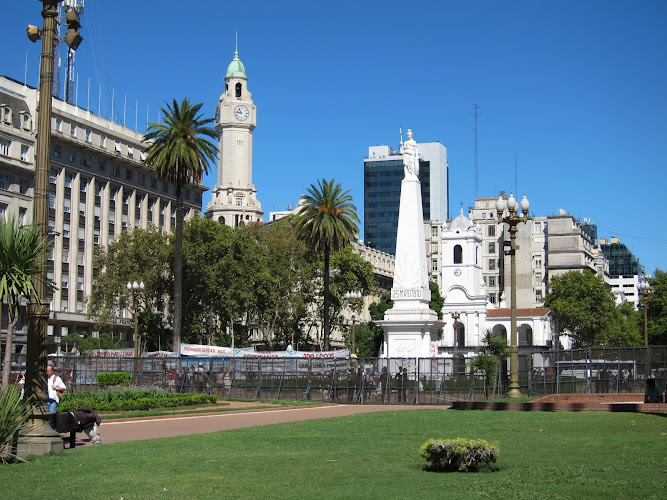
Pirámide de Mayo is Argentina’s first patriotic monument: a white, 18.8-meter pyramid in Plaza de Mayo, C1064AAA, in the Monserrat area of Buenos Aires, Argentina. First inaugurated on 25 May 1811 to mark the first anniversary of the May Revolution, it stands at the civic heart of the city, opposite Casa Rosada and close to the Cabildo and Metropolitan Cathedral. Travelers come for a concise, powerful introduction to Argentine independence, the monument’s neoclassical sculptural details, and the square’s continuing role in public life and demonstrations.
What to Expect at Pirámide de Mayo
This is an outdoor monument rather than a museum, so there are no indoor galleries, collections, ticket desk, or formal visitor trail. The experience is about reading the square itself: the broad paved paths, the pyramid’s elevated base, and sightlines toward Argentina’s principal political and religious landmarks. Pause on the pedestrian paths to view the monument in context, then circle it for changing perspectives against Casa Rosada’s pink façade and the arcades of the Cabildo.
The original 1811 structure, built under the direction of Francisco Cañete, was remodeled in 1856 by architect and painter Prilidiano Pueyrredón. Its present appearance is defined by a slender white obelisk-like pyramid, a square plinth, and the allegorical figure of Liberty at the summit. French sculptor Joseph Dubourdieu created the crowning statue and the allegorical works associated with the 1856 redesign. Look up for Liberty’s Phrygian cap, a long-standing emblem of freedom, and note the monument’s formal, vertical contrast with the low, open expanse of Plaza de Mayo.
- 1811 origin: Argentina’s first national monument commemorates the May Revolution, the political process that began the break from Spanish colonial rule.
- Liberty sculpture: Joseph Dubourdieu’s figure of Liberty crowns the pyramid and wears a Phrygian cap.
- Pueyrredón redesign: The 1856 intervention gave the monument its familiar tall, refined profile.
- Plaza de Mayo setting: View Casa Rosada, the Cabildo and the Metropolitan Cathedral from the same square.
- Living civic landmark: The plaza remains a central gathering place for commemorations, marches and public demonstrations.
Pirámide de Mayo at a Glance
| Detail | Information |
|---|---|
| Address | Plaza de Mayo, C1064AAA, Buenos Aires, Argentina |
| Neighborhood / Area | Monserrat, at the historic civic center |
| Operating Hours | Plaza de Mayo is a public outdoor square, generally accessible around the clock; police operations and events may restrict access. |
| Admission & Ticket Prices | Free public admission; no reservation or ticket is required. |
| Recommended Visit Duration | 20 to 40 minutes for the monument and immediate square; allow longer when pairing nearby landmarks. |
| Nearest Transit / Parking | Plaza de Mayo on Subte Line A; Catedral on Line D and Bolívar on Line E are a short walk away. Paid garages are available in the surrounding downtown streets. |
| Official Website / Phone | Buenos Aires Tourism; Buenos Aires city information: 147 |
Visiting Tips, Getting There & Nearby Pairings
Arrive early in the morning for clearer photographs and easier movement around the monument, especially on weekdays. The square is exposed to sun and rain, so bring water, sun protection or a rain layer according to the forecast. There is nothing to book for Pirámide de Mayo itself. Check city notices before visiting on national holidays, 24 March, 25 May, 9 July, major football celebrations, or days with announced marches; security perimeters can alter pedestrian access and traffic.
Subte Line A’s Plaza de Mayo station is the most direct arrival point; Catedral and Bolívar stations offer useful alternatives if your line does not connect with A. The plaza’s main walkways are level and paved, with curb ramps at surrounding crossings, making a stroller or wheelchair visit practical in normal conditions. Expect uneven sections near curbs, crowds during demonstrations, and no dedicated monument restroom, elevator, or indoor visitor facility. Within five minutes on foot, visit Casa Rosada and the Museo Casa Rosada, the Cabildo, and the Metropolitan Cathedral; within about 10 to 15 minutes, walk south to Manzana de las Luces or toward San Telmo’s cafés and restaurants.
Frequently Asked Questions
What are the hours, and when is the best time to visit Pirámide de Mayo?
As part of Plaza de Mayo, the monument can generally be viewed at any hour. Visit early morning for lighter pedestrian traffic and unobstructed exterior photos. Daytime is best for reading surrounding architecture and combining the stop with museums; access can change during official ceremonies or demonstrations.
Is there an admission fee or reservation requirement?
No. Viewing Pirámide de Mayo is free, and no timed entry or reservation is required. It is an outdoor public monument. Separate attractions around Plaza de Mayo, including museums or guided tours of nearby buildings, may have their own hours, security rules, and booking arrangements.
How much time should I budget?
Budget 20 to 40 minutes to examine the pyramid, photograph Liberty at its summit, and take in the square’s principal buildings. Allow 90 minutes to two hours if you also visit the Cabildo, Museo Casa Rosada, the Metropolitan Cathedral, or Manzana de las Luces.
Is Pirámide de Mayo suitable for families and wheelchair users?
Yes, for an exterior stop. Children can easily view the monument from the plaza paths, though they should remain close because this is a busy civic area. Wheelchair users and strollers can use the paved walkways and surrounding curb ramps, but should plan for crowds, occasional barriers, and uneven curbside surfaces.
When planning your Buenos Aires travel guide or comparing verified attractions and monument in Buenos Aires, pair this stop with standout local spots including Algodon Mansion, Parque Berlin, Floralis Generica, and Plaza de Mayo (nearby).


