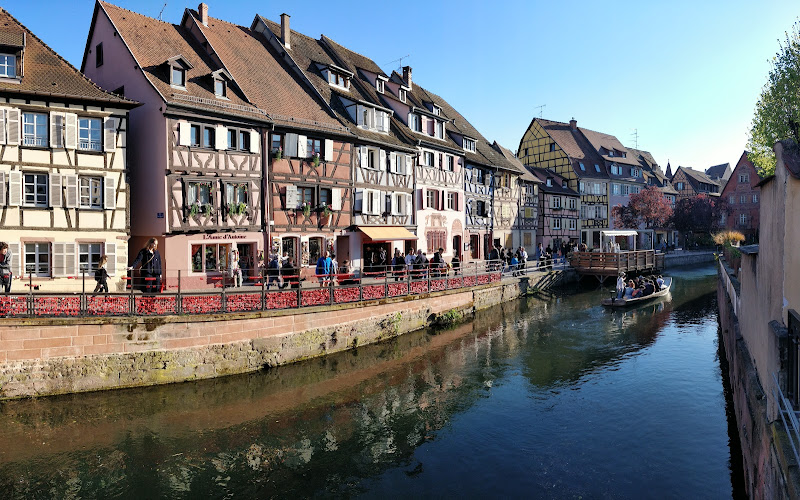
Salle du Corps de Garde is one of Colmar’s most rewarding small architectural discoveries: a former municipal guardhouse completed in 1575, standing beside the Collegiate Church of Saint-Martin on Place de la Cathédrale. Its Renaissance façade, open ground-floor loggia and steep roofline make a crisp visual counterpoint to the church’s much larger Gothic sandstone mass.
This is not a conventional museum stop with galleries to tour; it is a quick, free-to-view piece of civic history embedded in the Old Town streetscape. Pause in the square, look closely at the arcades and upper-storey detailing, then let the building anchor a slower wander through the lanes, shopfronts and church-centered spaces of central Colmar.
Standout Highlights & What Not to Miss
The pleasure here lies in reading the building in context. Salle du Corps de Garde began as a guardhouse, or municipal police post, on the site of a former chapel. Its public-facing loggia was more than decoration: guards stood watch here, and the structure later served as a platform from which judicial announcements could be made to the assembled public. Give yourself a few minutes to step back and take in how Renaissance civic architecture meets the medieval religious setting.
- The 1575 Renaissance façade: Look for the building’s composed proportions and stone detailing, which distinguish it from the surrounding half-timbered and Gothic architecture.
- The open loggia: The ground-floor arcade is the essential feature. It conveys the building’s original role as a visible, public instrument of city authority.
- The Saint-Martin pairing: Stand far enough back in the square to frame the guardhouse against the collegiate church. The contrast of civic Renaissance form and Gothic church fabric is the main visual payoff.
- Its former civic purpose: Remember that this was not a private townhouse. It was tied to policing, public order and the announcement of judgments in a busy historic urban center.
- Quiet façade details: This is a place to reward close observation rather than rush through. Notice the rhythm of the openings, the shelter of the arcade and the relationship between roof, stonework and square.
Visitor Strategy & Planning Snapshot
| Planning Factor | What to Expect | Practical Strategy |
|---|---|---|
| Ideal Arrival Window | Morning or later afternoon often gives gentler light on the arcade and church stone. | Build in a brief pause while walking the Old Town rather than treating it as a standalone destination. |
| Typical Time Needed | A focused exterior visit generally takes 15 to 25 minutes. | Allow longer if you enjoy architectural photography or want time inside Saint-Martin Church nearby. |
| Booking / Queue Reality | It is an exterior architectural stop, not a regular interior exhibition circuit. | No dedicated visit plan is usually necessary; simply approach from the cathedral square during an Old Town walk. |
| Terrain & Accessibility | The square is mostly level, but surrounding Old Town cobbles can be uneven. There is no regular public interior route or visitor facilities. | Wear stable footwear, move carefully over cobbles and view the façade from the open square. |
| Weather / Seasonal Fit | The exterior experience is most enjoyable in dry weather, though the arcade offers a little visual shelter. | On rainy days, keep this as a short stop between indoor sights, cafés or church visits. |
Honest Trade-Offs: Best For vs. Who Might Skip
History buffs, architecture lovers, solo walkers and first-time visitors will get the most from Salle du Corps de Garde, especially if they enjoy understanding how a city’s buildings once shaped public life. It is also a useful stop for photographers who prefer texture, proportion and historical context over blockbuster spectacle. Travelers expecting a staffed attraction, an interior museum, interpretive displays or a long activity may find it too slight on its own. The right expectation is a memorable façade and a concise history lesson, not a major time commitment. Its value increases considerably when seen alongside Saint-Martin Church and the surrounding Old Town.
Neighborhood Context & How to Pair Your Visit
Place de la Cathédrale makes this an easy, walkable addition to a central Colmar itinerary. Start by taking in the church and the guardhouse together, then continue through the nearby historic lanes at an unhurried pace, pausing for façades, small squares and Alsatian street details. Because the stop is brief, it works particularly well as a visual reset between larger sights: arrive with the church in view, study the loggia from across the square, then follow the pedestrian streets deeper into the Old Town. Avoid treating it as a checkbox. A few attentive minutes here reveal how commerce, worship and municipal authority once shared the same compact urban stage.
When planning your Colmar travel guide or browsing verified attractions in Colmar, pair this stop with standout local spots including Winstub Unterlinden, La Petite Venise, CHEZ RAPHY AU CORDON BLEU DE COLMAR, and Musée Bartholdi (nearby).