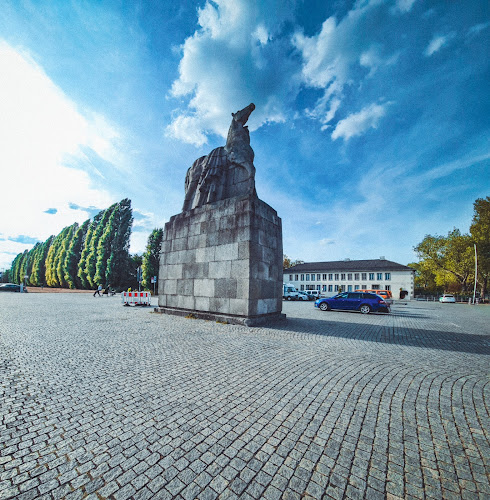
Vier Karyatiden is a free, open-air group of four monumental sandstone female figures at Kay-und-Lore-Lorentz-Platz, 40213 Düsseldorf, in the Altstadt beside St. Andreas Church and Kunsthalle Düsseldorf. Sculpted by Leo Müsch in 1879–81 for the façade of the former Kunsthalle, these survivors of a building lost in the Second World War reward travelers with a close-up encounter with Düsseldorf’s 19th-century civic art and the visual drama of classical architectural sculpture.
What to Expect at Vier Karyatiden
The four figures originally carried the gable of the old Kunsthalle, which opened in 1881 on Grabbeplatz. Rather than decorative statues placed on plinths, they are caryatids: sculpted women conceived as structural supports, a form derived from ancient Greek architecture. Müsch gave each figure a monumental, weight-bearing stance, with drapery falling in deep carved folds beneath the architectural load. Their scale and weathered sandstone surface make the group especially compelling when viewed from the side, where the physical relationship between bodies and entablature is easiest to read.
The old Kunsthalle did not survive wartime destruction, so the sculptures now carry unusual historical force as fragments detached from their original façade. Look for the contrast between their historicizing 19th-century language and the stark concrete geometry of the present-day Kunsthalle Düsseldorf nearby. This is a brief stop rather than a museum visit, but it fits naturally into an Altstadt walk linking the Kunsthalle, K20, the Andreasquartier and the Rhine-side old town. There is no ticket desk, gallery route, cloakroom, café or guided-tour program at the monument itself; it is part of the public square.
- Leo Müsch sculptures: Four surviving works made in 1879–81 by the Düsseldorf sculptor for the old Kunsthalle’s gable.
- Caryatid form: Study how the female figures are designed as architectural supports, not merely freestanding ornament.
- Old Kunsthalle connection: The group preserves a tangible piece of the 1881 Kunsthalle, destroyed during the Second World War.
- Sandstone detail: Deeply modeled robes, heads and supporting poses show best at close range in side light.
- Altstadt setting: The sculptures stand between Kunsthalle Düsseldorf and the baroque St. Andreas Church, steps from Grabbeplatz.
Vier Karyatiden at a Glance
| Detail | Information |
|---|---|
| Address | Kay-und-Lore-Lorentz-Platz, 40213 Düsseldorf, Germany |
| Neighborhood / Area | Altstadt, beside Grabbeplatz and St. Andreas Church |
| Operating Hours | Public outdoor monument, accessible 24 hours daily |
| Admission / Price Range | Free; no ticket or reservation required |
| Recommended Visit Duration | 15 to 30 minutes; longer when combined with nearby museums |
| Nearest Transit / Parking | Heinrich-Heine-Allee U-Bahn station; Parkhaus Kunsthalle/Grabbeplatz area |
| Official Website & Phone | Düsseldorf Kultur; +49 211 89-0 |
Visiting Tips, Getting There & Nearby Pairings
Come in the morning for the clearest photographs and a quieter square, or pause here before an evening in the Altstadt. From Heinrich-Heine-Allee, served by major U-Bahn routes including U70, U74, U75, U76, U77, U78 and U79, walk west toward Grabbeplatz in about five minutes. The site can also be reached from the Altstadt’s surface tram and bus connections. Drivers should use a central garage around Grabbeplatz rather than expect on-street parking directly beside the monument.
The sculptures are outdoors on a paved central-city square and can be viewed without steps, making the stop practical for wheelchair users, strollers and visitors who prefer a short cultural break. There are no dedicated toilets, seating areas or visitor facilities at the monument, so use museum or café facilities nearby. Pair it with the changing exhibitions at Kunsthalle Düsseldorf, the 20th-century collection at K20 on Grabbeplatz, and St. Andreas Church, all within a few minutes on foot. Marktplatz and the Rhine promenade are also an easy 10- to 15-minute walk through the old town.
Frequently Asked Questions
When can I visit Vier Karyatiden, and what is the best time?
The monument stands in a public outdoor space and is accessible 24 hours a day, every day. Visit in the morning for fewer pedestrians, or in late afternoon when angled light brings out the folds and contours of the sandstone figures.
Is there an admission fee or reservation requirement?
No. Vier Karyatiden is free to see and requires neither a ticket nor a reservation. Admission charges apply separately at nearby museums such as Kunsthalle Düsseldorf and K20.
How much time should I allow for the four caryatids?
Allow 15 to 30 minutes to inspect the sculptures, understand their former Kunsthalle setting and take photographs. Add one to three hours if combining the stop with Kunsthalle Düsseldorf or K20.
Is Vier Karyatiden suitable for wheelchairs and children?
Yes. The monument is visible from the level, paved square and makes an easy short stop for families and wheelchair users. As an unfenced historic outdoor work, it has no indoor facilities, hands-on displays or dedicated restroom.
When planning your Dusseldorf travel guide or browsing verified attractions in Dusseldorf, pair this stop with standout local spots including Arisha's Kitchen Düsseldorf, Schloss Benrath, riva restaurant & bar, and Kunsthalle Düsseldorf (nearby).