Dar al-Magana (Water Clock) is a 14th-century Marinid clock house on Rue Talaa Kebira in Fes el-Bali, Fes, directly opposite Bou Inania Madrasa. Commissioned by Sultan Abu Inan Faris and completed in 1357, its street-facing mechanism once used water, weights, opening shutters and bronze bowls to mark the hours. Travelers come to study one of medieval Fes’s most intriguing feats of public engineering and the remarkable facade that still anchors this central medina lane.
What to Expect at Dar al-Magana (Water Clock)
Dar al-Magana is best experienced as an exterior architectural stop rather than a conventional museum visit. Face the building from the pavement outside Bou Inania Madrasa and look closely at its long upper register of twelve small shuttered openings and the row of thirteen metal bowls below. The display was designed so that, as the hydraulic and weight-driven mechanism advanced, a shutter opened and a metal ball dropped into a bowl. The precise workings are still the subject of historical study, but the surviving facade makes the clock’s ingenious public-facing design immediately legible.
The clock formed part of Abu Inan’s ambitious 1357 building campaign, which also produced the madrasa across the lane. Its location on Talaa Kebira was practical: this was one of Fes el-Bali’s principal commercial and religious routes, where an audible hourly signal could be heard by passersby. There are no permanent galleries, timed tours, audio guides, café, museum shop, cloakroom or public interior route here. Bring a camera, but treat the narrow lane as a working pedestrian thoroughfare; photograph the facade without obstructing madrasa visitors, merchants or guides.
- Twelve shuttered apertures: The upper facade’s sequence of small doors represented the clock’s hourly progression.
- Thirteen bronze bowls: Mounted below the shutters, these bowls received the balls released by the original timekeeping system.
- Hydraulic engineering: Water and suspended weights regulated the mechanism inside the 14th-century house.
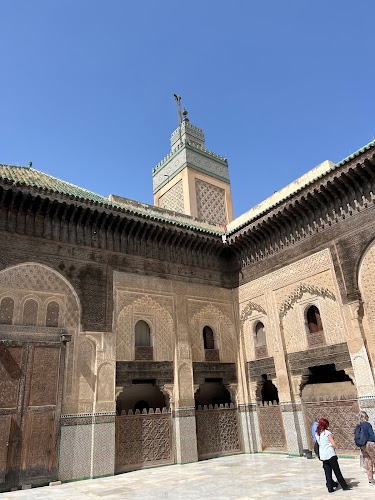
- Marinid pairing: The clock stands directly opposite the richly decorated Bou Inania Madrasa, commissioned by the same sultan.
- Talaa Kebira setting: Its position on Fes el-Bali’s main spine puts it amid carved doorways, small workshops and historic lanes.
Dar al-Magana (Water Clock) at a Glance
| Detail | Information |
|---|---|
| Address | Rue Talaa Kebira, Fes 30000, Morocco |
| Neighborhood / Area | Fes el-Bali medina, opposite Bou Inania Madrasa |
| Operating Hours | Exterior facade can be viewed 24 hours daily; daylight is best for detail and photography. |
| Admission / Price Range | Free to view from the street; no public interior admission. |
| Recommended Visit Duration | 15 to 25 minutes, or longer when paired with Bou Inania Madrasa. |
| Nearest Transit / Parking | Walk from Bab Bou Jeloud; vehicle access is outside the pedestrian medina. Use parking near Bab Bou Jeloud. |
| Official Website & Phone | No dedicated public website or visitor phone is listed for the clock. |
Visiting Tips, Getting There & Nearby Pairings
Arrive in the morning, before guided groups and delivery activity make Talaa Kebira busier, or return in late afternoon when the facade receives softer light. There is no ticket desk and no reservation process for the exterior, but Bou Inania Madrasa has separate visiting arrangements. Start at Bab Bou Jeloud, the Blue Gate, then follow Talaa Kebira east for roughly five minutes; taxis cannot continue through this portion of the medina. Drivers can drop passengers at or near the gate, where paid parking is available outside the walls.
The clock is viewed at street level, but access involves the medina’s uneven stone paving, changing gradients, tight pedestrian traffic and occasional steps on connecting lanes. There is no confirmed step-free interior entrance, elevator, restroom or seating area at Dar al-Magana itself; wheelchair users and strollers will find the clearest approach from Bab Bou Jeloud with assistance. Pair the stop with the carved stucco, zellij and cedar interiors of Bou Inania Madrasa opposite, then continue to Batha Museum and its Andalusian garden, about 10 minutes away, or to the Funduq al-Najjarin and Nejjarine Museum area in around 12 minutes on foot.
Frequently Asked Questions
When is Dar al-Magana open, and when should I visit?
The clock facade is an outdoor sight on a public medina street and can be seen at any hour. Visit in the morning or late afternoon for clearer photographs and easier passage along Talaa Kebira; the building’s interior is not a regular public attraction.
Do I need tickets or a reservation for the Water Clock?
No. Viewing Dar al-Magana from the street is free and requires neither a ticket nor a reservation. Budget separately if you plan to enter Bou Inania Madrasa or hire a licensed medina guide.
How much time should I allow for Dar al-Magana?
Allow 15 to 25 minutes to examine the shutters, bowls and their relationship to the madrasa across the road. Combine it with Bou Inania, Bab Bou Jeloud and the Batha quarter for a focused two- to three-hour walk.
Is Dar al-Magana suitable for children and wheelchair users?
Children can appreciate the visible bowls and the idea of a water-powered clock, though there are no hands-on displays. The exterior is free of an entry threshold, but Fes el-Bali’s cobbles, slopes and congestion make independent wheelchair and stroller travel challenging; assistance is advisable.
When planning a wider itinerary across Fez or browsing more top-rated attractions in Fez, consider pairing your visit with nearby highlights such as Salim Fez Guide (0.2 km away).