
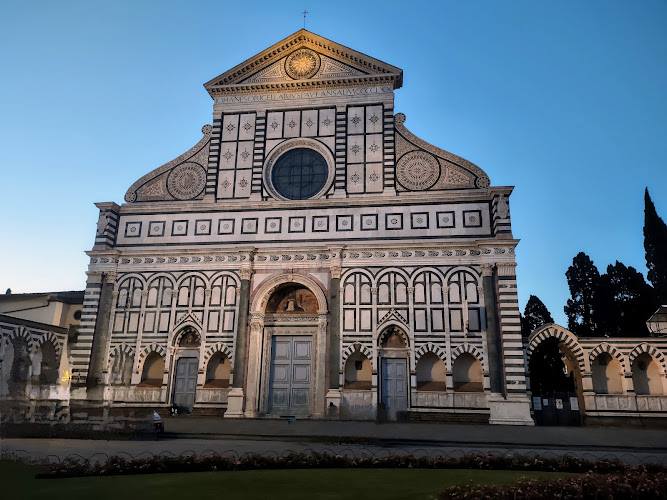
Basilica of Santa Maria Novella is Florence’s great Dominican church and museum complex at P.za di Santa Maria Novella, 18, 50123 Firenze FI, in the Santa Maria Novella area of the Metropolitan City of Florence, Italy. Founded by Dominican friars in 1221, with the present Gothic church begun in 1246, it draws travelers for a concentrated sequence of medieval and Renaissance masterpieces, from Masaccio’s revolutionary perspective fresco to Ghirlandaio’s vast chapel cycle, framed by Leon Battista Alberti’s landmark marble facade.
What to Expect at Basilica of Santa Maria Novella
Begin in Piazza Santa Maria Novella, where Alberti’s 15th-century facade unites older green-and-white Tuscan marble patterns with a classical pediment, scroll-like side volutes and unusually precise geometry. Inside, the broad nave leads through a working church rather than a conventional gallery. Look up for Giotto’s monumental painted Crucifix, then find Masaccio’s Trinity in the left aisle: painted in 1425–26, its convincingly receding barrel-vaulted chapel is a defining early use of linear perspective.
The single-complex ticket also opens areas beyond the nave. The Tornabuoni Chapel, or Cappella Maggiore, contains Domenico Ghirlandaio’s frescoes on the lives of the Virgin and St John the Baptist, populated with portraits of 15th-century Florentines. In the right transept, Filippino Lippi’s Strozzi Chapel frescoes confront visitors with episodes involving Saints Philip and John the Evangelist. Continue through the cloisters and museum spaces to the Spanish Chapel, painted by Andrea di Bonaiuto, and the Green Cloister, known for Paolo Uccello’s earth-toned frescoes. The visit also includes the sacristy and the Cemetery of the Avelli.
- Alberti facade: A key work of Renaissance architectural design, completed in the 15th century over the church’s earlier marble front.
- Masaccio’s Trinity: A pivotal 1425–26 fresco whose illusionistic architecture changed the course of Western painting.
- Giotto’s Crucifix: The large painted crucifix suspended in the nave, a major late-medieval devotional image.
- Tornabuoni Chapel: Ghirlandaio’s richly detailed fresco cycle in the main chapel, with biblical narrative and Florentine society intertwined.
- Cloisters and Spanish Chapel: A museum route linking the Green Cloister, Dominican imagery and Andrea di Bonaiuto’s allegorical frescoes.
Basilica of Santa Maria Novella at a Glance
| Detail | Information |
|---|---|
| Address | P.za di Santa Maria Novella, 18, 50123 Firenze FI, Italy |
| Neighborhood / Area | Santa Maria Novella, beside Firenze Santa Maria Novella railway station and the western edge of the historic center |
| Operating Hours | Mon–Thu and Sat 9am–5:30pm; Fri 11am–5:30pm; Sun 1pm–5:30pm. Liturgies can alter visitor access. |
| Admission & Ticket Prices | Paid admission covers the complete complex. Tariffs changed from November 1, 2026; check the official visit page for current prices and conditions. |
| Recommended Visit Duration | 1.5 to 2 hours |
| Nearest Transit / Parking | Firenze Santa Maria Novella station; Alamanni–Stazione tram stop; Parcheggio Stazione Santa Maria Novella |
| Official Website / Phone | smn.it/it/visita / +39 055 219257 |
Visiting Tips, Getting There & Nearby Pairings
Arrive close to opening, or later in the afternoon, for a quieter look at the chapels before the main tour-group rush. Buy or verify tickets through the official visitor page, particularly on weekends, holidays and high-season dates. This remains an active place of worship: access and hours may change for liturgical services, so check the day’s notices before setting out. Modest dress is appropriate, and allowing time to sit with the frescoes makes the visit far more rewarding than a quick pass through the nave.
From Firenze Santa Maria Novella station, the basilica is a short walk across the square; the T1 and T2 tram services stop at Alamanni–Stazione nearby. Drivers should use the Stazione Santa Maria Novella garage and pay close attention to Florence’s restricted-traffic-zone rules rather than attempting to park on surrounding historic-center streets. The basilica’s designated accessible route provides step-free access for wheelchair users and strollers, but the historic cloister and museum circuit has uneven stone surfaces and level changes; ask staff on arrival for the most suitable route and assistance. Within 5–15 minutes on foot, combine the church with the Basilica di San Lorenzo, Mercato Centrale, and the cafés and trattorias around Via della Scala and Piazza dell’Unità Italiana.
Frequently Asked Questions
What are the best hours to visit Santa Maria Novella?
Visitor hours are generally 9am–5:30pm Monday through Thursday and Saturday, 11am–5:30pm Friday, and 1pm–5:30pm Sunday. Go near opening or later in the afternoon, and always check official notices because services can change access.
Do I need a ticket or reservation?
Admission is paid and includes the basilica, frescoed chapels, sacristy, Cemetery of the Avelli and museum areas. Confirm current prices and ticket procedures on the official website before visiting, as new tariffs took effect on November 1, 2026.
How long should I budget for the basilica?
Allow 1.5 to 2 hours to see the nave, Masaccio’s Trinity, Giotto’s Crucifix, Tornabuoni and Strozzi chapels, and the cloister route. Art-focused visitors can easily spend longer reading the imagery in the Spanish Chapel.
Is Basilica of Santa Maria Novella suitable for families and wheelchair users?
Families can follow an easy visual route through the nave and chapels, though the frescoes reward older children most. A designated step-free entrance assists wheelchairs and strollers; request the accessible route from staff because historic cloister paving and internal level changes require planning.
When planning your Florence travel guide or comparing verified attractions and museums in Florence, pair this stop with standout local spots including Palazzo Pitti, Museo Galileo, Il Barretto, and The Gallery Immersive Experience (nearby).


