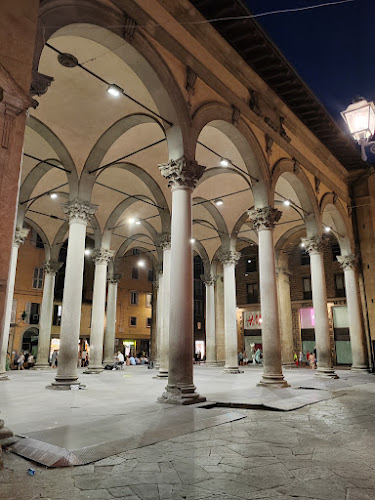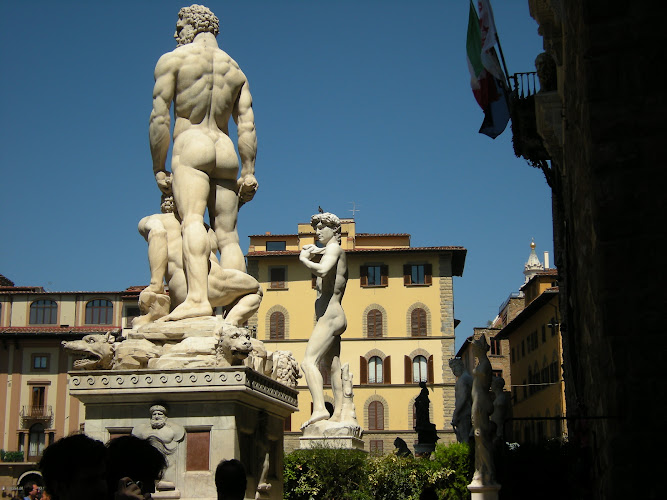
Hercules and Cacus is Baccio Bandinelli’s monumental marble sculpture outside Palazzo Vecchio at Piazza della Signoria, 50122 Firenze, in Florence’s historic center, in the San Giovanni quarter. Unveiled in 1534, it depicts Hercules overpowering the cattle-stealing monster Cacus. Travelers come for its muscular Renaissance carving, its politically charged Medici history, and its position beside the replica of Michelangelo’s David, framing the entrance to Florence’s medieval town hall.
What to Expect at Hercules and Cacus
The group rises approximately five meters above its pedestal: Hercules stands upright while Cacus crouches beneath him, his body compressed against the hero’s legs. A club identifies Hercules, while the contrast between the standing victor and defeated opponent makes the story readable from across the square. In Roman mythology, Cacus stole cattle that Hercules had captured from Geryon. Bandinelli concentrates on physical domination rather than the chase, giving the figures exaggerated muscles, sharply defined anatomy, and conspicuously different poses.
The commission’s history involved both Michelangelo and Bandinelli, but the completed work belongs to Bandinelli and the era of restored Medici rule. Its installation in 1534, during Duke Alessandro de’ Medici’s government, placed an image of overpowering strength at the seat of Florentine authority. Contemporary criticism of its anatomy helped establish its contentious reputation. Look between the sculpture and Palazzo Vecchio’s rusticated stone facade: the setting explains why this is more than an isolated mythological subject. Unlike the neighboring David, this outdoor group is the original sculpture.
- Bandinelli’s original marble: A major sixteenth-century sculpture still occupying its intended civic setting.
- Hercules and Cacus: Standing and crouching figures turn a complicated myth into an immediately legible confrontation.
- Palazzo Vecchio entrance: The group stands to the right of the palace doorway when viewed from the square.
- David comparison: The neighboring replica offers a direct contrast in anatomy, posture, and political symbolism.
- Open-air sculpture ensemble: Nearby are Ammannati’s Neptune Fountain and the statues beneath the Loggia dei Lanzi.
Hercules and Cacus at a Glance
| Detail | Information |
|---|---|
| Address | Piazza della Signoria, 50122 Firenze FI, Italy; outside Palazzo Vecchio |
| Neighborhood / Area | San Giovanni quarter, historic center |
| Operating Hours | Monday–Sunday: accessible 24 hours in the public square |
| Admission / Price Range | Free outdoor viewing; $ budget category |
| Recommended Visit Duration | 15 to 30 minutes |
| Nearest Transit / Parking | T2 tram: Unità, approximately 15 minutes on foot; paid parking at Santa Maria Novella, approximately 20 minutes away |
| Official Website & Phone | Florence municipal culture portal; +39 055 055, city information service |
Visiting Tips, Getting There & Nearby Pairings
Arrive before 9am for more space to study the figures and photograph the palace entrance without the busiest daytime pedestrian traffic. Evening offers a different view under the square’s lighting, although restaurant crowds remain. No reservation, ticket, bag check, or dress code applies to viewing the sculpture outdoors. Start opposite the palace doorway, then move sideways to understand Cacus’s compressed pose; keep clear of entrance queues and never climb the pedestal. There is no dedicated visitor center, shop, or toilet attached to the monument.
From the T2 terminus at Unità, walk through the center toward Piazza della Repubblica and Piazza della Signoria. Drivers should use parking outside the restricted-traffic streets rather than attempt to reach the square by car. The piazza provides step-free viewing from surrounding street level, but stone paving can be uneven and the raised palace platform has steps; wheelchair users and families with strollers can appreciate the sculpture without mounting it. Continue to Ponte Vecchio, about five minutes away, the Duomo, around eight minutes away, or Piazza Santa Croce, roughly ten minutes east.
Frequently Asked Questions
What are the opening hours and best visiting time?
The sculpture is outdoors and visible 24 hours a day, every day. Early morning is best for a quieter encounter; Palazzo Vecchio’s indoor opening hours do not govern access to the square.
Do you need tickets or a reservation?
No ticket or reservation is required, and viewing is free. Admission to Palazzo Vecchio’s museum and tower is separate from this outdoor monument.
How long should you spend here?
Allow 15 to 30 minutes to examine the group and compare it with David. Extend that to around an hour if you also explore the Neptune Fountain and Loggia dei Lanzi.
Is it accessible and suitable for children?
Street-level viewing is accessible without climbing steps, although uneven paving requires care. Children can follow the Hercules story easily, but the sculpture includes nudity and a scene of physical violence.
When planning your Florence travel guide or comparing verified attractions and sculpture in Florence, pair this stop with standout local spots including Rucellai Palace, Garden of Archimedes, Rinaldo Carnielo Gallery, and Perseus with the head of Medusa (nearby).