
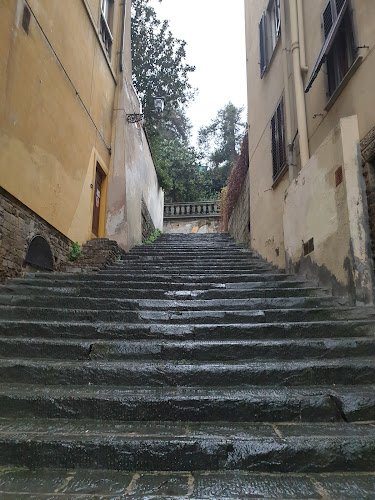
Rampa delle Coste is not a conventional museum despite its heritage listing: it is a compact outdoor pedestrian passage in Florence’s Oltrarno, where stone paving, stairs, and a pronounced slope reveal the city’s less ceremonial hillside fabric. Just south of the Arno and close to Costa San Giorgio, it trades grand façades and timed entry for the close-up texture of masonry, changing levels, and narrow routes shaped by difficult terrain.
The appeal is atmospheric and architectural rather than destination-scale. This is a useful detour for travelers moving between the riverfront around Ponte Vecchio and the higher streets toward the Boboli and Bardini garden area. In ten to twenty minutes, the ramp offers a clear sense of how Florence climbs away from the river: lanes tighten, sightlines shift, and the busy central-city rhythm recedes into an older residential street network.
Standout Highlights & What Not to Miss
Come with the right expectations. Rampa delle Coste is a fragment of the city rather than a self-contained attraction with galleries, interpretation, or a major viewpoint at the end. Its reward is the walk itself: look slowly at the paving, retaining walls, doorways, and the way the passage solves Florence’s steep southern-bank topography.
- The hillside transition: Notice the immediate change from lower Oltrarno streets to a steeper, more enclosed route. The ramp makes the rise behind the Arno physically legible.
- Stone underfoot: Uneven paving and steps are central to its character. They also demand attention, especially where polished or damp stone can be slick.
- Close-grained historic fabric: The pleasure lies in details rather than monuments: masonry surfaces, compressed turns, and glimpses between buildings that frame the slope.
- Costa San Giorgio connection: Use the passage as part of a wider wander around this historic hillside street, rather than treating it as an isolated stop.
- A lower-city return: Santa Felicita and the Ponte Vecchio area provide a natural downhill counterpart, bringing the route back to Florence’s riverfront and busier historic core.
Visitor Strategy & Planning Snapshot
| Planning Factor | What to Expect | Practical Strategy |
|---|---|---|
| Ideal Arrival Window | It is most enjoyable when you can walk unhurriedly and watch your footing; strong midday light can flatten the intimate street atmosphere. | Build it into a morning or later-afternoon Oltrarno stroll, leaving room to pause rather than rushing between headline sights. |
| Typical Time Needed | Most visitors need roughly 10 to 20 minutes for the passage itself, depending on photography, pace, and how far they explore nearby lanes. | Allow additional time if linking it with Costa San Giorgio, Santa Felicita, or the gardens and fortifications uphill. |
| Booking / Queue Reality | This is a public outdoor passage, not a ticketed exhibition experience; its value does not depend on a formal visit sequence. | No dedicated booking should be necessary. Treat it as a flexible connector within a larger walking route and remain considerate of local residents. |
| Terrain & Accessibility | Expect steps, gradients, narrow sections, and irregular stone paving. It is not a dependable step-free route for wheelchairs or strollers. | Wear shoes with reliable grip, move carefully after rain, and choose a more level riverfront route if mobility or balance is a concern. |
| Weather / Seasonal Fit | Cooler, drier conditions make the climb more comfortable; wet stone and summer heat can make a brief passage feel more demanding. | Carry water in warm weather and postpone the detour during heavy rain if secure footing is important to you. |
Honest Trade-Offs: Best For vs. Who Might Skip
Rampa delle Coste suits urban walkers, architecture enthusiasts, independent history travelers, and repeat Florence visitors who enjoy understanding a city through its connective tissue. It is free to experience and gives an unusually direct impression of the Oltrarno hillside without requiring much time. It will disappoint anyone seeking an indoor collection, explanatory displays, a famous standalone landmark, broad panoramic views, or a smooth and accessible route. Families with strollers and travelers with limited mobility should regard the stairs and gradients as a real constraint, not a minor inconvenience. First-time visitors with only a few hours in Florence may be better served by prioritizing nearby major sights, then using the ramp only if their route already brings them south of the Arno.
Neighborhood Context & How to Pair Your Visit
The most satisfying approach is to make Rampa delle Coste one link in a south-bank walk. Start around Ponte Vecchio or Santa Felicita, where the river-crossing crowds and Renaissance landmarks establish the familiar Florence setting. From there, turn into the quieter streets around Via de’ Bardi and Costa San Giorgio, taking the ramp as a short upward detour rather than a destination that needs a long stay. Continue uphill only if your energy and footwear suit the gradient, with the Boboli and Bardini garden zone and the area around Forte di Belvedere forming a broader hillside context. Alternatively, descend back toward the Arno for a contrast between intimate residential lanes and the open riverfront. This pairing makes the passage meaningful: it is a small but telling transition between Florence’s celebrated center and the terrain that rises directly behind it.
When planning your Florence travel guide or browsing verified attractions in Florence, pair this stop with standout local spots including Pescaia delle Cascine, Fondazione Sensus, Boboli Gardens, and Ristorante dei Rossi (nearby).


