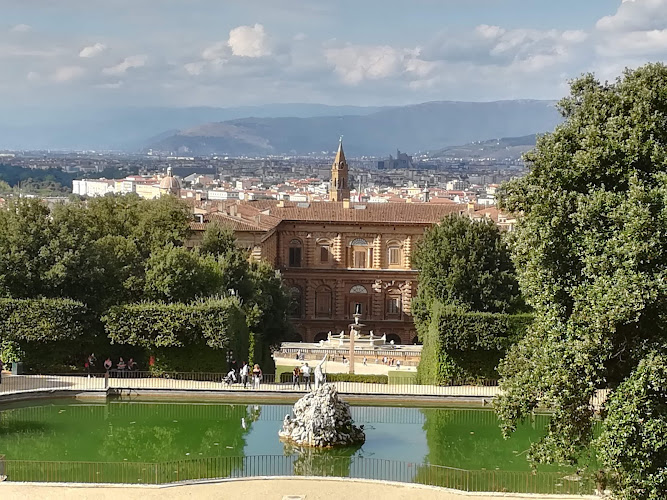
Boboli Gardens is a historic Italian formal garden behind Palazzo Pitti at Piazza de’ Pitti 1, 50125 Florence, in the Oltrarno neighborhood, Metropolitan City of Florence, Italy. Its Medici transformation began in 1549 after Eleonora di Toledo acquired the palace. Travelers visit for Renaissance sculpture, theatrical landscaping, monumental fountains, and elevated views that reveal how gardens became part of Florentine court life.
What to Expect at Boboli Gardens
Boboli unfolds across a hillside rather than along one flat promenade. Behind the palace, the amphitheater occupies the site of a former quarry; its Egyptian obelisk and enormous granite basin create an architectural stage. Continue uphill toward the Neptune Fountain, where Stoldo Lorenzi’s bronze sea god presides over the water. The climb makes the garden’s organizing geometry easier to understand: terraces, carefully framed sightlines, clipped planting, and sculpture work together, with the palace anchoring the view below.
A different route follows the Viottolone, the broad cypress-lined avenue leading toward the Isolotto, an island garden centered on the Ocean Fountain. Allow time for the smaller compositions rather than treating this as a march between monuments. Near the palace, Buontalenti’s Grotto replaces ordered greenery with artificial rockwork and sculptural drama. The garden’s development continued beyond the Medici: the eighteenth-century Kaffeehaus introduces a lighter, Rococo architectural language, while the Limonaia reflects the practical business of protecting citrus trees through winter.
- Buontalenti’s Grotto: An elaborate artificial cave combining architecture, sculpture, and deliberately fantastical surfaces.
- Amphitheater: The palace-facing composition provides the clearest introduction to Boboli’s ceremonial scale.
- Neptune Fountain: An uphill destination worth approaching slowly, with pauses to look back toward Pitti.
- Viottolone and Isolotto: A long, strongly defined axis that rewards visitors who explore beyond the central terraces.
- Giardino del Cavaliere: A raised garden offering a contrasting outlook toward the hills beyond the city.
Boboli Gardens at a Glance
| Detail | Information |
|---|---|
| Address | Piazza de’ Pitti 1, 50125 Florence, Italy |
| Neighborhood / Area | Oltrarno, behind Palazzo Pitti |
| Operating Hours | Opens 8:15am. Closes 4:30pm November–February; 5:30pm March/October on standard time; 6:30pm March/October on daylight time and April, May, September; 7:10pm June–August. Closed first and last Mondays monthly and December 25. Last entry one hour before closing. |
| Admission & Ticket Prices | Adults €10 same-day or €13 advance; eligible reduced admission €2. Pitti–Boboli combination €22 same-day or €25 advance. |
| Recommended Visit Duration | 2–3 hours; longer with Palazzo Pitti |
| Nearest Transit / Parking | Porta Romana bus stops for the southern entrance; Oltrarno–Calza parking near Porta Romana |
| Official Website / Phone | Official Boboli Gardens visitor information; +39 055 294883 |
Visiting Tips, Getting There & Nearby Pairings
Arrive near opening, particularly during summer, and tackle the uphill sections before the hottest part of your visit. Wear shoes with traction and carry water. Purchase through the official website, distinguishing the garden-only ticket from palace combinations; advance admission costs more than same-day purchase. From Santa Maria Novella station, allow roughly 25–30 minutes on foot to Piazza Pitti. Alternatively, use the Porta Romana bus stops and southern entrance. Drivers should approach parking outside the historic center’s restricted-traffic streets rather than navigate directly to the palace.
Wheelchair-accessible entrances are at Piazza Pitti and Porta Romana, but gravel and frequent slopes make assistance advisable. An accessible toilet near the amphitheater requires a stairlift operated with staff assistance; baby-care facilities are nearby. Strollers also require effort on inclines: choose a shorter loop instead of attempting every terrace. After exiting at Pitti, pair the garden with Santo Spirito’s square and restaurants, about five minutes away, or walk roughly ten minutes to Ponte Vecchio. Palazzo Pitti itself is the natural art-focused pairing, but allow a separate block of time rather than squeezing both into two hours.
Frequently Asked Questions
When does Boboli Gardens open, and when is best to visit?
Opening is 8:15am; closing varies seasonally. Choose an early start for a longer walking circuit, and check monthly Monday closures before setting out.
How much are tickets, and should I reserve?
Standard adult admission is €10 when purchased that day or €13 in advance. Use the official booking channel and choose the combination ticket only if you also intend to explore Pitti’s museums.
How much time should I budget?
Allow two to three hours for the principal fountains, grotto area, and longer garden axes. With only an hour, concentrate on the palace-facing terraces rather than rushing to the distant Isolotto.
Is Boboli suitable for children and wheelchair users?
Families can plan a shorter sculpture-and-fountain circuit. Wheelchair users should arrange assistance and discuss a manageable route with entrance staff; accessible entry does not mean the entire hillside is step-free or easy to traverse.
When planning your Florence travel guide or comparing verified attractions and parks in Florence, pair this stop with standout local spots including Ponte Santa Trinita, Basilica di Santo Spirito, Hotel degli Orafi, and Ghiacciaia (0.2 km away).