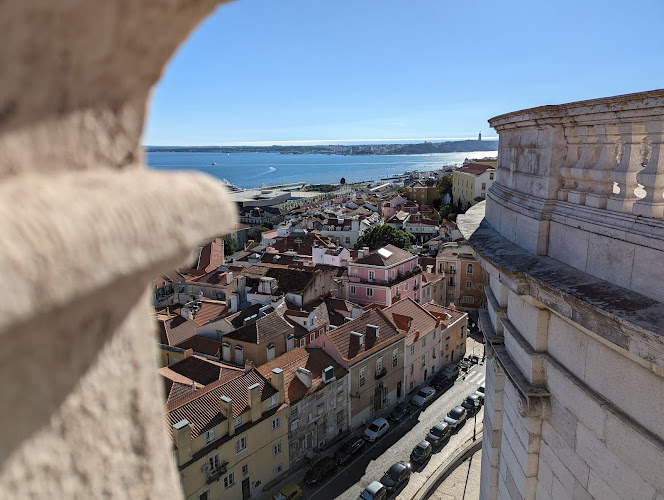
Alfama is Lisbon’s oldest hillside quarter, running from Castelo de São Jorge down toward the Tagus River in the parishes of Santa Maria Maior and São Vicente, 1100 Lisbon, Portugal. Shaped by medieval Moorish street patterns and largely spared by the 1755 earthquake, this free-to-explore district draws travelers for tiled houses, miradouros, Romanesque churches and the intimate restaurants where fado is performed after dark.
What to Expect at Alfama
Alfama is best approached as a walk rather than a single sight: its lanes turn sharply between staircases, tiny largos and clothes-lined residential façades. Begin near the 12th-century Lisbon Cathedral (Sé), recognizable by its heavy Romanesque west front, then climb past the church of Santa Luzia to Miradouro das Portas do Sol. The terrace looks across terracotta roofs to the river; a separate Santa Luzia terrace is known for its blue-and-white tile panels and garden pergola.
Continue uphill to Castelo de São Jorge, whose walls preserve Lisbon’s former Moorish citadel, then descend through the old lanes toward Largo do Chafariz de Dentro and the Fado Museum. Alfama’s name is commonly linked to the Arabic al-hamma, referring to baths or springs, and its tight urban grain predates the ordered streets of Baixa below. At night, fado houses offer seated dinners and performances; reserve ahead for a specific venue, as the music is generally presented in quiet listening rooms rather than as street entertainment.
- Miradouro das Portas do Sol: Broad east-facing terrace overlooking Alfama’s roofs, the river and the cruise-terminal side of the waterfront.
- Lisbon Cathedral: The city’s oldest church began after the 1147 Christian reconquest; look for its fortress-like twin towers and Romanesque interior.
- Castelo de São Jorge: Hilltop ramparts, archaeological remains and a small permanent exhibition interpreting the castle’s long occupation.
- Fado Museum: Exhibits on singers, Portuguese guitar makers, recordings and the history of Lisbon’s UNESCO-listed fado tradition.
- São Vicente de Fora: A 16th-century monastery with tile-lined cloisters, including panels of La Fontaine’s fables and scenes from Portuguese history.
Alfama at a Glance
| Detail | Information |
|---|---|
| Address | Alfama historic district, 1100 Lisbon, Portugal |
| Neighborhood / Area | Santa Maria Maior and São Vicente, between Castelo de São Jorge and the Tagus |
| Operating Hours | Public streets are open at all hours; individual monuments, museums and fado houses keep separate schedules. |
| Admission / Price Range | Free to walk; paid entry applies at Castelo de São Jorge, the Fado Museum and other attractions. Dining ranges from $$ to $$$. |
| Recommended Visit Duration | 2 to 4 hours by day; allow an evening for dinner and fado. |
| Nearest Transit / Parking | 28E tram; 737 bus to Castelo; Santa Apolónia Metro on the Blue Line. Use Chão do Loureiro car park outside the narrow core. |
| Official Website & Phone | Lisbon City Council; no single district telephone number. |
Visiting Tips, Getting There & Nearby Pairings
Arrive early, ideally before 9am, for clearer lanes and cooler uphill walking; late afternoon is ideal for the viewpoints, but the terraces become busy around sunset. Tram 28E is historic but often crowded and can be difficult with luggage. A more practical route is the 737 bus from Praça da Figueira to Castelo, followed by a downhill circuit through Portas do Sol, Santa Luzia and lower Alfama. From Santa Apolónia station, the lower quarter is roughly a 10-minute uphill walk.
Alfama is challenging for wheelchair users, strollers and anyone unsteady on slopes: many streets are steep, narrow and paved in uneven Portuguese cobblestone, with frequent steps. Taxis can reach only selected edges and parking within the quarter is extremely limited. Pair a walk with the Sé, the tiled cloisters of São Vicente de Fora and the National Pantheon, all within about 5 to 15 minutes on foot depending on the route. For a flatter waterfront finish, descend to Campo das Cebolas and Praça do Comércio.
Frequently Asked Questions
What are Alfama’s hours, and when is the best time to go?
Alfama is a lived-in public neighborhood, so its streets have no opening or closing time. Visit early for quieter walking and return near sunset for the miradouros; check each museum, church and restaurant separately before setting out.
Does it cost anything to visit Alfama or hear fado?
Walking Alfama, its lanes and public viewpoints is free. Museums and the castle charge admission, while fado venues commonly require dinner, a cover charge or both; booking directly with the chosen house is wise for evening performances.
How much time should I allow for Alfama?
Allow two to four hours for a self-guided route covering the cathedral, viewpoints and lower lanes. Add at least two hours for Castelo de São Jorge, or plan a separate evening for a full fado dinner.
Is Alfama suitable for families and visitors with limited mobility?
Families who are comfortable with hills can enjoy the trams, viewpoints and castle, though children need close supervision on steep pavements and stairways. The historic core has uneven cobbles and many stepped routes, so wheelchair users should focus on accessible individual attractions and use taxis between upper and lower areas.
When planning your Lisbon travel guide or browsing verified attractions in Lisbon, pair this stop with standout local spots including Baixa de Lisboa, Monument to the Discoveries, Armazéns do Chiado, and Miradouro das Portas do Sol (nearby).