
- Tottenham Court Road (Central & Northern Lines & Elizabeth Line): 5-minute walk.
- Holborn (Central & Piccadilly Lines): 7-minute walk.
- Russell Square (Piccadilly Line): 7-minute walk.
Frequently Asked Questions
Is admission to The British Museum free?
Yes, admission to all permanent galleries—including the Rosetta Stone, Parthenon Sculptures, and Egyptian mummies—is completely free of charge to all visitors.
Where is the Rosetta Stone located inside the museum?
The Rosetta Stone is located on the ground floor in Room 4 (Egyptian Sculpture Gallery), immediately to the left after entering through the Great Court.
How much time do you need at The British Museum?
A focused highlights visit takes roughly 2.5 to 3.5 hours, which allows you to view the top ten world treasures without cognitive exhaustion.
- Saturday through Thursday: 10:00 AM – 5:00 PM (galleries clear at 4:45 PM)
- Friday Evening Lates: 10:00 AM – 8:30 PM (selected major galleries remain open late; ideal for crowd-free viewing)
- Tottenham Court Road (Central & Northern Lines & Elizabeth Line): 5-minute walk.
- Holborn (Central & Piccadilly Lines): 7-minute walk.
- Russell Square (Piccadilly Line): 7-minute walk.
Frequently Asked Questions
Is admission to The British Museum free?
Yes, admission to all permanent galleries—including the Rosetta Stone, Parthenon Sculptures, and Egyptian mummies—is completely free of charge to all visitors.
Where is the Rosetta Stone located inside the museum?
The Rosetta Stone is located on the ground floor in Room 4 (Egyptian Sculpture Gallery), immediately to the left after entering through the Great Court.
How much time do you need at The British Museum?
A focused highlights visit takes roughly 2.5 to 3.5 hours, which allows you to view the top ten world treasures without cognitive exhaustion.
- Saturday through Thursday: 10:00 AM – 5:00 PM (galleries clear at 4:45 PM)
- Friday Evening Lates: 10:00 AM – 8:30 PM (selected major galleries remain open late; ideal for crowd-free viewing)
- Tottenham Court Road (Central & Northern Lines & Elizabeth Line): 5-minute walk.
- Holborn (Central & Piccadilly Lines): 7-minute walk.
- Russell Square (Piccadilly Line): 7-minute walk.
Frequently Asked Questions
Is admission to The British Museum free?
Yes, admission to all permanent galleries—including the Rosetta Stone, Parthenon Sculptures, and Egyptian mummies—is completely free of charge to all visitors.
Where is the Rosetta Stone located inside the museum?
The Rosetta Stone is located on the ground floor in Room 4 (Egyptian Sculpture Gallery), immediately to the left after entering through the Great Court.
How much time do you need at The British Museum?
A focused highlights visit takes roughly 2.5 to 3.5 hours, which allows you to view the top ten world treasures without cognitive exhaustion.
- Address: Great Russell Street, London WC1B 3DG, United Kingdom.
- Operating Hours:
- Saturday through Thursday: 10:00 AM – 5:00 PM (galleries clear at 4:45 PM)
- Friday Evening Lates: 10:00 AM – 8:30 PM (selected major galleries remain open late; ideal for crowd-free viewing)
- Nearest Tube Stations:
- Tottenham Court Road (Central & Northern Lines & Elizabeth Line): 5-minute walk.
- Holborn (Central & Piccadilly Lines): 7-minute walk.
- Russell Square (Piccadilly Line): 7-minute walk.
- Secondary Entrance Secret: The rear entrance on Montague Place typically has significantly shorter security queues than the main front colonnade on Great Russell Street.
Frequently Asked Questions
Is admission to The British Museum free?
Yes, admission to all permanent galleries—including the Rosetta Stone, Parthenon Sculptures, and Egyptian mummies—is completely free of charge to all visitors.
Where is the Rosetta Stone located inside the museum?
The Rosetta Stone is located on the ground floor in Room 4 (Egyptian Sculpture Gallery), immediately to the left after entering through the Great Court.
How much time do you need at The British Museum?
A focused highlights visit takes roughly 2.5 to 3.5 hours, which allows you to view the top ten world treasures without cognitive exhaustion.
- Address: Great Russell Street, London WC1B 3DG, United Kingdom.
- Operating Hours:
- Saturday through Thursday: 10:00 AM – 5:00 PM (galleries clear at 4:45 PM)
- Friday Evening Lates: 10:00 AM – 8:30 PM (selected major galleries remain open late; ideal for crowd-free viewing)
- Nearest Tube Stations:
- Tottenham Court Road (Central & Northern Lines & Elizabeth Line): 5-minute walk.
- Holborn (Central & Piccadilly Lines): 7-minute walk.
- Russell Square (Piccadilly Line): 7-minute walk.
- Secondary Entrance Secret: The rear entrance on Montague Place typically has significantly shorter security queues than the main front colonnade on Great Russell Street.
Frequently Asked Questions
Is admission to The British Museum free?
Yes, admission to all permanent galleries—including the Rosetta Stone, Parthenon Sculptures, and Egyptian mummies—is completely free of charge to all visitors.
Where is the Rosetta Stone located inside the museum?
The Rosetta Stone is located on the ground floor in Room 4 (Egyptian Sculpture Gallery), immediately to the left after entering through the Great Court.
How much time do you need at The British Museum?
A focused highlights visit takes roughly 2.5 to 3.5 hours, which allows you to view the top ten world treasures without cognitive exhaustion.
- 100% Free General Admission: Entry to the permanent galleries of The British Museum is completely free to all visitors.
- Advance Online Timed Entry: While walk-up entry is permitted, queues at the Great Russell Street front gates can take 45 to 60 minutes during peak afternoons. Booking a complimentary timed-entry digital ticket in advance through the museum website (britishmuseum.org) allows you to enter through priority queue lanes.
- Paid Special Exhibitions: Temporary temporary blockbuster exhibitions (such as Silk Roads or Ancient Rome) require paid tickets ranging from £18 to £24 GBP.
Practical Visitor Details, Hours & Transit
- Address: Great Russell Street, London WC1B 3DG, United Kingdom.
- Operating Hours:
- Saturday through Thursday: 10:00 AM – 5:00 PM (galleries clear at 4:45 PM)
- Friday Evening Lates: 10:00 AM – 8:30 PM (selected major galleries remain open late; ideal for crowd-free viewing)
- Nearest Tube Stations:
- Tottenham Court Road (Central & Northern Lines & Elizabeth Line): 5-minute walk.
- Holborn (Central & Piccadilly Lines): 7-minute walk.
- Russell Square (Piccadilly Line): 7-minute walk.
- Secondary Entrance Secret: The rear entrance on Montague Place typically has significantly shorter security queues than the main front colonnade on Great Russell Street.
Frequently Asked Questions
Is admission to The British Museum free?
Yes, admission to all permanent galleries—including the Rosetta Stone, Parthenon Sculptures, and Egyptian mummies—is completely free of charge to all visitors.
Where is the Rosetta Stone located inside the museum?
The Rosetta Stone is located on the ground floor in Room 4 (Egyptian Sculpture Gallery), immediately to the left after entering through the Great Court.
How much time do you need at The British Museum?
A focused highlights visit takes roughly 2.5 to 3.5 hours, which allows you to view the top ten world treasures without cognitive exhaustion.
- 100% Free General Admission: Entry to the permanent galleries of The British Museum is completely free to all visitors.
- Advance Online Timed Entry: While walk-up entry is permitted, queues at the Great Russell Street front gates can take 45 to 60 minutes during peak afternoons. Booking a complimentary timed-entry digital ticket in advance through the museum website (britishmuseum.org) allows you to enter through priority queue lanes.
- Paid Special Exhibitions: Temporary temporary blockbuster exhibitions (such as Silk Roads or Ancient Rome) require paid tickets ranging from £18 to £24 GBP.
Practical Visitor Details, Hours & Transit
- Address: Great Russell Street, London WC1B 3DG, United Kingdom.
- Operating Hours:
- Saturday through Thursday: 10:00 AM – 5:00 PM (galleries clear at 4:45 PM)
- Friday Evening Lates: 10:00 AM – 8:30 PM (selected major galleries remain open late; ideal for crowd-free viewing)
- Nearest Tube Stations:
- Tottenham Court Road (Central & Northern Lines & Elizabeth Line): 5-minute walk.
- Holborn (Central & Piccadilly Lines): 7-minute walk.
- Russell Square (Piccadilly Line): 7-minute walk.
- Secondary Entrance Secret: The rear entrance on Montague Place typically has significantly shorter security queues than the main front colonnade on Great Russell Street.
Frequently Asked Questions
Is admission to The British Museum free?
Yes, admission to all permanent galleries—including the Rosetta Stone, Parthenon Sculptures, and Egyptian mummies—is completely free of charge to all visitors.
Where is the Rosetta Stone located inside the museum?
The Rosetta Stone is located on the ground floor in Room 4 (Egyptian Sculpture Gallery), immediately to the left after entering through the Great Court.
How much time do you need at The British Museum?
A focused highlights visit takes roughly 2.5 to 3.5 hours, which allows you to view the top ten world treasures without cognitive exhaustion.
Architecture: The Queen Elizabeth II Great Court
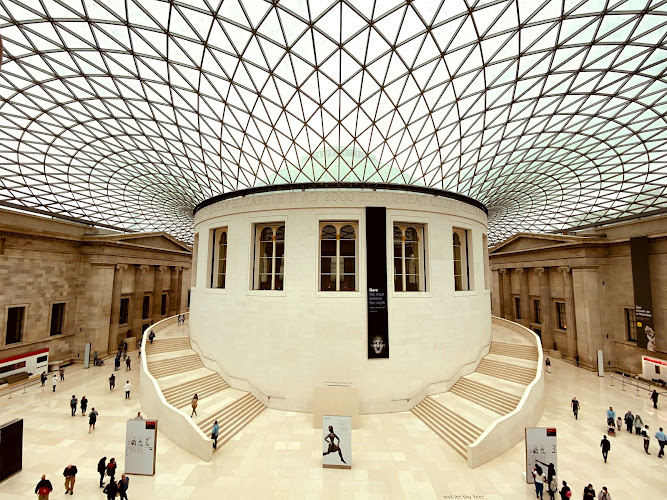
Upon entering the museum, visitors emerge into the Queen Elizabeth II Great Court—the largest covered public square in Europe. Designed by Foster and Partners and opened in 2000, this two-acre central courtyard encloses the famous circular neo-classical Round Reading Room (where historical figures like Karl Marx, Virginia Woolf, and Mahatma Gandhi studied).
The courtyard is covered by a breathtaking geometric glass canopy composed of 3,312 individual triangular glass panes, each unique in size and shape to span the irregular space between the circular library and the rectangular quadrangle. The canopy floods the limestone plaza with natural light, creating a tranquil meeting space complete with cafes, bookshops, and central ticket desks.
Tickets, Pricing & Timed Entry Booking
- 100% Free General Admission: Entry to the permanent galleries of The British Museum is completely free to all visitors.
- Advance Online Timed Entry: While walk-up entry is permitted, queues at the Great Russell Street front gates can take 45 to 60 minutes during peak afternoons. Booking a complimentary timed-entry digital ticket in advance through the museum website (britishmuseum.org) allows you to enter through priority queue lanes.
- Paid Special Exhibitions: Temporary temporary blockbuster exhibitions (such as Silk Roads or Ancient Rome) require paid tickets ranging from £18 to £24 GBP.
Practical Visitor Details, Hours & Transit
- Address: Great Russell Street, London WC1B 3DG, United Kingdom.
- Operating Hours:
- Saturday through Thursday: 10:00 AM – 5:00 PM (galleries clear at 4:45 PM)
- Friday Evening Lates: 10:00 AM – 8:30 PM (selected major galleries remain open late; ideal for crowd-free viewing)
- Nearest Tube Stations:
- Tottenham Court Road (Central & Northern Lines & Elizabeth Line): 5-minute walk.
- Holborn (Central & Piccadilly Lines): 7-minute walk.
- Russell Square (Piccadilly Line): 7-minute walk.
- Secondary Entrance Secret: The rear entrance on Montague Place typically has significantly shorter security queues than the main front colonnade on Great Russell Street.
Frequently Asked Questions
Is admission to The British Museum free?
Yes, admission to all permanent galleries—including the Rosetta Stone, Parthenon Sculptures, and Egyptian mummies—is completely free of charge to all visitors.
Where is the Rosetta Stone located inside the museum?
The Rosetta Stone is located on the ground floor in Room 4 (Egyptian Sculpture Gallery), immediately to the left after entering through the Great Court.
How much time do you need at The British Museum?
A focused highlights visit takes roughly 2.5 to 3.5 hours, which allows you to view the top ten world treasures without cognitive exhaustion.
Architecture: The Queen Elizabeth II Great Court
Upon entering the museum, visitors emerge into the Queen Elizabeth II Great Court—the largest covered public square in Europe. Designed by Foster and Partners and opened in 2000, this two-acre central courtyard encloses the famous circular neo-classical Round Reading Room (where historical figures like Karl Marx, Virginia Woolf, and Mahatma Gandhi studied).
The courtyard is covered by a breathtaking geometric glass canopy composed of 3,312 individual triangular glass panes, each unique in size and shape to span the irregular space between the circular library and the rectangular quadrangle. The canopy floods the limestone plaza with natural light, creating a tranquil meeting space complete with cafes, bookshops, and central ticket desks.
Tickets, Pricing & Timed Entry Booking
- 100% Free General Admission: Entry to the permanent galleries of The British Museum is completely free to all visitors.
- Advance Online Timed Entry: While walk-up entry is permitted, queues at the Great Russell Street front gates can take 45 to 60 minutes during peak afternoons. Booking a complimentary timed-entry digital ticket in advance through the museum website (britishmuseum.org) allows you to enter through priority queue lanes.
- Paid Special Exhibitions: Temporary temporary blockbuster exhibitions (such as Silk Roads or Ancient Rome) require paid tickets ranging from £18 to £24 GBP.
Practical Visitor Details, Hours & Transit
- Address: Great Russell Street, London WC1B 3DG, United Kingdom.
- Operating Hours:
- Saturday through Thursday: 10:00 AM – 5:00 PM (galleries clear at 4:45 PM)
- Friday Evening Lates: 10:00 AM – 8:30 PM (selected major galleries remain open late; ideal for crowd-free viewing)
- Nearest Tube Stations:
- Tottenham Court Road (Central & Northern Lines & Elizabeth Line): 5-minute walk.
- Holborn (Central & Piccadilly Lines): 7-minute walk.
- Russell Square (Piccadilly Line): 7-minute walk.
- Secondary Entrance Secret: The rear entrance on Montague Place typically has significantly shorter security queues than the main front colonnade on Great Russell Street.
Frequently Asked Questions
Is admission to The British Museum free?
Yes, admission to all permanent galleries—including the Rosetta Stone, Parthenon Sculptures, and Egyptian mummies—is completely free of charge to all visitors.
Where is the Rosetta Stone located inside the museum?
The Rosetta Stone is located on the ground floor in Room 4 (Egyptian Sculpture Gallery), immediately to the left after entering through the Great Court.
How much time do you need at The British Museum?
A focused highlights visit takes roughly 2.5 to 3.5 hours, which allows you to view the top ten world treasures without cognitive exhaustion.
Architecture: The Queen Elizabeth II Great Court
Upon entering the museum, visitors emerge into the Queen Elizabeth II Great Court—the largest covered public square in Europe. Designed by Foster and Partners and opened in 2000, this two-acre central courtyard encloses the famous circular neo-classical Round Reading Room (where historical figures like Karl Marx, Virginia Woolf, and Mahatma Gandhi studied).
The courtyard is covered by a breathtaking geometric glass canopy composed of 3,312 individual triangular glass panes, each unique in size and shape to span the irregular space between the circular library and the rectangular quadrangle. The canopy floods the limestone plaza with natural light, creating a tranquil meeting space complete with cafes, bookshops, and central ticket desks.
Tickets, Pricing & Timed Entry Booking
- 100% Free General Admission: Entry to the permanent galleries of The British Museum is completely free to all visitors.
- Advance Online Timed Entry: While walk-up entry is permitted, queues at the Great Russell Street front gates can take 45 to 60 minutes during peak afternoons. Booking a complimentary timed-entry digital ticket in advance through the museum website (britishmuseum.org) allows you to enter through priority queue lanes.
- Paid Special Exhibitions: Temporary temporary blockbuster exhibitions (such as Silk Roads or Ancient Rome) require paid tickets ranging from £18 to £24 GBP.
Practical Visitor Details, Hours & Transit
- Address: Great Russell Street, London WC1B 3DG, United Kingdom.
- Operating Hours:
- Saturday through Thursday: 10:00 AM – 5:00 PM (galleries clear at 4:45 PM)
- Friday Evening Lates: 10:00 AM – 8:30 PM (selected major galleries remain open late; ideal for crowd-free viewing)
- Nearest Tube Stations:
- Tottenham Court Road (Central & Northern Lines & Elizabeth Line): 5-minute walk.
- Holborn (Central & Piccadilly Lines): 7-minute walk.
- Russell Square (Piccadilly Line): 7-minute walk.
- Secondary Entrance Secret: The rear entrance on Montague Place typically has significantly shorter security queues than the main front colonnade on Great Russell Street.
Frequently Asked Questions
Is admission to The British Museum free?
Yes, admission to all permanent galleries—including the Rosetta Stone, Parthenon Sculptures, and Egyptian mummies—is completely free of charge to all visitors.
Where is the Rosetta Stone located inside the museum?
The Rosetta Stone is located on the ground floor in Room 4 (Egyptian Sculpture Gallery), immediately to the left after entering through the Great Court.
How much time do you need at The British Museum?
A focused highlights visit takes roughly 2.5 to 3.5 hours, which allows you to view the top ten world treasures without cognitive exhaustion.
- The Rosetta Stone (Room 4 — Egyptian Sculpture): Discovered by French soldiers in Egypt in 1799, this granodiorite slab carved in 196 BC bears a royal decree inscribed in three distinct scripts: Ancient Egyptian hieroglyphs (the sacred script of priests), Demotic script (the everyday administrative script), and Ancient Greek. By comparing the known Greek text to the hieroglyphs, French linguist Jean-François Champollion deciphered ancient Egyptian writing in 1822, unlocking three thousand years of forgotten Pharaonic history.
- The Parthenon Sculptures / Elgin Marbles (Room 18): Monumental 5th-century BC classical Greek marble friezes, metopes, and pedimental statues sculpted under the direction of Phidias for the Parthenon temple on the Acropolis of Athens, depicting the Panathenaic procession and mythic battles between Lapiths and Centaurs.
- Egyptian Mummies & The Book of the Dead (Rooms 62–63): The upper Egyptian galleries contain the world’s finest collection of mummies, gilded sarcophagi, and intricately painted funerary papyrus scrolls outside Cairo, including the intact mummy of Katebet and ginger-preserved predynastic burials.
- The Assyrian Lion Hunt Reliefs (Room 10): Masterpieces of ancient narrative stone relief carving from the 7th-century BC royal palace of Nineveh (modern Iraq), capturing King Ashurbanipal hunting fierce wild lions from his royal chariot.
- The Sutton Hoo Anglo-Saxon Ship Burial (Room 41): Unearthed in Suffolk in 1939, this 7th-century royal Anglo-Saxon ship burial hoard features the iconic iron ceremonial helmet with animal-motif silver inlays and gold-and-garnet shoulder clasps.
- The Lewis Chessmen (Room 40): Intricately hand-carved 12th-century walrus-ivory chess pieces discovered on the Isle of Lewis in Scotland, featuring comical, wide-eyed berserker warriors biting their shields.
Architecture: The Queen Elizabeth II Great Court
Upon entering the museum, visitors emerge into the Queen Elizabeth II Great Court—the largest covered public square in Europe. Designed by Foster and Partners and opened in 2000, this two-acre central courtyard encloses the famous circular neo-classical Round Reading Room (where historical figures like Karl Marx, Virginia Woolf, and Mahatma Gandhi studied).
The courtyard is covered by a breathtaking geometric glass canopy composed of 3,312 individual triangular glass panes, each unique in size and shape to span the irregular space between the circular library and the rectangular quadrangle. The canopy floods the limestone plaza with natural light, creating a tranquil meeting space complete with cafes, bookshops, and central ticket desks.
Tickets, Pricing & Timed Entry Booking
- 100% Free General Admission: Entry to the permanent galleries of The British Museum is completely free to all visitors.
- Advance Online Timed Entry: While walk-up entry is permitted, queues at the Great Russell Street front gates can take 45 to 60 minutes during peak afternoons. Booking a complimentary timed-entry digital ticket in advance through the museum website (britishmuseum.org) allows you to enter through priority queue lanes.
- Paid Special Exhibitions: Temporary temporary blockbuster exhibitions (such as Silk Roads or Ancient Rome) require paid tickets ranging from £18 to £24 GBP.
Practical Visitor Details, Hours & Transit
- Address: Great Russell Street, London WC1B 3DG, United Kingdom.
- Operating Hours:
- Saturday through Thursday: 10:00 AM – 5:00 PM (galleries clear at 4:45 PM)
- Friday Evening Lates: 10:00 AM – 8:30 PM (selected major galleries remain open late; ideal for crowd-free viewing)
- Nearest Tube Stations:
- Tottenham Court Road (Central & Northern Lines & Elizabeth Line): 5-minute walk.
- Holborn (Central & Piccadilly Lines): 7-minute walk.
- Russell Square (Piccadilly Line): 7-minute walk.
- Secondary Entrance Secret: The rear entrance on Montague Place typically has significantly shorter security queues than the main front colonnade on Great Russell Street.
Frequently Asked Questions
Is admission to The British Museum free?
Yes, admission to all permanent galleries—including the Rosetta Stone, Parthenon Sculptures, and Egyptian mummies—is completely free of charge to all visitors.
Where is the Rosetta Stone located inside the museum?
The Rosetta Stone is located on the ground floor in Room 4 (Egyptian Sculpture Gallery), immediately to the left after entering through the Great Court.
How much time do you need at The British Museum?
A focused highlights visit takes roughly 2.5 to 3.5 hours, which allows you to view the top ten world treasures without cognitive exhaustion.
- The Rosetta Stone (Room 4 — Egyptian Sculpture): Discovered by French soldiers in Egypt in 1799, this granodiorite slab carved in 196 BC bears a royal decree inscribed in three distinct scripts: Ancient Egyptian hieroglyphs (the sacred script of priests), Demotic script (the everyday administrative script), and Ancient Greek. By comparing the known Greek text to the hieroglyphs, French linguist Jean-François Champollion deciphered ancient Egyptian writing in 1822, unlocking three thousand years of forgotten Pharaonic history.
- The Parthenon Sculptures / Elgin Marbles (Room 18): Monumental 5th-century BC classical Greek marble friezes, metopes, and pedimental statues sculpted under the direction of Phidias for the Parthenon temple on the Acropolis of Athens, depicting the Panathenaic procession and mythic battles between Lapiths and Centaurs.
- Egyptian Mummies & The Book of the Dead (Rooms 62–63): The upper Egyptian galleries contain the world’s finest collection of mummies, gilded sarcophagi, and intricately painted funerary papyrus scrolls outside Cairo, including the intact mummy of Katebet and ginger-preserved predynastic burials.
- The Assyrian Lion Hunt Reliefs (Room 10): Masterpieces of ancient narrative stone relief carving from the 7th-century BC royal palace of Nineveh (modern Iraq), capturing King Ashurbanipal hunting fierce wild lions from his royal chariot.
- The Sutton Hoo Anglo-Saxon Ship Burial (Room 41): Unearthed in Suffolk in 1939, this 7th-century royal Anglo-Saxon ship burial hoard features the iconic iron ceremonial helmet with animal-motif silver inlays and gold-and-garnet shoulder clasps.
- The Lewis Chessmen (Room 40): Intricately hand-carved 12th-century walrus-ivory chess pieces discovered on the Isle of Lewis in Scotland, featuring comical, wide-eyed berserker warriors biting their shields.
Architecture: The Queen Elizabeth II Great Court
Upon entering the museum, visitors emerge into the Queen Elizabeth II Great Court—the largest covered public square in Europe. Designed by Foster and Partners and opened in 2000, this two-acre central courtyard encloses the famous circular neo-classical Round Reading Room (where historical figures like Karl Marx, Virginia Woolf, and Mahatma Gandhi studied).
The courtyard is covered by a breathtaking geometric glass canopy composed of 3,312 individual triangular glass panes, each unique in size and shape to span the irregular space between the circular library and the rectangular quadrangle. The canopy floods the limestone plaza with natural light, creating a tranquil meeting space complete with cafes, bookshops, and central ticket desks.
Tickets, Pricing & Timed Entry Booking
- 100% Free General Admission: Entry to the permanent galleries of The British Museum is completely free to all visitors.
- Advance Online Timed Entry: While walk-up entry is permitted, queues at the Great Russell Street front gates can take 45 to 60 minutes during peak afternoons. Booking a complimentary timed-entry digital ticket in advance through the museum website (britishmuseum.org) allows you to enter through priority queue lanes.
- Paid Special Exhibitions: Temporary temporary blockbuster exhibitions (such as Silk Roads or Ancient Rome) require paid tickets ranging from £18 to £24 GBP.
Practical Visitor Details, Hours & Transit
- Address: Great Russell Street, London WC1B 3DG, United Kingdom.
- Operating Hours:
- Saturday through Thursday: 10:00 AM – 5:00 PM (galleries clear at 4:45 PM)
- Friday Evening Lates: 10:00 AM – 8:30 PM (selected major galleries remain open late; ideal for crowd-free viewing)
- Nearest Tube Stations:
- Tottenham Court Road (Central & Northern Lines & Elizabeth Line): 5-minute walk.
- Holborn (Central & Piccadilly Lines): 7-minute walk.
- Russell Square (Piccadilly Line): 7-minute walk.
- Secondary Entrance Secret: The rear entrance on Montague Place typically has significantly shorter security queues than the main front colonnade on Great Russell Street.
Frequently Asked Questions
Is admission to The British Museum free?
Yes, admission to all permanent galleries—including the Rosetta Stone, Parthenon Sculptures, and Egyptian mummies—is completely free of charge to all visitors.
Where is the Rosetta Stone located inside the museum?
The Rosetta Stone is located on the ground floor in Room 4 (Egyptian Sculpture Gallery), immediately to the left after entering through the Great Court.
How much time do you need at The British Museum?
A focused highlights visit takes roughly 2.5 to 3.5 hours, which allows you to view the top ten world treasures without cognitive exhaustion.
Overview: Why The British Museum Is Humanity’s Encyclopedia
The British Museum, situated on Great Russell Street in the historic literary district of Bloomsbury in central London, is the world’s oldest national public museum and an unrivaled treasure house of human history, art, and culture. Established by an Act of Parliament in 1753 following the bequest of physician and naturalist Sir Hans Sloane and opened to the public in 1759, the institution was founded on the radical Enlightenment principle that its collections should belong to all citizens of the world and remain completely free of charge for all generations.
Welcoming roughly six million visitors annually, the museum houses a vast permanent collection of over eight million objects documenting the story of human civilization from its two-million-year-old prehistoric beginnings to the present day. Housed within Sir Robert Smirke’s monumental Greek Revival palace and crowned by Norman Foster’s dazzling two-acre glass-roofed Queen Elizabeth II Great Court, the museum displays iconic historical cornerstones including the Rosetta Stone, the Parthenon Sculptures, ancient Egyptian mummies, and the Sutton Hoo treasure.
World-Defining Antiquities: The Top Must-See Exhibits
With more than sixty public galleries spanning two miles of walking paths, prioritizing these foundational artifacts is essential:
- The Rosetta Stone (Room 4 — Egyptian Sculpture): Discovered by French soldiers in Egypt in 1799, this granodiorite slab carved in 196 BC bears a royal decree inscribed in three distinct scripts: Ancient Egyptian hieroglyphs (the sacred script of priests), Demotic script (the everyday administrative script), and Ancient Greek. By comparing the known Greek text to the hieroglyphs, French linguist Jean-François Champollion deciphered ancient Egyptian writing in 1822, unlocking three thousand years of forgotten Pharaonic history.
- The Parthenon Sculptures / Elgin Marbles (Room 18): Monumental 5th-century BC classical Greek marble friezes, metopes, and pedimental statues sculpted under the direction of Phidias for the Parthenon temple on the Acropolis of Athens, depicting the Panathenaic procession and mythic battles between Lapiths and Centaurs.
- Egyptian Mummies & The Book of the Dead (Rooms 62–63): The upper Egyptian galleries contain the world’s finest collection of mummies, gilded sarcophagi, and intricately painted funerary papyrus scrolls outside Cairo, including the intact mummy of Katebet and ginger-preserved predynastic burials.
- The Assyrian Lion Hunt Reliefs (Room 10): Masterpieces of ancient narrative stone relief carving from the 7th-century BC royal palace of Nineveh (modern Iraq), capturing King Ashurbanipal hunting fierce wild lions from his royal chariot.
- The Sutton Hoo Anglo-Saxon Ship Burial (Room 41): Unearthed in Suffolk in 1939, this 7th-century royal Anglo-Saxon ship burial hoard features the iconic iron ceremonial helmet with animal-motif silver inlays and gold-and-garnet shoulder clasps.
- The Lewis Chessmen (Room 40): Intricately hand-carved 12th-century walrus-ivory chess pieces discovered on the Isle of Lewis in Scotland, featuring comical, wide-eyed berserker warriors biting their shields.
Architecture: The Queen Elizabeth II Great Court
Upon entering the museum, visitors emerge into the Queen Elizabeth II Great Court—the largest covered public square in Europe. Designed by Foster and Partners and opened in 2000, this two-acre central courtyard encloses the famous circular neo-classical Round Reading Room (where historical figures like Karl Marx, Virginia Woolf, and Mahatma Gandhi studied).
The courtyard is covered by a breathtaking geometric glass canopy composed of 3,312 individual triangular glass panes, each unique in size and shape to span the irregular space between the circular library and the rectangular quadrangle. The canopy floods the limestone plaza with natural light, creating a tranquil meeting space complete with cafes, bookshops, and central ticket desks.
Tickets, Pricing & Timed Entry Booking
- 100% Free General Admission: Entry to the permanent galleries of The British Museum is completely free to all visitors.
- Advance Online Timed Entry: While walk-up entry is permitted, queues at the Great Russell Street front gates can take 45 to 60 minutes during peak afternoons. Booking a complimentary timed-entry digital ticket in advance through the museum website (britishmuseum.org) allows you to enter through priority queue lanes.
- Paid Special Exhibitions: Temporary temporary blockbuster exhibitions (such as Silk Roads or Ancient Rome) require paid tickets ranging from £18 to £24 GBP.
Practical Visitor Details, Hours & Transit
- Address: Great Russell Street, London WC1B 3DG, United Kingdom.
- Operating Hours:
- Saturday through Thursday: 10:00 AM – 5:00 PM (galleries clear at 4:45 PM)
- Friday Evening Lates: 10:00 AM – 8:30 PM (selected major galleries remain open late; ideal for crowd-free viewing)
- Nearest Tube Stations:
- Tottenham Court Road (Central & Northern Lines & Elizabeth Line): 5-minute walk.
- Holborn (Central & Piccadilly Lines): 7-minute walk.
- Russell Square (Piccadilly Line): 7-minute walk.
- Secondary Entrance Secret: The rear entrance on Montague Place typically has significantly shorter security queues than the main front colonnade on Great Russell Street.
Frequently Asked Questions
Is admission to The British Museum free?
Yes, admission to all permanent galleries—including the Rosetta Stone, Parthenon Sculptures, and Egyptian mummies—is completely free of charge to all visitors.
Where is the Rosetta Stone located inside the museum?
The Rosetta Stone is located on the ground floor in Room 4 (Egyptian Sculpture Gallery), immediately to the left after entering through the Great Court.
How much time do you need at The British Museum?
A focused highlights visit takes roughly 2.5 to 3.5 hours, which allows you to view the top ten world treasures without cognitive exhaustion.


