
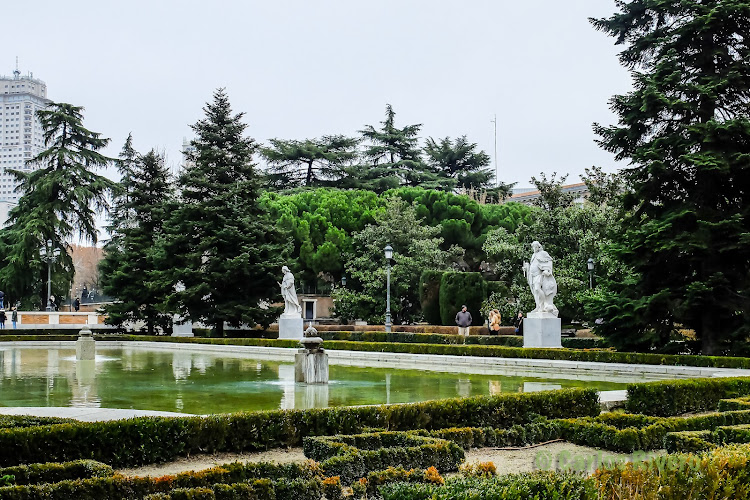
Sabatini Garden, usually called Jardines de Sabatini, is Madrid’s formal neoclassical garden on the north side of the Royal Palace. Its geometry is the draw: clipped hedges, straight gravel walks, sculpted greenery and royal statues frame a long rectangular reflecting pool, while the palace’s pale stone façade rises beyond the water. It is a public garden with an unusually ceremonial setting, but it works best as a composed pause rather than a full-scale park day.
The garden sits in Centro, between the Royal Palace precinct and the Cuesta de San Vicente/Plaza de España side of central Madrid. Architect Fernando García Mercadal created the garden on the site of former royal stables, opening it in 1978; its name recalls Francesco Sabatini, the eighteenth-century architect associated with those stables. Three terraces descend through the site, making a compact landscape that rewards slow looking, especially when the pool catches the palace in reflection.
Standout Highlights & What Not to Miss
Do not approach Sabatini expecting lawns, playgrounds or a botanical collection on the scale of Madrid’s largest parks. Come for symmetry, architectural framing and a particularly satisfying palace view. The garden’s formal design changes character as you move down its terraces: close-up details of hedges and fountains give way to broader, more photographic sightlines. A short circuit can feel complete, but stopping at several viewpoints reveals why this modestly sized garden is one of the city center’s most popular free outdoor stops.
- The central reflecting pool: Stand at either end for the clearest mirror effect and the strongest axial view toward the Royal Palace. Still water and softer light make the composition especially effective.
- Royal Palace backdrop: The north façade is the garden’s visual anchor. Look past the low geometric hedges rather than trying to photograph the building from every path; the planned sightlines do the work.
- Three terraced levels: Walk the garden from top to bottom, then glance back uphill. The changing elevation clarifies the formal layout and gives each level a different relationship to the palace.
- Statues of Spanish monarchs: These stone figures add a historical layer to the garden’s clean lines. They are worth seeking out along the lower paths, where the atmosphere is less dominated by the pool.
- Evergreen structure and seasonal contrast: Cypress, magnolias and tightly clipped planting keep the space legible year-round. Seasonal flowers and changing light can add color, but the appeal is fundamentally architectural.
Visitor Strategy & Planning Snapshot
| Planning Factor | What to Expect | Practical Strategy |
|---|---|---|
| Ideal Arrival Window | Bright midday light can flatten the stone and make the most exposed paths feel busy. | Visit early or later in the day for gentler light, quieter photographs and more comfortable strolling; check same-day access conditions before setting out. |
| Typical Time Needed | The garden is compact, yet its terraces and viewpoints invite a slower circuit. | Allow 30 to 60 minutes, or less if using it as a scenic link between larger nearby landmarks. |
| Booking / Queue Reality | This is a public garden, not a timed palace interior, but entry flow can feel crowded at popular moments. | There is no garden visit to build a ticketed itinerary around; leave buffer time if pairing it with the Royal Palace, where visitor procedures are separate. |
| Terrain & Accessibility | Wide gravel and paved paths cover much of the site, while the three terraces introduce elevation changes. | Wheelchair and stroller users should confirm the available step-free route on arrival and allow extra time rather than assuming every terrace connects without steps. |
| Weather / Seasonal Fit | The formal planting is appealing in every season, though shade is limited in places and rain can affect gravel paths. | Bring water and sun protection in warm weather; after rain, wear footwear suited to potentially damp or loose surfaces. |
Honest Trade-Offs: Best For vs. Who Might Skip
Sabatini Garden is especially well suited to couples, photographers, first-time visitors and history-minded travelers who want a memorable Royal Palace view without committing to another museum or paid attraction. It is also a useful breather after the palace’s grand interiors or a dense old-town walk. The trade-off is that this is a formal, compact garden, not a secluded urban refuge: its appeal depends on sightlines and atmosphere, and crowds can dilute both. Travelers seeking extensive shade, a long nature walk, children’s facilities, elaborate flower displays or a fully level route may prefer a larger park. If your time in Madrid is extremely limited and you are not visiting the palace district, it is pleasant but not essential as a stand-alone detour.
Neighborhood Context & How to Pair Your Visit
Build Sabatini Garden into a walk through royal Madrid rather than treating it as an isolated destination. Start around Plaza de Oriente for palace-facing streets and the Teatro Real area, continue through the garden for its northern perspective, then connect downhill toward Plaza de España or return toward the Almudena Cathedral and the older streets around the palace. The garden is most useful as a visual reset between monuments: arrive with a camera or simply take a lap around the pool, then continue on foot. Its position makes it easy to combine monumental architecture, city viewpoints and a café stop in the surrounding Centro district without needing transport between each stop.
When planning your Madrid travel guide or comparing verified attractions and garden in Madrid, pair this stop with standout local spots including Museo del Romanticismo, Hotel Riu Plaza España, Hyatt Centric Gran Via Madrid, and La Mi Venta (0.1 km away).


